
JeffGu
Been here much more than a while
- Location
- Osceola, Nebraska
Yeah, if you think you're in Nebraska and see trees much over 90' tall... turn around. You missed a turn somewhere.

Follow along with the video below to see how to install our site as a web app on your home screen.
Note: This feature may not be available in some browsers.
What interests you? The height of the trees?This is really interesting to me. Any idea why this is the case? Maybe really "cold tolerant" species don't get too tall?
Must be talking deciduous trees only, here? Reg posts pics of what I think might be Douglas firs that seem to get to 140 feet tall fairly often.
I've never actually measured any tree yet, but we have some fairly giant oaks here in Virginia. I'd be betting they're at least 120 feet tall, easy. They are just really awesome to look at, literally.
I wonder if the Douglas fir would or does grow in your area.
Tim
It's all about climate. Trees don't grow in the cold. The more temperate the climate the bigger the trees, it's that simple. I've seen Doug fir planted in Ontario and they will never grow as big as their west coast cousins.This is really interesting to me. Any idea why this is the case? Maybe really "cold tolerant" species don't get too tall?
Must be talking deciduous trees only, here? Reg posts pics of what I think might be Douglas firs that seem to get to 140 feet tall fairly often.
I've never actually measured any tree yet, but we have some fairly giant oaks here in Virginia. I'd be betting they're at least 120 feet tall, easy. They are just really awesome to look at, literally.
I wonder if the Douglas fir would or does grow in your area.
Tim
What interests you? The height of the trees?
Around here you can do 95% of your work with 120' rope or shorter (ddrt), I have a 150' but I'm on my 3rd 120' & 1st 150' rope
I wonder if the Douglas fir would or does grow in your area.

Exactly what he saidDouglas Fir trees grow here, but don't get up to the sizes they do elsewhere. Prior to the settlers moving into the area, this was all prairie grass with mostly cottonweed trees along the rivers. There are quite a number of native tree species, but most of what you see were planted by settlers, at least all through the central part of the state. Much different out in the western panhandle, and in the southeast corner of the state. I do see the occasional Ponderosa Pine that's over 100 feet, but they're not indigenous to this part of the state, either.
No idea on why we don't get the really big trees with serious height to them. Probably climate and the high winds we get across prairie (now farmland) part of the country. We get nasty winter ice storms that rival just about anybody else's.

You have the math figured out right for sure.Yeah, Kevin, it is the height that the trees manage to grow to, or really, not grow to, that interests me. And now you are saying that a 120 foot long rope will work DdRT on 95% of the trees that you typically climb. So if I'm understanding you right, most of your trees are just a bit taller than 60 feet?
I'm not saying we don't have shorter trees here in Virginia, because obviously there are a lot of species that just never get very tall. There are really tall trees in great abundance, however. I think the oaks are my favorite.
Tim
Farther north than that and there's tundra and next to or no trees. With a 2 month growing season you get grass, flowers, sedges, etc.It's all about climate. Trees don't grow in the cold. The more temperate the climate the bigger the trees, it's that simple. I've seen Doug fir planted in Ontario and they will never grow as big as their west coast cousins.
Your comment about "cold tolerant" species is interesting. If you go far enough north eventually you will find the forests become literally nothing but spruce.

Lol, too true. I haven't even bought one of the fancy 5:1 fiddleblock kits yet. Just my homemade 3:1 setup clipped to the top of the portawrap. 2 micropulleys, two carabiners, a friction cord, and a small length of 1/2" red is dead rope (retired climbing line) comes in at just under 60 bucks. I think I'll go ahead and ride it out til it's time for a GRCS upgradeFor those who can afford the new stuff it's the way to go. For the rest of us fiddle blocks still reign.


That's awesome! Do you happen to have any pictures of the"set up" or any pictures of any of the work you all did that day?Did a nasty storm damage job the other week that had no good solutions. Wound up setting a pull rope high, cutting a small notch and forcing the entire mess over. 5:1 fiddle blocks pulling against a 2:1 setup on the bull rope. Net gain, 10:1, with 4 guys working in sync ("1…, 2…, HEAVE!") pulling down a hill. We actually two-blocked the 5:1 twice after pulling all 110' thru it (net gain ~25'), held tension with the porty, reset the fiddles, and pulled again.
Point being, fiddles saved the day, once again, at a fraction of the cost of a GRCS or winch. Love them things!

Farther north than that and there's tundra and next to or no trees. With a 2 month growing season you get grass, flowers, sedges, etc.
You'd be hard pressed to get a willow to grow with no sun for 6 months and still fit in a spring flush and autumn fall.
Nope. Cold, damp day, I was sick and we were rushing to beat the approaching rain, so no time to take pics. Besides, it ended up being such a tangled mess of ropes near the 5:1/porty that it would have just looked like a plate of spaghetti in the photo. So, I recreated it as best as I could for you. (Note, the drawing is not to scale. I spread things out a little just to make it easier to comprehend.)Do you happen to have any pictures of the"set up"
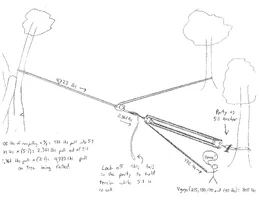
Thank you Jeff . That's was super cool of you.Nope. Cold, damp day, I was sick and we were rushing to beat the approaching rain, so no time to take pics. Besides, it ended up being such a tangled mess of ropes near the 5:1/porty that it would have just looked like a plate of spaghetti in the photo. So, I recreated it as best as I could for you. (Note, the drawing is not to scale. I spread things out a little just to make it easier to comprehend.)
Oops, some of my math on the bottom left got cut off. That's 705 lbs, 472 lbs, and 2,361 lbs reading down the left hand side.
View attachment 35381


