









Dead Pine Removal

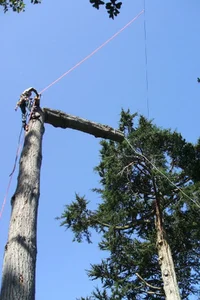
This was a job that I worked on a couple of years ago while I was with Bartlett, in the San Francisco Botanical Garden. The tree to be removed was a Monterey Pine that had been dead for some time and we did not feel good about sending a climber up and there was no bucket or crane access.

Our safety coordinator came up with the solution of setting a tight line between two large Monterey Cypress and using this as his primary tie in point. (see attached photo)

There was nothing to rig the pieces out on so everything was bombed out. If I remember correctly there were only a few under story plants sacrificed.

One thing I remember being concerned about on this was the climber being lanyarded in to the spar. If the tree suddenly failed it could have been an ugly situation. It did seem to be the safest way to do it though.
 

Attachments

  • 197619-TightLine.webp
    197619-TightLine.webp
    252.1 KB · Views: 559
Nice Jesse! That brings up an issue that has been bugging me for about 9 years. WHAT do others people use for a break/tear away, lanyard, in those high risk situations? Personally I would rather be suspended in the middle of no-where than riding a failed tree to the ground!

I know what I us, just like to hear others opinions.
 
A chainsaw breakaway lanyard tied as your flipline with a 200lb tear-away rating can be used as well.

This topic has been discussed extensively here on the Buzz in the past. If you do a search you can find more info.
 
Some have used the belt loop on pants. It can be simple assistance for balance (if there is a T.I.P.). I've only had to the feeling that it was necessary 2 times. But, other than that I try to avoid schetcy situations like those.

But, in your situation, I'd like to have something more sophisticated. And for that, I've got nutt'n.
bangtard.gif
 
What about adapting the Whichard clip (big shot trigger) ....
This comes up occasionally but i must admit i got nuttin either
crazy.gif

Ps Awesome pic of the topping out...certain sphinkter muscles would have been tight!!
 
[ QUOTE ]
...One thing I remember being concerned about on this was the climber being lanyarded in to the spar. If the tree suddenly failed it could have been an ugly situation. It did seem to be the safest way to do it though.

[/ QUOTE ]
First - nice job Jesse!!!

You bring up something that I think about almost everytime I climb. I make it a rule (me personally) to be tied in twice - to different limbs/anchors in some manner. Probably an overkill, well, that's not a good choice of a word, but I guess like the safety factor - if it really is a safety factor - e.g. - if one limb/anchor fails and falls, I'm tied to it, and me, my harness, and the remaining anchor point would probably get a pretty good shock load.

'Course that probably beats free falling with the failed anchor point.
 
One thought I had for a breakaway lanyard is to use some heavy duty zip ties from carabiner to d ring. Strong enough to hold your weight but would easily break if much force. I may have stolen this idea from someone but can't remember who.
 
Jesse, What do you do in order to utilize the "tight line" you set up. I've never seen this used, but in many situations wanted to do it myself. I just never knew what to tie my climbing line off of (pulley on a swivel, friction saver over the line...?) What'd you do? Thanks
 
Really great work Jesse.v like others, that is something i've always wanted to implement but i've yet to have the opportunity. I assume you set a redirect at the top of each tree and a GRCS at the base of one to create tension? I've also wondered about rigging/lifting pieces from a tree with a similar system, what do you guys who have used it think about that?

way to be safe
 
[ QUOTE ]
Jesse, What do you do in order to utilize the "tight line" you set up. I've never seen this used, but in many situations wanted to do it myself. I just never knew what to tie my climbing line off of (pulley on a swivel, friction saver over the line...?) What'd you do? Thanks

[/ QUOTE ]

If it were me, I'd get the low-stretch tightline over the appropriate crotches, with my climbline "prussic'ed" (tied similarly to how you'd tie a tautline, I guess you'd say) in the appropriate point on the tightline. Then tension and position the tightline/ climbline combo using a lowering device on one, or both anchor trees. Ascend SRT.

Or prussic on some appropriate cord with a life-support rated pulley carabinered onto the eyes. Pass climbline through pulley, raise up into the tree, and climb DdRT.
 

Attachments

  • 202731-tightline.webp
    202731-tightline.webp
    20.9 KB · Views: 108
Correct, Sean, and well explained. I'll add to that, If that tight line and anchors are strong, it can even be used to lower from. I once did a dead, smallish and light maple. I set a double block overhead, one sheave had the lowering line, the other my lifeline. There was little or no shock loading, and I was lanyarded in during each cut.

Numerous discussions have been held on various boards over the years about breakaway lanyard ideas. Several good ones were brought up here as well.

Hobby Climber devised a really slick one, but I thought it was a tad over-engineered.
 
they had tight line set up at the rigging demo/ aerial rescue thing in Arlinton they used a device (descender) in place of a prussic. Seemed to work really well. Or perhaps it was a progress capture pulley. It was positional from the ground, pretty slick. maybe someone here would remember better what was used.
 
I think we had an eye and eye prussic positioned in the middle of the tight line with a carabiner and pulley with the climb line through it. We had the tight line anchored on one side and used the GRCS to tension from the other. Simple but effective.
 
[ QUOTE ]
I once did a dead, smallish and light maple. I set a double block overhead, one sheave had the lowering line, the other my lifeline. There was little or no shock loading, and I was lanyarded in during each cut.

[/ QUOTE ]

Still doesn't sound like a great idea. Certainly not my first choice.


I've used my friction saver retrieval ring, girthed to my side d-ring, as a "breakaway. Only because it was on my saddle at the time I needed a breakaway.


Nice pictures, Jesse.
 

New threads New posts

Kask Stihl NORTHEASTERN Arborists Wesspur TreeStuff.com Teufelberger Westminster X-Rigging Teufelberger
Back
Top Bottom












