Choked Biner Rigging

cbachmann

Participating member
Location
Seattle
Hey folks. We are in the process of standardizing rigging practices at the company where I work. We recently had a bunch of rigging gear destroyed due to under-estimating dynamic loads. But that's another story.

One specific area where we have a difference of opinion is regarding the use of a "choked carabiner" on the rigging line.

The Z133 is clear that carabiners only be loaded on the major axis, which pretty much rules out "choking" configurations. That said, I'm typically comfortable using a steel carabiner in a choking configuration, with a half hitch above it, for static rigging applications (i.e. below the block). This is true on pieces smaller than 3/400 lbs. For larger pieces, I'll ditch the biner and tie a suitable knot.

I've been strongly against using a choked carabiner for negative/dynamic rigging. Several other climbers at my work are evidently very comfortable with this practice and use it regularly for taking tops up to 7/800 lbs. This seems like a dangerous practice. The physics are all wrong.

What are your opinions?

And, does anyone have evidence of rigging failures caused by a choked carabiner?

Thanks in advance.
 
I don't use a carabiner on the end of my rigging. If I want to speed things up there are several devices on the market that offer the capability to do what you are looking at without compromising the standard. I personally either tie the knots (98% of the time) or will use a loop slings and an end of rope device.
I did have a carabiner open on a choked basil tie ascent line and that kinda spooked me so I just don't use them choked. Nothing bad happened but when I got back down and saw it, it bothered me.
 
I rigged with a choked big Dan for years. I have been working for NATS supervised projects for the past year, and it is an absolute no no.

My next system will be a large steel ring spliced into the end of my rigging line. I will clip slings with bieners girth hitched into them, into the ring. This should allow for the best of both worlds. No cross loading of the hardwear, and no knots for the groundies to fight. When it came time to bust out the bull line, I would just stick to knots/hitches.
Eye slings with the treeangle or the big sherrill thing, would be a great system for logs I would assume.

Sent from my SAMSUNG-SM-G891A using Tapatalk
 
For most of the rigging of limbs or canopy I use a combination of choked steel biners carefully rigged, maybe with a marl, or choked sling to a biner on the rigging rope. I've never had a gear failure

When the pieces got bigger I'd shift to knots

When to shift??? I learned in the time of natural
Fiber ropes And then synthetics. Just a gut feeling or art at the time. Now we have so much more science and we can get some pretty close load calculations that can then be coordinated with the breaking strength of gear and our chosen Safety Factor

If I find that the weak link in my rigging system is the XX # breaking strength biner then I shift.

If you're writing a company policy I can see how it would be a challenge to establish thresholds for shifting gear. It seems a shame to require tieing light loads when a biner works so well

Lots of good replies
 
I have seen things go wrong from the ground when a biner was being choked for rigging. I'd say that for a company policy the best bet would be to stick with knots. You can validate a climbers knowledge of knot tying while on the ground prior to in tree execution.
 
As far as policy, you could draw the line at fall factor. If you have a fall factor of 0, there for overhead rigging, with no impact force, a choked steel triple action biener, with a marl, would be safe, in my opinion. If any fall factor is generated, and there for impact force, knots or a rated knotless rigging system should be used.
Personally I think that sets a clear, defined boundary that will be easy to recognize and follow.

Sent from my SAMSUNG-SM-G891A using Tapatalk
 
As far as policy, you could draw the line at fall factor. If you have a fall factor of 0, there for overhead rigging, with no impact force, a choked steel triple action biener, with a marl, would be safe, in my opinion. If any fall factor is generated, and there for impact force, knots or a rated knotless rigging system should be used.
Personally I think that sets a clear, defined boundary that will be easy to recognize and follow.

Sent from my SAMSUNG-SM-G891A using Tapatalk

That's a great way to differentiate the use. Thanks for the suggestion.
 
Work with a guy from time to time who uses a rigging line with a splice and two shackles. The thought with two is that it adds weight for tossing and if he drops a shackle pin, there's a second shackle right there.
But in my experience, its undoubtedly slower
 
@cbachmann, I'm glad you brought this up. I just re-introduced this practice. I had decided years ago I didn't like the possible side loading on the gate. Especially when throwing the biner up over a crotch, hooking up, and hauling the biner back up choked on the rope. It's set where it lies unless you want to climb up and check the positioning. Which kills the point of lassoing said choking point. I now started using the biner again. I only use it now when brushing something out with tight quarters on the ground, and everything is rigged down piece by piece. The repetitive knot tying is eliminated. When weight is involved, or the biner may experience a blow to the spar, I practice rope only.
Nice thread ..... be safe everyone.
 
Thanks for everyone's thoughtful responses. The concern at my work came from several folks taking larger pierces without consideration of the dynamic loads and risk of failure. It's great to hear your reasons for why and when you do/don't use the choked biner technique.
 
Work with a guy from time to time who uses a rigging line with a splice and two shackles. The thought with two is that it adds weight for tossing and if he drops a shackle pin, there's a second shackle right there.
But in my experience, its undoubtedly slower
I only use a shackle when dealing with big wood. I usually just use an iron wizard on just about everything. Big wood and pulling get a shackle....
 
I use a shackle
4621b8958f2df61971e7ee6645888a80.jpg

Like this of course.
 
So do you have to use a sling and... another shackle to use your shackle? The pin on that thing alone has to be a few hundred pounds.

Sent from my SAMSUNG-SM-G891A using Tapatalk
 
For static loads or even for negative rigging of tops I have no problem with the use of a carabiner in a choked configuration as long as a marl is receiving the load first. Unless the load is very small (less than 200 pounds) I always use at least one marl so that the marl receives the load instead of the carabiner. If I am butt hitching wood I always start tying on the pieces because what I fear is the carabiner getting damaged by slamming into the trunk.
 
...the carabiner getting damaged by slamming into the trunk...

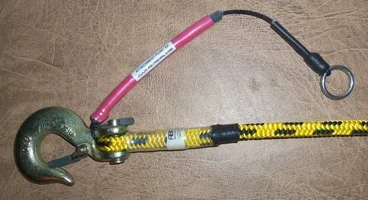
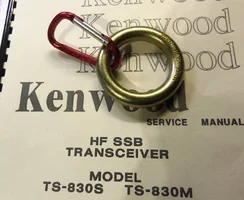
That's why I've developed a fondness for this low-budget solution for knotless rigging. These hooks are cheap and handle the abuse. The small line with a little ring on it is for retrieving the hook with an 1/8" retrieval line I take up with me. The short piece of hose shrink wrapped to it keeps it from getting tangled up with the hook. I also have a steel ring I slide onto the rope, with a small 'biner, and clip it to that retrieval ring so that it stays with the hook. I clip the hook onto the steel ring instead of directly onto the rope. That way I don't have to worry about the rope getting damaged by the stamped steel gate on these hooks. I have a beefed up version of this on the 5/8" ropes.

Eclipse-Knotless1.webp SteelRingClip.webp

Most of the time, I use webbing slings and clip the rope onto those, but if I run out of them I have the option of choking the rope around the piece. I also like using a marl below the choke on bigger pieces, but mostly because of how the load hangs with it in there, and it's less flex on the splice when the rope is choked around smaller wood.
 

New threads New posts

Kask Stihl NORTHEASTERN Arborists Wesspur TreeStuff.com Teufelberger Westminster X-Rigging Teufelberger
Back
Top Bottom