per Steve Connally:
manufacturers of certain gear who state only XYZ approved rope should be used with their products
Indeed.
Although drifting off topic...you have raised an interesting question.
There is a lot of this going on - and its driven by perceived legal risk (and product liability insurance). In the USA, suing someone appears to be a national sport. So USA product manufacturers are cautious - and I can understand their position on this matter.
One only has to think back to what happened to Chouinard which later became the phoenix rising from the ashes as Black Diamond.
When manufacturers of belay/abseil/rope access devices test their products against a published standard, they test with a specific rope type and diameter. Certification of their product is tied to the rope that was used for the test.
They are simply being cautious about which types of rope they will 'warrant' for use in their products... and its reflected in their user instructions.
I liken this to getting your car serviced by a mechanic. Some manufacturers try to 'convince' you to only bring your car back to the dealership for servicing...and its'implied' that you will void your vehicle warranty if you fail to do so. The legal reality is somewhat different.
With rope diameters, its really hard to pin down with precision exactly what a given rope diameter really is. A manufacturer could try to create an impression that the rope diameter must be to within a nano-meter...which would be patently silly and likely backfire. All ropes somewhat flatten and change their diameter under load - and the exact degree of change is impossible to predict over all possible rope brands. If a manufacturer declares that only brand 'xyz' at 11.0mm diameter can be used with their product - this is actually borderline anti-competitive (anti-trust in the USA).
Also, some manufacturers of belay devices try to suggest that you should only use carabiners of brand 'abc' with their product - which again is silly.
A lot of this hasn't been tested in a court of law, and I would be very interested to study any 'test cases' where someone tried to sue a product manufacturer for injuries resulting from a brand of rope or a particular brand of carabiner that wasn't specifically recommended for their device (ie same rope diameter, just different brand).
Another related but interesting issue is users who weigh more than 100kg. In the case of EN892 dynamic ropes, manufacturers only test with 80kg. And yet, there are hundreds of climbers who weigh more than 80kg. Does this mean that it is unsafe to rock climb if you weigh more than 80kg? Will such a person 'void' the rope 'warranty'?
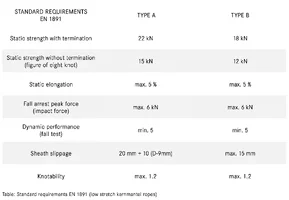
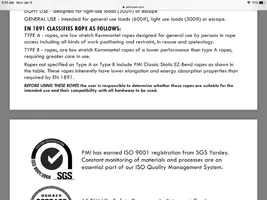
Same goes for EN1891 low stretch ropes - which are tested at 100kg (type A). What happens if you weigh more than 100kg?
I would suggest that a significant number of tree climbers would exceed 100kg - particularly if you factor in all the equipment worn and carried while working at height.
...
Some manufacturers are starting to produce energy absorbers (ie tear-web shock absorbers) for certain weight classes - this is a good sign of things to come...