Casanova's Case Studies

Does the type of mulch matter? I tend to use cypress mulch on bigger plants and cypress sawdust on smaller ones. That has held up well.
I like a mix of compost and wood chips. Wood chips by itself is great though. Don't know much about the cypress mulch but I think I recall some negatives but am not positive.
 
Wood chips from recently chipped live trees are excellent. The green wood and leaves provide some more labile OM and nutrient while the older wood slowly breaks down and is great for water retention and weed suppresion. Great stuff.
 
The last thing the tree needs is any kind of fertilizer. Question. Have you had the tree on timed drip irrigation to soak the pot several times a day? A nursery tree is basically a sunflower growing in a dixie cup. Since it's got a very limited root mass, they get over the lack of uptake mechanisms, by making sure there's always plenty of water to take up. Having further reduced that root mass, if you haven't been keeping up on that schedule, it may well be on the fast track to croaking.
 
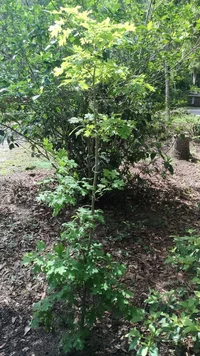
I didn't realize it was half dead - I thought that was another maple in the picture, lol.

No pruning (except dead wooding) until established.

Plant it high, not low.

Dig the hole to depth - not lower. Backfill, if necessary, will be loose, so if you end up having to backfill, plant a couple extra inches higher. You're supposed to loosen the soil in a radius of 3 times the root ball. I feel like this is excessive, but I don't have empirical evidence, and hopefully the 3xers do have empirical evidence. I often just run my stump grinder around the outside and leave everything in place...

Get automated drip system. Try to set a cycle that provides lots of water, with dry episodes mixed in. Up to a point, more water means more growth.

Fertilizer is only needed if you test the soil and get a recommendation for the species based on that. If you do fertilize, put it on a gradient outside the root ball to encourage root growth away from the trunk. Once its been a while and you don't know where the roots are, good luck...

Red maples often have structural and health issues. If you plant it within range of your house, make sure the lower trunk wood gets set in at a good angle away from the house, and follow up with pruning to the same end.
 
The status of the maple is on hold. The plan is to plant it, let it adjust, start reducing the codoms, and post an update. I am going to put it in a different location and that will require removing a sweetgum first. I planted a live oak near where I was going to put the maple and I don't think they will do well that close.

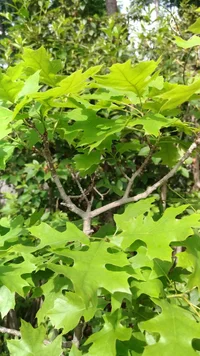
The next case study will be a shumard oak. It is planted and has great structure except for the tip. It was planted a month or two ago and it has fully leafed out. I think it is ready to prune.
 
Nah...let it fill in for a bit. Just a baby.

I am fine with that. When would be a good time to address the top or would it best to leave it and let it develop like that? I don't see that union having included bark later in life. It too was only $5. I did get some good trees and a few that need some help. I got a literal truck load for $55.
 
It generally takes one year per caliber inch for a transplant to establish in its new location. Determine which of the forked leaders of the top is most likely to become dominant, take the other side and pinch back half the new growth on it. That should be all that is needed to establish the new central lead and all the pruning needed this year.
 
It generally takes one year per caliber inch for a transplant to establish in its new location. Determine which of the forked leaders of the top is most likely to become dominant, take the other side and pinch back half the new growth on it. That should be all that is needed to establish the new central lead and all the pruning needed this year.

I would probably keep the one on the left because that one is going away from my house. The other one would parallel my house so it would not be a problem either. Do you see any negatives to keeping both?
 
Bear in mind that nothing on the tree that you're looking at now, will be a permanent branch. You want to force growth upward. Until it's about 20 feet tall, you want it to look more or less like a single stemmed bottle brush, with short foliage on narrow stems, which will help the trunk form good taper, while staying small enough that they won't become dominant stems, or leave large wounds when they're eventually removed.

 
Bear in mind that nothing on the tree that you're looking at now, will be a permanent branch. You want to force growth upward. Until it's about 20 feet tall, you want it to look more or less like a single stemmed bottle brush, with short foliage on narrow stems, which will help the trunk form good taper, while staying small enough that they won't become dominant stems, or leave large wounds when they're eventually removed.


Would you start to reduce one of them now?
 
I'd let it settle in and get fully established. I really meant to point out that diving too deep at this point over decisions on keeping any of the branches on the tree at its present height, is time better spent on something else. Pruning young trees that size should take about 3 minutes per tree, including planning.

Let it sit for a year undisturbed, then cut out the co-dominant lead wanna-bees and shorten any lateral branches to a couple feet in length max. You still ought not to be making any cuts much larger than a nickel or a quarter in diameter, and on a young tree that's nothing.

Also throw the book away on what percentage of canopy to prune. That book wasn't written with little juvenile saplings in mind.
 
Bear in mind that nothing on the tree that you're looking at now, will be a permanent branch. You want to force growth upward. Until it's about 20 feet tall, you want it to look more or less like a single stemmed bottle brush, with short foliage on narrow stems, which will help the trunk form good taper, while staying small enough that they won't become dominant stems, or leave large wounds when they're eventually removed.

To the OP. Bear in mind that not everyone is in agreement that all trees need to be trained into central leader specimens.
 
Agreed. Depends on species form, wood, and branch attachment characteristics as well as desired function of a plant within design parameters. Some are meant to be multi-stemmed for aesthetic reasons. Examples here include crabapples and species with showy bark like kousa dogwoods, lacebark pine, or white birches.

Some do well with more acute branch attachments such as many elms but Freeman maples, not so much.
 
  • Like
Reactions: ATH
Here's what UF (which is right around the corner from the OP) has to say about Shumard Oaks. Having seen plenty of oaks with co-dominant stems 5 feet above grade fail at that point under their own weight here in Florida, I'm inclined to agree with them.

I won't presume to speak for the rest of the world, but here in Florida, most of the big limb failures we see, are from stems which should have been pruned off at planting or within the first or second pruning cycle thereafter.
 

New threads New posts

Kask Stihl NORTHEASTERN Arborists Wesspur TreeStuff.com Teufelberger Westminster X-Rigging Teufelberger
Back
Top Bottom