Bur Oak Trunk Flare Excavation - Now What?

roxy

New member
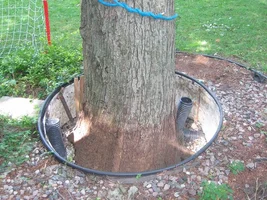
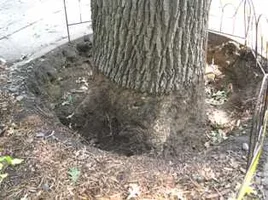
This house and garage is about 100 years old. This bur oak was buried....sometime in the last 100 years. We did a trunk flare excavation...went down about 24 inches. I think it was a good call, but does anyone have any advice for safety / landscaping, etc. Canopy has only slightly more dieback than "normal" and we'll be pruning and checking for two lined chestnut borer larvae come cold weather. We also did a root zone innoculation of mycorhhizae. The really interesting thing to me is that the bark has begun to decay, but even though it's been covered in soil for so long, decay hasn't progressed beyond.
 

Attachments

  • 188296-DSCN7587.webp
    188296-DSCN7587.webp
    24.7 KB · Views: 225
recommend filling back with round river stones to grade. prevents sunscald and litter/trash settling in, and it looks good.

not filled for long imo unless you ran into circling roots.
 
It was an excellent diagnosis of a big problem, particularly with oaks Roxy.

Are you certain you've found true grade though?

Look's to me from the pic you might still be as much as 6 inches shy?

How did you determine the original grade? Did you go down enough to find feeder roots?

jomoco
 
I've dug into deep river rocks and found they retain moisture almost as well as soil or mulch. I think leaving the pit open is better. We struggle with this as just leaving a pit makes it almost impossible to avoid constant refilling by debris, especially if the tree is mulched properly, not to mention it looks bad.

For the next step, the simplest method is to shovel away the edges of the hole to make it more of a wide saucer, which still doesn't really solve the problem; the most expensive/extensive is to create a tree well. There are undoubtedly middle ground solutions. We usually tell people we corrected the tree problem and they have to find someone else to correct the landscape problem, but that may be losing us business in the long term.
 
It's usually always an arboreally clueless landscape architect that's responsible for the bonehead move most of the time, the rest are more understandably mistaken home owners themselves.

Fixing the problem sometimes exceeds the cost of a removal and grind.

The most economical successful resolution I've seen is a bunch of two foot dia plastic pipes buried down to the original grade full of rocks with sealed grates 6 inches above the new grade. Depth of the pipes is determined by the depth of the original grade.

Apparently this works good enough to get oxygen to atleast enough of the tree's roots to keep them alive for many additional years. Whether the tree can ever reach it's true potential health and vigor again though is highly doubtful.

But I've seen it done many times trying to save mature old trees, sometimes very successfully.

It's a fairly inexpensive option Roxy.

Good luck with your save-a-tree project!

jomoco
 
[ QUOTE ]
recommend filling back with round river stones to grade

[/ QUOTE ]


Guy,
I have some questions about this...

One client had an older tree (Mimosa) with river rocks around it. The tree was definitely struggling. The client was considering removal.
I suggested first removing the rock and see if the tree responds.
I went back 5 months later and that tree was just flourishing!

Did the same thing at another location with an olive and a magnolia tree. Remove the river rock and the tree springs back to life!
People spread the rocks out (in a single layer) around the tree's base anywhere from 1 - 10 ft. out. They like 'the look' rather than soil, mulch or understory plantings.

However, perhaps this just creates too much compression and interferes with O2 exchange with the soil, not to mention the added heat (since rocks absorb sunlight), trapped moisture etc., etc. too close to the crown/root flare area and the surrounding roots within the dripline?

So far river rocks are like the 'cousin' of cement in my observations.

-Diane-
 
Keith, how do rocks retain moisture? I agree this is a tree problem so not good service to client to dump it back on landscapers--as if they knew what to do!

Diane, I hear ya. i used to spec expanded slate aggregate (stalite/volebloc) because it was more porous, but was concerned about bark abrasion. with bur oak less of a problem tho so maybe i need to spec that more on moist sites.

o and jomoco we can see buttresses spreading out--why do you say original grade was deeper?
 
[ QUOTE ]
i used to spec expanded slate aggregate (stalite/volebloc) because it was more porous

[/ QUOTE ]

This can be a dangerous solution; water gets trapped (decreases drainage) because it cannot flow from the smaller micropores of surrounding soil to the larger macropores of the backfill.

Esp. a problem for oaks that are very sensitive to drainage problems.

Props for finding the flare!
cool.gif


jp
grin.gif
 
[ QUOTE ]


o and jomoco we can see buttresses spreading out--why do you say original grade was deeper?

[/ QUOTE ]

It's just my opinion that the depth of the actual feeder roots needing the oxygen are the best indicators of the original grade topography than the flare roots themselves.

The original grade may have been a slope or mound, feeder root locale is the best means of finding true grade again in my opinion.

jomoco
 
Finding the flare is more important; whether the grade was too low or too high are both indicators of a stressful condition.

Remove soil until root flare is evident; no need to over expose root crown for extended periods.

jp
grin.gif
 
[ QUOTE ]
One client had an older tree (Mimosa) with river rocks around it. The tree was definitely struggling. The client was considering removal.
I suggested first removing the rock and see if the tree responds.
I went back 5 months later and that tree was just flourishing!


[/ QUOTE ]

Really happy to hear this! We recently moved to a new house and all 6 mature trees had a major grade change. 3 Bur Oak and 3 silver maples. Sometime in the last 30 yrs. 2 silver maples had tree wells created and it looks like it was done pretty well, breathing tubes and all. The wells were filled with gravel and one of the first things I did was dig it all out. The trees look good but I'll still hope for "flourishing".

I've also started DEEP aerating. I use an old 3' drill bit (1/2") and core down all over the root zone to get air down to the original grade. I'll probably do it once a year. Really couldn't hurt
tongue.gif


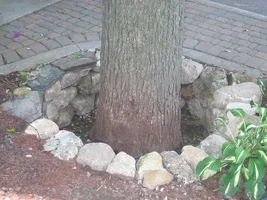
The 2 attached photos show the landscape solution. First photo is 'before' with the gravel removed. You can clearly see the stained bark from moisture retension. Second photo is 'after'. We dug the well wider and made a retaining wall of dry-stone wall (no mortar). Looks pretty sharp I think and easy enough to keep clean of debris and soccer balls. The dry stone wall is also totally porous so drainage should be alright.

 

Attachments

  • 188459-IMG_4653.webp
    188459-IMG_4653.webp
    133.8 KB · Views: 99
I looked at trees today at a four year old house. It looked like they had been buried with the landscaping/ dirtwork. The customer wants one smaller maple removed, but there are two large douglas-firs in the same bed. I mentioned this to her, and explained simply that it is not a good situation. If/ when we remove the one maple, I will investigate more.

My Question: what amount of soil addition is going to affect a tree and how will it affect it? One inch? Two inches? Won't the root absorbing roots grow upward into the top of the soil?

It seems clear that the trunk should not be buried. Scientifically speaking, why is this bad? Is it correct that it can promote fungal rot, in addition to the increased potential for stem girdling roots? If so, what types/ species of decay-causing organisms are promoted?
 
A foot deep or more, the rocks create a wide zone that doesn't get sun or much air circulation. Clearly, it's not the same amount of water that would be retained in soil or in a bowl, but when I dig into deep rocks, I find the lower ones are frequently wet (especially when sprinklers run regularly). Notwithstanding our current drought (see oakwilt's "48 days over 100" thread).

The difficulty of resolving these problems is that we don't know how deep we're going until we get there, so it's hard to tell clients what to expect. If you've got a day to do what you can, you just gotta stop when the time runs out. Then when you try to explain what's next, it depends so much on the client's budget that you don't know what to suggest. Or you tell them all their options until their eyes glaze over.

I'd really like to hear any other solutions people have come up with. Bad landscapers may often cause the problem, but good landscapers are better equipped to correct it than I am, I think.
 

New threads New posts

Kask Stihl NORTHEASTERN Arborists Wesspur TreeStuff.com Teufelberger Westminster X-Rigging Teufelberger
Back
Top Bottom