
Yeah, I know this again. But, @New2trees in another thread said that he got uniform separation force when using magnets, and I wonder if any testing was done to get consistent results. It might be the elusive answer for a "safe" breakaway lanyard.

Navigation
Install the app
How to install the app on iOS
Follow along with the video below to see how to install our site as a web app on your home screen.
Note: This feature may not be available in some browsers.
More options
You are using an out of date browser. It may not display this or other websites correctly.
You should upgrade or use an alternative browser.
You should upgrade or use an alternative browser.
Breakaway Lanyard
- Thread starter Brocky
- Start date

treebilly
Branched out member
- Location
- N. Lawrence
Great idea. The whole multiple ziptie or key chain thing can be a bit sketchy. You need enoughcto hold when needed but separate when also needed.

Nish
Branched out member
- Location
- North Carolina
Little loops of throwline kept on one side of the harness work pretty well. Its breaking point is familiar. Add or subtract loops as the situation requires.

- Location
- Retired in Minneapolis
if you're at the decision point where you're going to incorporate a breakaway in your lanyard you should really consider making both ends breakaway. I wouldn't want to risk being attached in any way when I'm that far into the Red Zone
Nish
Branched out member
- Location
- North Carolina
you should really consider making both ends breakaway
But then weigh the risk of your rope snap getting snagged against the possibly greater risk of later forgetting that the neglected side of your lanyard is still attached to a breakaway. I like my breakaway device to be such that, whenever I deploy/redeploy the lanyard, it requires a conscious decision to build in the breakaway; otherwise the lanyard is properly secured.
Last edited:
Anybody using a breakaway, at what weight do you want it to break and how did you test to determine that?
Until I saw the thread about the magnets, I had formed the opinion that a breakaway was too unpredictable with the things being used to break. And to break only when needed, not before due to a minor slip or fall while working.
When I get the time I was going to try to make a releaseable lanyard using the device below. Both ends of the lanyard would attach to it, so that the lanyard goes with the tree and doesn't come to smack the climber, which is possible if only one end were attached.
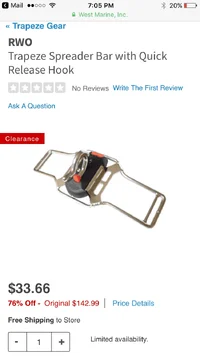
Until I saw the thread about the magnets, I had formed the opinion that a breakaway was too unpredictable with the things being used to break. And to break only when needed, not before due to a minor slip or fall while working.
When I get the time I was going to try to make a releaseable lanyard using the device below. Both ends of the lanyard would attach to it, so that the lanyard goes with the tree and doesn't come to smack the climber, which is possible if only one end were attached.
- Location
- Retired in Minneapolis
There is no 'forgetting' when you're in a situation where you use a break away. This would only be used in the most extraordinary situations. Every move is considered and made with deliberation. A slip is not allowed

Yeah, I know this again. But, @New2trees in another thread said that he got uniform separation force when using magnets, and I wonder if any testing was done to get consistent results. It might be the elusive answer for a "safe" breakaway lanyard.
Brocky, are you talking about a lanyard that would break away in the event of a climber being crushed/suffocated by a split trunk etc.?
The idea I had posted was of having a recess in one side of a breakaway. So that the magnets are separated by a straight pull every time, not slid apart by a side pull. As anyone who has played with magnets knows you can slide two magnets apart a lot easier than you can pull them apart. That said the usage was a tether that runs to a drag bikes ignition so that if the rider falls of the bike the bike does not continue under power on its own. So in this situation if there is an unexpected release it sucks as the bike looses power and can be dangerous but a lot less so than a lanyard attachment.
Brocky, not sure if you are talking about a lanyard that would separate before a climber were choked, crushed, or otherwise killed... but if so here are my thoughts.
My concern on using a magnetic breakaway on a lanyard attachment would be that a momentary high force would separate a magnet coupling just as easily as a steady or long term force.
My thoughts are (and I could be wrong) that along with 100% reliable separation force of X amount, you would ideally want a safety breakaway lanyard to require more force to separate if the force only occurred for 1/100th of second than if the force were continual?
That way if you encountered say something like a top catching on the lanyard as it fell past and a momentary force of X was encountered the lanyard would not separate.
However if the top remained lodged in the lanyard, then after X amount of time the lanyard would separate before the climber was suffocated etc.
Along with suffocation, choking, and loss of circulation, many tissues (particularly connective tissues like ligaments) on the human body have a similar property...just like bubble gum they will withstand a hard quick pull but a light long pull will easily separate them.
So a quick momentary force it would seem would be much less likely to cause serious injury than a steady one.
So for these reasons I would think that a dual breakaway system where X amount of momentary force would be tolerated but X amount for longer than a certain time would cause separation. But secondarily a force past X amount for any period of time would cause immediate separation.
All the Xs are way above my pay grade and its likely due to our litigious society manufacturers may be reluctant to even venture down this road.
My concern on using a magnetic breakaway on a lanyard attachment would be that a momentary high force would separate a magnet coupling just as easily as a steady or long term force.
My thoughts are (and I could be wrong) that along with 100% reliable separation force of X amount, you would ideally want a safety breakaway lanyard to require more force to separate if the force only occurred for 1/100th of second than if the force were continual?
That way if you encountered say something like a top catching on the lanyard as it fell past and a momentary force of X was encountered the lanyard would not separate.
However if the top remained lodged in the lanyard, then after X amount of time the lanyard would separate before the climber was suffocated etc.
Along with suffocation, choking, and loss of circulation, many tissues (particularly connective tissues like ligaments) on the human body have a similar property...just like bubble gum they will withstand a hard quick pull but a light long pull will easily separate them.
So a quick momentary force it would seem would be much less likely to cause serious injury than a steady one.
So for these reasons I would think that a dual breakaway system where X amount of momentary force would be tolerated but X amount for longer than a certain time would cause separation. But secondarily a force past X amount for any period of time would cause immediate separation.
All the Xs are way above my pay grade and its likely due to our litigious society manufacturers may be reluctant to even venture down this road.
The situation is climbing a suspect tree while being tied into another tree. If the suspect tree fails the lanyard would break and the climber would swing back to the other tree. One problem is the lanyard has to be used to keep the climber attached the suspect tree and has to hold his weight in case of an unindented slip, without breaking. It seemed similar to your use and I was wondering how "scientific" you got with your testing.

Acerxharlowii
Branched out member
- Location
- Greensboro
I dont think i trust magnets..i mean what if a polar shift happens
Acerxharlowii
Branched out member
- Location
- Greensboro
lol...trueYou got more to worry about if that happens then staying attached to a tree!
Nish
Branched out member
- Location
- North Carolina
There is no 'forgetting' when you're in a situation where you use a break away. This would only be used in the most extraordinary situations. Every move is considered and made with deliberation. A slip is not allowed
I use breakaways in fairly ordinary situations. Whenever my climb line tie-in-point is well positioned to serve as the primary life-support I'll readily deploy a breakaway on my flipline. So often the weakest link in the rigging system, or the biggest unknown, is the tree/branch I'm rigging off of and sometimes lanyarded into. I like knowing that I'll just swing free from it if it breaks, splits, or the whole thing just gives way from under me.
Last edited:
The situation is climbing a suspect tree while being tied into another tree. If the suspect tree fails the lanyard would break and the climber would swing back to the other tree. One problem is the lanyard has to be used to keep the climber attached the suspect tree and has to hold his weight in case of an unindented slip, without breaking. It seemed similar to your use and I was wondering how "scientific" you got with your testing.
I like the idea, I have seen vids of guys doing this and it had always seemed like it might be kinda tough to unclip the lanyard just as the tree fell out from under them

As far as the setup we used, I honestly have no idea how much pull it took to separate the magnets, but not a lot maybe 20lbs. In this usage you only want enough force to ensure that the system never separates due to tire shake or wind buffeting, but in the event of a crash or swerve and rider blow-off for it to release easily with no possibility of binding.
Thanks for your answers. I guess it's back to the drawing board. I guess it would depend on where the tree fails and how, drops or peels off, for the climber to have enough time to unclip a lanyard.
Did a little digging and found this page.
http://www.kjmagnetics.com/selectasize.asp?grade=N52&show=2&shape=disc
So if you used 3 of the 2" by 1" thick N52 grade magnets (in a triangular shape) you would have a breakaway strength of 772.5 if you used a properly machined steel plate for the other side of the device.

evo
Been here much more than a while
- Location
- My Island, WA
So in a basket that would take over 1,500 to "break away" .. once a reliable method is found, the next question is how much force should be used?
A "screamer" could also be used. Carefully cut the webbing on the fold. It may even act as a shock absorber before it fully breaks away. It would be interesting to see if it would work, but I don't need one enough to experiment
A "screamer" could also be used. Carefully cut the webbing on the fold. It may even act as a shock absorber before it fully breaks away. It would be interesting to see if it would work, but I don't need one enough to experiment
Nish
Branched out member
- Location
- North Carolina
once a reliable method is found, the next question is how much force should be used?
Variable break strength is a nice feature.
Heavy breakaway: You're spiking up a large tree that may give way at its base and fall forward, and your climb line tie-in-points are below you or far away on other trees.
Light breakaway: Your climb line T.I.P is well positioned above you, but you are concerned about over loading it.
Sometimes you'll want to split the difference.


