evo
Been here much more than a while
- Location
- My Island, WA
I just realized that this forum doesn’t have a cabling/bracing/propping sub group. These conversations haven’t been had enough here, and certainly have tapered off over the years. Even if not a very common discussion topic it’s a very relevant one that could have discussion and reference value for years.
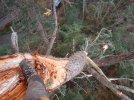
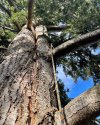
Now here is the issue, I have a very large chubby, thick Douglas fir (think 25’ limbs and 5-8” diameter to 60’ up) I’m working with. Somewhere between 1/2 and 2/3rds of the way up there is a stem bifurcation nearly equal in diameter. However one of the two tops has been reduced only about 15’ above the union. If I cabled the two tops, the cabling would have less than 3” showing between the stems, and would require stopper terminations (like the rigguy). OR just taking a wrap or two with a dynamic system.
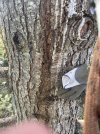
The tree is about 120’ tall. Failure would amount to a 20-24” 40’ tall Douglas fir landing squarely on the house below from 80’ up. Like I said one top is about 15’ and the other is 40’ so no option for the 2/3rds rule. The union itself is deeply included complete with a crack about 4’ down the stem dead center on the cross section.
This cabling and bracing stuff like this isn’t atypical around here, sometimes coupled with “reduction” (small topping!). But what is very atypical is reduction on this tree would be topping if we reduced it to the 2/3 cabling specs. The only solution I can think of, is about 4 sets of 3/4” bracing rods, stitching the stems, union, and crack together.
I’m no fool, and I’d at least take a core sample or very carefully inspect the drill chips for decay on the first hole or three). If a significant pocket of decay was present I’d abort and remove the tree. I feel that this tree is worth the effort and would be at least maintained for the next decade.
I’ve always heard and have been taught to brace a tree is always should be cabled. The only time I’ve gone contrary to that is with Japanese maples, and fruit trees (bracing only, and very low consequences if it failed). As well as a western red cedar, where I used rods in place of cables.
So I know there has been some different guidelines in Europe (Germany?) where bracing alone is enough as long as it’s above the union. And cases where a super low dynamic cable is sufficient.
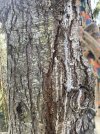
Yes photos are important.
Now here is the issue, I have a very large chubby, thick Douglas fir (think 25’ limbs and 5-8” diameter to 60’ up) I’m working with. Somewhere between 1/2 and 2/3rds of the way up there is a stem bifurcation nearly equal in diameter. However one of the two tops has been reduced only about 15’ above the union. If I cabled the two tops, the cabling would have less than 3” showing between the stems, and would require stopper terminations (like the rigguy). OR just taking a wrap or two with a dynamic system.
The tree is about 120’ tall. Failure would amount to a 20-24” 40’ tall Douglas fir landing squarely on the house below from 80’ up. Like I said one top is about 15’ and the other is 40’ so no option for the 2/3rds rule. The union itself is deeply included complete with a crack about 4’ down the stem dead center on the cross section.
This cabling and bracing stuff like this isn’t atypical around here, sometimes coupled with “reduction” (small topping!). But what is very atypical is reduction on this tree would be topping if we reduced it to the 2/3 cabling specs. The only solution I can think of, is about 4 sets of 3/4” bracing rods, stitching the stems, union, and crack together.
I’m no fool, and I’d at least take a core sample or very carefully inspect the drill chips for decay on the first hole or three). If a significant pocket of decay was present I’d abort and remove the tree. I feel that this tree is worth the effort and would be at least maintained for the next decade.
I’ve always heard and have been taught to brace a tree is always should be cabled. The only time I’ve gone contrary to that is with Japanese maples, and fruit trees (bracing only, and very low consequences if it failed). As well as a western red cedar, where I used rods in place of cables.
So I know there has been some different guidelines in Europe (Germany?) where bracing alone is enough as long as it’s above the union. And cases where a super low dynamic cable is sufficient.
Yes photos are important.