Bodnarziewia berkeleyii

What treatments should be considered?

  • Make firewood.

    Votes: 1 33.3%
  • Fertilize.

    Votes: 0 0.0%
  • More of the same; probe interior to assess decay.

    Votes: 0 0.0%
  • More of the same, drill exterior to assess decay.

    Votes: 2 66.7%

  • Total voters
    3

guymayor

Branched out member
Location
East US, Earth
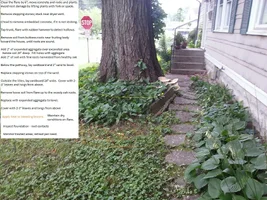
This is 1 of 2 trees that I work with that have B.b. I'm scheduling a winter checkup and wondering about the best way to manage it.
37# of conk came off in 2014. Cleaned and cleared the infection site, replaced soil with porous aggregate, reduced crown.
What next?20140723_083321_resized - Copy.webp
 
Am I right in seeing that the lean is away from the house? What is it leaning into? Can you tell the portion of the circumference at the base which is killed? Of course, the amount of sound wood to the outside is more important than the volume of decay on the inside, but my concern here is how much necrosis is present around the base, not just the thickness of the band of wood to the outside. Does the crown look good with good branch extension? This is where you practicing arborists have tougher decisions to make than I do. If tree preservation is the top priority, I'd go with drill exterior. If safety/peace of mind was top priority, I'd consider firewood. But that's just me, you see more of the success and failures than I do.
As for the amount of bracket fungus you removed, I have attached a 1970 paper from my research grandfather, F.A. Wolf. This is a later article from him, he was E.S. Luttrell's major professor at Duke, who in turn was mine at University of Georgia. At the risk of losing anyone who might be reading, Wolf studied with G.F. Atkinson who was a student of W.R. Dudley's at Cornell, the latter whom went to Strasbourg to study with A. De Bary, father of the germ theory and modern mycology. De Bary is remembered mostly now as being also the major professor of Louis Pasteur. Pasteur had good industrial and business connections through his work with bacteria, but most of the principles he "discovered" were previous identified and published by de Bary.

 

Attachments

Visit during moderate to high winds and observe soil, flare and stem for deflection/movement. Carpenters level works well for this or bottle of water with a level mark can be secured to stem or set on the ground.
 
Interesting history!

We won't be drilling, for fear of accelerating outward spread. But yes measuring the circumferential spread is a primary task.

It leans toward the road and wires etc. Looking to take off 10-15% more. Last visit we cut back a red oak that crowded it on the house side.

Owner values the tree for cooling and other contributions.
 
If your not drilling, which I like, how aggressive of an organism is it and how will wind and storms affect the tree? We can probably assume the root system house side is lousy and your pic shows the brackets there
 
If your not drilling, which I like, how aggressive of an organism is it and how will wind and storms affect the tree? We can probably assume the root system house side is lousy and your pic shows the brackets there
By limited past experience, aggressive
Wind and storms will push the tree around, as they always do. The reduced tree will probably stand, as it always has.
No assumptions re roots; i probed and measured a few, and will remeasure in Jan when i see it again. It's in Cincinnati; will you be going to the chapter conference?
 
Only climbing I do these days is up an orchard ladder with a Silky.
Two knee surgeries and shoulder coming sooner than later.
Turned to the books and PHC long ago.
Thanks for the invite though.
 

New threads New posts

Kask Stihl NORTHEASTERN Arborists Wesspur TreeStuff.com Teufelberger Westminster X-Rigging Teufelberger
Back
Top Bottom