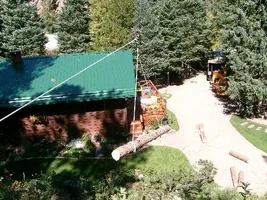
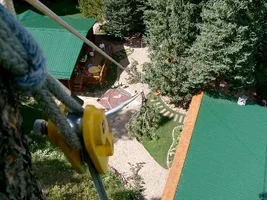
Arbor X Tree crew in action

one larger diameter log section.

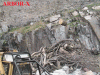
On these big ash logs, we had to cut them up into like 3 foot lengths (due to the limited weight we could put on the speed-line). With the short length, we cut a grove in them to make sure the sling stayed in place.

don't think any of these were on the youtube version.
 

Attachments

  • 119988-chunk5.gif
    119988-chunk5.gif
    133.8 KB · Views: 101
alright, last one I'll do.

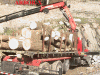
picture of the "big" wood loaded on the truck, almost all is loaded in this picture I think.. No straps and chains on the load yet this this picture.

Smaller stuff, up to about 10 inches was chipped.
-----------------------------------


thanks to Tarry McGuirk and Travis Scampton for most of these pictures I posted here.
 

Attachments

  • 119992-Big-wood-loaded-on-truck.gif
    119992-Big-wood-loaded-on-truck.gif
    181.9 KB · Views: 108
No doubt that was the trick for the site.

What I am about to mention is not critique, but observation. The observation is also something I have noticed when I have used a speed line too.

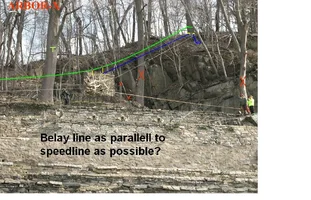
Why didn't you place the control line parallel to the speed line? Was it simply because it was too far up the hill for someone to be at? You ran out of blocks/pulleys to put a re-direct on the anchoring tree?

Just curious?

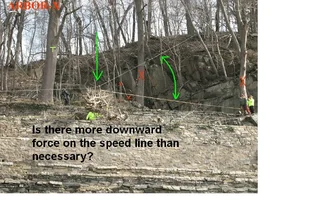
Because if the control line is not parallel to the speed line, it will add extra force on the whole system.

See attachment.
 

Attachments

  • 120000-ArborXspeedlinemod1.webp
    120000-ArborXspeedlinemod1.webp
    178.7 KB · Views: 95
Very good point.

I picked the closest anchor to the load take off point. Why? Because I didn't have a control line over 200 feet.

We decided later that the control line, (belay line) really wasn't holding much weight and stepped down a size in rope so it wasn't so heavy to haul back, we had to add a short section of rope to the end to make it long enough though.

There was a little old stump directly in line with the speed-line that they guys later put a snatch block on and used it. They spotted it and made a smart move. Now, I recall, they put a block on that little stump and ran it over to the LD if they needed a wrap. Small loads, they could just hold by hand and run it through that block on the stump.

Also, shortly after the load went down the speed-line in the picture of mine that you showed, the belay line wasn't pulling down on the speedline anymore. Every so slightly to the side maybe, but I never noticed the speedline being pulled.

But you are absulutely right, if one wanted the perfect set-up, with the least amount of load on the speedline, it would be best to have the belay line right with the speedline and start where it does.

Maybe even the belay line above the speedline, but then you'd probably have problems rubbing the belay line against the speed-line.

Thanks for the intelligent post!

 
[ QUOTE ]
Also, shortly after the load went down the speed-line in the picture of mine that you showed, the belay line wasn't pulling down on the speedline anymore. Every so slightly to the side maybe, but I never noticed the speedline being pulled.

[/ QUOTE ]

Ah. That clears it up. Makes me want to buy more rope and do some sick speed line action!
pbj.gif


Nicely done!
icon10.gif
icon14.gif
 

New threads New posts

Back
Top Bottom