
I refrained from getting further in to it because I don't have experience using a bowling with Yosemite finish. It's my very casual understanding that that is just fine, and now I understand that it may be better than an alpine butterfly, as you have said. The OP's post left it ambiguous as to whether he was using a Yosemite finish, so I thought it better to check in.I agree that a standard running bowline that is not locked off is a problem, but using a bowline is far from irregular for canopy anchors. I prefer a Yosemite finish on my running bowline, which I will tie on the tail or midline with a bight. Most climbers I’ve worked with do the same.
In my opinion a properly finished bowline is superior to the butterfly in its function aloft because it requires no hardware to be midline detachable. I don’t think I’ve used a butterfly for an anchor since 2015.
At the end of the day, as long as knots are properly locked off for their intended use, preference, right?

Navigation
Install the app
How to install the app on iOS
Follow along with the video below to see how to install our site as a web app on your home screen.
Note: This feature may not be available in some browsers.
More options
You are using an out of date browser. It may not display this or other websites correctly.
You should upgrade or use an alternative browser.
You should upgrade or use an alternative browser.
Anyone able to recommend a full Haas Knee ascender setup ?
- Thread starter treeajnin
- Start date


@Crimsonking can you explain what you mean about a running bowline being midline detachable? I'm having trouble visualizing this and would like to know.

climbstihl
Branched out member
- Location
- Germany
He means you can undo the knot if you have the tail, but he forgot that the alpine butterfly is exactly the same.@Crimsonking can you explain what you mean about a running bowline being midline detachable? I'm having trouble visualizing this and would like to know.

Crimsonking
Been here a while
Not quite. When I’m setting a canopy anchor on shorter trees, instead of tying a running bowline with the tail, I’ll use the other side, midline, and tie a bowline w/ Yosemite with a bight, then fish the tail through. If for some reason it needs to be untied and reset, you don’t have to pull twice the height of your TIP to unthread a butterfly. You just untie the bowline.He means you can undo the knot if you have the tail, but he forgot that the alpine butterfly is exactly the same.
Crimsonking
Been here a while
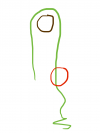
Where’s Brocky when you need a good sketch? In my preschool artwork from my iPhone’s notepad, observe-
Tie the bowline using the side circled in red, not the tail. Then thread tail through bowline.
Now you automatically have a retrieval as long as your rope is long enough, and you can untie it at the anchor without fishing a bunch of rope through a loop.
Tie the bowline using the side circled in red, not the tail. Then thread tail through bowline.
Now you automatically have a retrieval as long as your rope is long enough, and you can untie it at the anchor without fishing a bunch of rope through a loop.
Attachments
Crimsonking
Been here a while
For sure!I refrained from getting further in to it because I don't have experience using a bowling with Yosemite finish. It's my very casual understanding that that is just fine, and now I understand that it may be better than an alpine butterfly, as you have said. The OP's post left it ambiguous as to whether he was using a Yosemite finish, so I thought it better to check in.
I would never be offended by such a question/comment, in fact I appreciate it. My father taught me to "remain teachable".
Anyhow ...so for me, I send up my spliced end of the rope over a branch TIP, and than I use a running bowline backed up with a couple half hitches and ill put a carabiner in the splice. Than we Tie,Dress,Set the knot and I put a 2nd climbing line through the carabiner that is already inserted into the splice. Now is when I pull the climbing line all the way up and tight to the TIP. This 2nd rope is to pull the knot back down in case things don't work out and I can't get the knot up top or something happens/change of plans and I am not stuck with a rope up there. Once I am confident things look good I will pull that 2nd rope out or sometimes just move it out of the way so I can have access to that 2nd rope up there for various reasons. I will not go for this when its an obvious situation where the knot is not going to pull up and over clean or cinch up.
Where I personally draw the line and for no reason other than just fear of the unknown is I will not work off that canopy anchor. I will only ascend up to it before I switch over to the double rope for working the tree. If I intend on working the tree SRT I use a basal anchor which to me is important since I work with non-climbers I have taught them how to lower me if need be.
I am relatively new to single/stationary rope techniques so I keep an open mind and these are the habits I have thus far.
I welcome constructive criticism and advice. I am excited to learn from you all. I start a lot of sentences with I.
Thanks!
Anyhow ...so for me, I send up my spliced end of the rope over a branch TIP, and than I use a running bowline backed up with a couple half hitches and ill put a carabiner in the splice. Than we Tie,Dress,Set the knot and I put a 2nd climbing line through the carabiner that is already inserted into the splice. Now is when I pull the climbing line all the way up and tight to the TIP. This 2nd rope is to pull the knot back down in case things don't work out and I can't get the knot up top or something happens/change of plans and I am not stuck with a rope up there. Once I am confident things look good I will pull that 2nd rope out or sometimes just move it out of the way so I can have access to that 2nd rope up there for various reasons. I will not go for this when its an obvious situation where the knot is not going to pull up and over clean or cinch up.
Where I personally draw the line and for no reason other than just fear of the unknown is I will not work off that canopy anchor. I will only ascend up to it before I switch over to the double rope for working the tree. If I intend on working the tree SRT I use a basal anchor which to me is important since I work with non-climbers I have taught them how to lower me if need be.
I am relatively new to single/stationary rope techniques so I keep an open mind and these are the habits I have thus far.
I welcome constructive criticism and advice. I am excited to learn from you all. I start a lot of sentences with I.
Thanks!
I do the same thing with an AB. Essentially you're tying a midline loop in your rope and feeding the tail thru it after the tail is over the anchor point. You pull the tail down which pulls the loop up until it cinches at the anchor point. Then you work SRT off the tail and use the other end as a pull down line. I do this with an AB. I'm probably missing something but I just don't know what it is. Thanks for your patience
Well, I now have something new canopy anchor to try out so thanks!
Now to find suspenders for the Petzl Sequoia. As long as these monkey beaver suspenders fit I might give them a try they look cozy. =P I really just need something to clip on the chest or whatever for advancing my rope wrench/hitch during Rope walking.
Now to find suspenders for the Petzl Sequoia. As long as these monkey beaver suspenders fit I might give them a try they look cozy. =P I really just need something to clip on the chest or whatever for advancing my rope wrench/hitch during Rope walking.
Crimsonking
Been here a while
The only difference is the ability to untie the bowline at the anchor point without pulling all the line through the loop first, if you need to reset your anchor somewhere else.
It’s not a major thing, just minimizes hardware and motion.
For @treeajnin , have you considered tying the tail of your climbing line to the carabiner in the spliced tail of your bowline and doing without a second line for your retrieval side during installation?
Btw, kudos for sending up a retrieval during installation, as I’m sure you’ve experienced how the line can twist or do other undesirable things on the way up. I preach that to trainees.
If you use the tail of your line, the system becomes a giant loop. When you get to the top and switch to ddrt, you now have the option to send your tail down any direction you want. This way you can set up a ponytail redirect from the start, potentially saving you a step later. Less rope, less movement.
It’s not a major thing, just minimizes hardware and motion.
For @treeajnin , have you considered tying the tail of your climbing line to the carabiner in the spliced tail of your bowline and doing without a second line for your retrieval side during installation?
Btw, kudos for sending up a retrieval during installation, as I’m sure you’ve experienced how the line can twist or do other undesirable things on the way up. I preach that to trainees.
If you use the tail of your line, the system becomes a giant loop. When you get to the top and switch to ddrt, you now have the option to send your tail down any direction you want. This way you can set up a ponytail redirect from the start, potentially saving you a step later. Less rope, less movement.

JeffGu
Been here much more than a while
- Location
- Osceola, Nebraska
I've always just used a bungee neck tether. Some folks don't like things around their neck, though. It's never bothered me because the bungee cordage I use won't hold a bowling ball's weight, let alone my fat ass. So, it's always a disappointment to the gathering crowds when they waited all day for a hanging and it didn't happen. Screw 'em. I still make a bundle on the popcorn sales.
I have done it once or twice but find that I often am using a 2nd rope for things anyways. I think the habit developed for me since I climb a lot of very tall white and red oaks. I often make that 2nd line the soon to be lowering line so I have it up there with me already, OR ill often use that 2nd line to haul up gear,rigging,cabling gear, on a micropulley + hitch + carabiner and sling kit ( progress capturing gear lifting thingy ?) all in an effort to reduce wear and tear on the body and conserve energy.The only difference is the ability to untie the bowline at the anchor point without pulling all the line through the loop first, if you need to reset your anchor somewhere else.
It’s not a major thing, just minimizes hardware and motion.
For @treeajnin , have you considered tying the tail of your climbing line to the carabiner in the spliced tail of your bowline and doing without a second line for your retrieval side during installation?
Btw, kudos for sending up a retrieval during installation, as I’m sure you’ve experienced how the line can twist or do other undesirable things on the way up. I preach that to trainees.
If you use the tail of your line, the system becomes a giant loop. When you get to the top and switch to ddrt, you now have the option to send your tail down any direction you want. This way you can set up a ponytail redirect from the start, potentially saving you a step later. Less rope, less movement.
Crimsonking
Been here a while
Heck yeah, man I like it!
Chaplain242
Branched out member
These are the SRT suspenders? What makes them complex?I highly recommend CAMP’s knee ascender. It’s super lightweight and compact, and it screams up a rope. I’m curious about the MB suspenders. I like my CAMP suspenders, but they are a little more complex than I think some will care for.
climbstihl
Branched out member
- Location
- Germany
Ah, very smart, I was thinking of a regular bowline at the end, which has no advantage (or disadvantage really) over an alpine at the end. I rarely use a bowline with a bight, so I didn't really have it on my radar. I might start using that technique myself though. Usually it's an alpine with a quickie or steel biner if it's temporary.Not quite. When I’m setting a canopy anchor on shorter trees, instead of tying a running bowline with the tail, I’ll use the other side, midline, and tie a bowline w/ Yosemite with a bight, then fish the tail through. If for some reason it needs to be untied and reset, you don’t have to pull twice the height of your TIP to unthread a butterfly. You just untie the bowline.
New threads New posts
-
test
-

-
 Alternatives to standard asphalt around roots
- Started by southsoundtree
- Replies: 11
-
-

-

-


