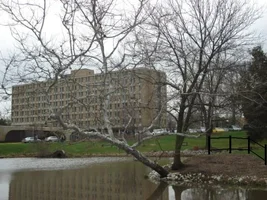
Any advice for propping this tree??

My suggestions would be first improve the soil and root environment for the tree, you want the healthiest root system you can get, (though there really isn't much you can do about the existing physical problems!)

No matter what physical support system you install you will always have the potential problem of ill advised human actions ie students climbing into the tree and jumping into the water!!

Perhaps a fence around both trees, visually inobtrusive but enough to physically direct overly stimulated students from the base of the leaning tree....? the fence would also permit effective mulching of significant root and soil area.

Then yes install a cobra support in the location Dan indicated, but agree with the previous comment about the 30yrs...probably longer without storm events or human interaction.
 

Attachments

  • 125086-syc.webp
    125086-syc.webp
    57 KB · Views: 65
I will have to bring these issues up to Dr. Green on Monday after class and get the answers from him about Paul authorizing the work. I like the idea of the 1/4" EHS steel cable, probably going to be a better option for the overall holding of the tree. The only thing I don't like about the steel is having to drill into the "historical tree." Was it an Ash that you removed with the speed line? If so, I believe the stump is still sitting there and rotting.
 
[ QUOTE ]
My suggestions would be first improve the soil and root environment for the tree, you want the healthiest root system you can get, (though there really isn't much you can do about the existing physical problems!)

No matter what physical support system you install you will always have the potential problem of ill advised human actions ie students climbing into the tree and jumping into the water!!

Perhaps a fence around both trees, visually inobtrusive but enough to physically direct overly stimulated students from the base of the leaning tree....? the fence would also permit effective mulching of significant root and soil area.

Then yes install a cobra support in the location Dan indicated, but agree with the previous comment about the 30yrs...probably longer without storm events or human interaction.

[/ QUOTE ]

The fence may be a really good idea, I will bring that up as well! Thanks
 
it does need 2 cables, but not in the configuration that was already suggested..... one cable from the leaning tree to the upright one, and one from the upright one to a ground anchor..... this would keep the upright tree upright

what do you think?
 
[ QUOTE ]
Was it an Ash that you removed with the speed line? If so, I believe the stump is still sitting there and rotting.

[/ QUOTE ]

Indeed it was.

Rob, if there is another tree behind the ash I would go to that tree. Installing a ground anchor at a University has to many liabilities.
 
[ QUOTE ]
[ QUOTE ]
one day you might see both trees in the water

[/ QUOTE ]


And hopefully at that point, they are both wearing white T-shirts!


Boo-Yahhhh!


SZ

[/ QUOTE ]

Naughty Easy!!! I like it (too much)
grin.gif

I know a good therapist who'll let you stroke some bark whilst you talk your heart out
wink.gif


PS Why is winter the sexiest time of year?


Because most of the trees get naked!
smirk.gif
 
Has anyone taken any measurements over time to see if this tree is falling? If parents remember this leaning "white tree", it seems to me that it has been this way awhile. We have HUGE Sycamores along the Delaware river that have leans like that and have been that way for centuries. I would leave that tree alone.
 
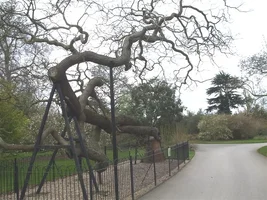
I don't recognise the tree however if it is in Kew, its interesting that you chose to post a picture of it as evidence of others (more respected Arboricultural minds?) following the same management options as those you suggested for the leaning tree in the original post.

Just for the sake of conversation, I'll assume you know a little about the history of Kew gardens, its origins, its development, and the evolution of the ethos of the modern gardens to increase public knowledge and understanding of the value and vital importance of plants.

The picture you posted is most likely a tree impacted by the one in 300yr storm in 1987, it would therefore be one of the very few trees windthrown that remain, 700 others (one third of the mature tree population) in the gardens were lost that early October morning.

Decisions to retain the few that could be salvaged were based on their species specific characteristics, their location in relation to targets and their suitability for ongoing risk mitigation.

I did not undertake a studentship at Kew (I only wish I'd been so lucky!!
frown.gif
) however I know personally a number of Arborists/horticulturalists who did. I would suggest to you that the cuts in what was the upper canopy of this tree were made to mitigate the obstructive position of the now horizontal canopy into the sealed path to the right...more so than reduce any weight consideration.

What is relevant for me about the experience of the storm event at Kew and the aftermath is that it provided irrefutable evidence to the garden managers of the importance of proper proactive root and soil works for all the trees....far more than any canopy works.

The storm exposed hundreds of root systems and it became very clear that a lack of understanding and neglect had dramatically increased the vulnerability of their trees.

Root management is a major element in the work at the arboretum. Every tree has a circle of bark chippings and mulch around it, which helps to recreate a natural forest floor. Staff also encourage fungi and other micro-organisms which turn over the soil, keep water draining efficiently and reduce compaction.

For me your picture does not support the suggestion that canopy works are either a necessary nor a desirable primary focus for the leaning tree in the first post....for me it merely reinforces the point that the roots and soil are the primary focus when dealing with all trees especially those with a lean....but then thats just me
wink.gif
 
Is there indications of a problem? Have roots that were once covered now become exposed, sinking of the side exposed to the pond? The tree appears to have adapted to the way it leans so, what compels this desire to do something?
 
[ QUOTE ]
Well how 'bout here?

The TreeHouse

[/ QUOTE ]

I would go with your first end weight cut... that is what I was thinking when I first saw the tree. Get as much wood off as you can, then you wont even need to support it.

Prop in the water sounds like a bad idea, not to mention it would be pretty tough to do.
 
I would prop it rather than hang it up with bracin...sideways loading will do for that thing and bracing then wont help..!
Do this by constructing a pad undrwater and using green oak probably for pole...then drill the tree and attach with stainless bolt......
That pic of kew is interesting cos I think the design of structure would be the same in this case... might look a bit ..well...U see...you maybe have to attach lights for shippin'?
 
As usual, it's really easy to be a sidewalk engineer :)

From the pictures I'm with Treegazer in post #125022. It seems like two cables to support the Y shaped crown would be in order. Guying back to the ash and then guying the ash back has merit too.

There are several cabling systems that use wide webbing with eyes sewn into them. Use them with steel cable to have the best of both worlds.

Keep the cable slathered with a generous layer of really smelly lubricating grease and it will almost eliminate climbing. Ask the mechanics in the motor pool for some nasty smelling stuff. When I was at the Wye Oak just before it toppled I touched the lightning protection cable and lived to regret that. Smell! Yuch! And the grease was hard to wash off even with soap and hot water.

Ask around campus for some historical photos to compare then and now. It might not be tipping any more. Even so, I would feel much more comfortable having some support because the tree is only getting larger and heavier. Sooner or later the soil mechanics will fail because the roots can't generate enough friction to hold the tree.

Somewhere I have a picture of the tree in Kew Gardens. The historical one has just the brick wall as a trunk brace. It seems like that was installed decades ago. When I was at Kew I could tell by the aging and lichen growth on the bricks that the wall had been there a LONG time. The steel post props were newer but still many years old. It did seem to me that the ends of the limbs were removed to keep people from hitting their heads while walking on the paths.
 
Hey, sounds like you've gotten some good suggestions.It looks like to me the Ash is sitting on the root system of the sycamore witch I'm sure helps hold it down but it is not large enough or tall enough to to set a reasonable cabling system of any kind else your gonna end up with both trees in the drink. A heavy pruning doesn't sound like a good idea that might cause a decline in the health of the tree. My suggestion would be to prop the tree from underneath. This would be difficult due to the water but it sounds like you have some good resources at your disposal and should be the best long term solution to this dilemma. Also I have seen several trees done this way and the visual effect is really quite impressive. Best of luck to ya!!!
 
Taking some time to plan a crown subordination will be more beneficial than thinning the crown. Lower the center of gravity and the tree will be much more stable and healthier too.
 

New threads New posts

Back
Top Bottom