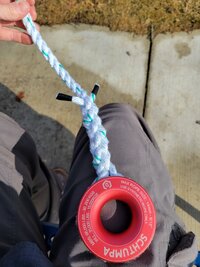
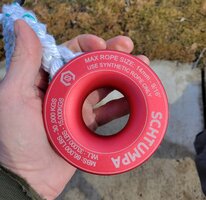
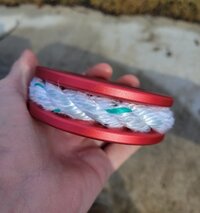
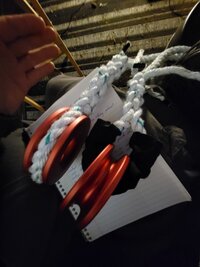
Rigging rings as snatch blocks

Dyneema melts real quick so you have to be extra careful about slownessxloadsize product in your configuration with the ring spinning on the same section of rope eye. I wouldn't do it except if I could guarantee slow and no transient load or motions under load.

How do you break a dyneema throw line? Yank hard and fast as the combination will heat the contacting section over the tree crotch and lower it's strength just long enough for it to snap at a lower load.

However, kind of neat. Keep em polished! Burr free!

You can look up the gas mileage er efficiency er ... tension loss for pulleys, biners, and rigging rings etc in the Base Tied SRT Tip forces thread. Been down that road a bit.
 
Dyneema melts real quick so you have to be extra careful about slownessxloadsize product in your configuration with the ring spinning on the same section of rope eye. I wouldn't do it except if I could guarantee slow and no transient load or motions under load.

How do you break a dyneema throw line? Yank hard and fast as the combination will heat the contacting section over the tree crotch and lower it's strength just long enough for it to snap at a lower load.

However, kind of neat. Keep em polished! Burr free!

You can look up the gas mileage er efficiency er ... tension loss for pulleys, biners, and rigging rings etc in the Base Tied SRT Tip forces thread. Been down that road a bit.
For most applications I use them, 10 to 15 RPM is as high as it gets under load. And I have seen no signs of melting at those speeds. Winching and pulling doesn't create enough heat to do any damage. The four wheeler people use them almost extensively these days for winching their rigs out of the crud they get themselves stuck in.
I also have them spliced directly onto double braid rigging ropes, and have some soft shackles I have made from Tenex-TEC that I use them on, but most often I have them on a Dyneema type soft shackle.
Dyneema doesn't like shock loads. I certainly wouldn't want to use it in an attempt to catch me if I fell out of a tree. But for this situation, it shines.
 
Last edited:
A regular block would give more softer bending radius with less friction.
i think hitching to something would allow bend radius X statically;
that could be too small for cranking around same arc/curve dynamically.
i have done like this, especially to industrial size clevises from local phosphate mines,
but watch the numbers and how far you play them out i think.
 
I have been using the rings like this for several years now and I have not had a need to cut off an eye splice where the rings rub and splice a new eye due to wear. Not like you are winching miles of rope, or dropping chuncks down from a stem. Short pulls that are slow.
Just thought I would see what the rest of you guys are doing with rings other than redirects, and dropping / lowering.
I was obviously not referring to your original post in regards to what your achieving in the configuration your utilizing those rings that's awesome. I've thrown a ring in midline knot and redirect bight back to block to lift and pull quite bit , I've never had a ring spliced into end of a rig line but like that idea too. Thanks for posting
 
IF I'm going to take the time to set up a MA, I will use the most efficient tool first and dig in the tool box from there.
Sometimes that efficient tool is a oldschool truckers hitch, efficient because it will do the job for the load and application vs taking the time to setup a low friction pulley system.
The higher the MA needed, the more friction loss comes in. The more friction in the system under high loads, the more heat.
 

RENO Winch Snatch Recovery Ring 66,000 lbs​

for about $32 dollars, and they handle 5/8" rope. You can find them on Amazon.
This is cool! Thanks for sharing.

Is something like this available on one of the small wonderful tree-focused companies we have available to us?

Just seeing the news that New Tribe is closing, we gotta support our lil tree innovators and manufacturers whenever possible!
 
This is cool! Thanks for sharing.

Is something like this available on one of the small wonderful tree-focused companies we have available to us?

Just seeing the news that New Tribe is closing, we gotta support our lil tree innovators and manufacturers whenever possible!
These have been used with the off road people for several years now, as most have gone with synthetic ropes for their winches. I don't know why the arborists supply companies have not glommed onto to them.
I began using large rigging rings for this purpose when they showed up for us, and they work pretty well. A bit more drag on the soft shackles because the outer edges flare out rather than in, but I have not seen any significant wear on my soft shackles from that, and the extra friction is not noticeable.
I have moved to using the winch rings this past year and a half, having tried several different ones. I like the Reno ones the best. A lot of them have a flat area inside with a radius on each side. I don't know if it matters, but the Reno rings are a nice radius all the way across the center hole, and they will handle a rope up to 5/8". And they are cheap, but well made, with them being thinner away from the hole so only the only friction is where the rope runs through the center.

I have never owned a New Tribe saddle, but I know my Monkey Beaver saddle would not be if it weren't for New Tribe. They are the ones who got the Monkey Beaver saddle going for August.
 
I used to be solely rigging rings. As a crew we decided we like the consistency of blocks and rings combined more than just rings. Personally I like how light rings are and I'm comfortable leaving them in a top of a tree and bombing it out if I want to avoid going back up to it.

Someone mentioned rope pinching. I use 3 rings if I'm negative rigging because they won't position themselves to pinch. The stack of 3 almost always lays sideways on the stem, leaving the rope free to run.
I'll use a double ended ring and a single ring. Single at the top of the tree, double as a redirect. Then attacht the double ender as a prussic to the single ring to negative rig down.
 
I'm worried about it being left out of reach at the top of a peg, feels like the pull rope could just pop out of the groove and be left to rub on the sling. This way is bomber and I don't care about this cheap ring smashing on the ground
Well you could always tighten up the eye splice so there wasn't enough room for the rope to go along side the ring. But give it a go that way and see if you like it. I have not run into that problem as of yet and have been using them for a few years now.
 
Am I just being paranoid? I was thinking that if I spliced it the other way, tight enough to keep the rope from jumping out, it might be too tight to rotate properly...

I am a chronic over thinker, and a hyper hypo
 
Last edited:
Am I just being paranoid? I was thinking that if I spliced it the other way, tight enough to keep the rope from jumping out, it might be too tight to rotate properly...

I am a chronic over thinker, and a hyper hypo
Good project for your truckers hitch pull test to see what the difference would be.
 
I have found that in the tree the weight of the rope keeps it put. The only time I have the rope come out of the grove is when I am using them in a horizontal multi MA and let them go completely slack. But most often they go back in the grooves when I tight it back up.
 
I'm worried about it being left out of reach at the top of a peg, feels like the pull rope could just pop out of the groove and be left to rub on the sling. This way is bomber and I don't care about this cheap ring smashing on the ground
I would be concerned about that too, less so if it was something I could start with a little tension and have constant tension on it but rigging where it might bounce or something just seems like it could be more of a risk than I like.
 
I would be concerned about that too, less so if it was something I could start with a little tension and have constant tension on it but rigging where it might bounce or something just seems like it could be more of a risk than I like.
I don't advocate using them as a rigging ring where you are going to be dropping stuff. I just use them as pulleys and MA where the end result is irrelevant what happens to the rope in the ring. We have better equipment for dropping wood.
 

New threads New posts

Kask Stihl NORTHEASTERN Arborists Wesspur TreeStuff.com Teufelberger Westminster X-Rigging Teufelberger
Back
Top Bottom