












Navigation
Install the app
How to install the app on iOS
Follow along with the video below to see how to install our site as a web app on your home screen.
Note: This feature may not be available in some browsers.
More options
You are using an out of date browser. It may not display this or other websites correctly.
You should upgrade or use an alternative browser.
You should upgrade or use an alternative browser.
1/2" Minimum Rope Requirements??
- Thread starter COtreerat
- Start date

- Location
- Retired in Minneapolis
So it's basically there to avoid osha regulations? Is it safe to say that most of osha passing at height regulations are not climbing arborists? If that's the case than it's there to bypass regulations passed by non climbers.Basically this annotation is there because there is OSHA standard language that affects line clearance arborists. This is a legit way of providing an ‘out’ to the rest of the profession

cerviarborist
Very stable member
- Location
- Florida, USA
"Arborist Climbing Ropes are required to have a minimum breaking strength of 5,400 lb (24 kN) when new, and should be no smaller than 1/2” (12.7mm) unless the employee has been trained in the use of smaller line (down to 7/16” / 10.5mm), and the line's working elongation should not exceed 7% at 540 lb load."
Note the repeated presence of the word "Should" throughout the standard, and the absence of the word "Shall". This means basically that if you are going to deviate from this standard, you can do it, as long as you can show that it is a safer way to do things, given specific conditions. You should also think ahead to a scenario of you being on the stand as a defendant in the event of an incident occuring while your alternative practice is being utilized, and you should determine whether or not you would have sound reasoning to explain and justify your deviation from the standard.
The ANSI standards are all written in the blood of people who came to a bad end.
Note the repeated presence of the word "Should" throughout the standard, and the absence of the word "Shall". This means basically that if you are going to deviate from this standard, you can do it, as long as you can show that it is a safer way to do things, given specific conditions. You should also think ahead to a scenario of you being on the stand as a defendant in the event of an incident occuring while your alternative practice is being utilized, and you should determine whether or not you would have sound reasoning to explain and justify your deviation from the standard.
The ANSI standards are all written in the blood of people who came to a bad end.

- Location
- Retired in Minneapolis
No, it's not an OSHA avoidance.
This has been discussed many times. All of the info is in the archives. My fingers would be worn to the bone if I had to type out the whole issue.
The "half inch rope thing" has taken up hours of Z133 meeting time. That horse is down.
@Vicente since I don't understand your attitude towards Z133 committee members or OSHA regulators I can say that your attitude is misplaced and wrong.
DId you take a look in your copy of the Z to see the names of who is on the committee? Go back and look at past membership lists too.
This has been discussed many times. All of the info is in the archives. My fingers would be worn to the bone if I had to type out the whole issue.
The "half inch rope thing" has taken up hours of Z133 meeting time. That horse is down.
@Vicente since I don't understand your attitude towards Z133 committee members or OSHA regulators I can say that your attitude is misplaced and wrong.
DId you take a look in your copy of the Z to see the names of who is on the committee? Go back and look at past membership lists too.

cerviarborist
Very stable member
- Location
- Florida, USA
For starters, more surface area for hands, prussiks and any other devices to grab to apply friction. Possibly more material redundance in the case of abrasion or perforation. It's not just strength, it's durability and friendliness toward users and devices, as well as how it might respond to adversity.How is a larger diameter rope safer? (If a smaller rope is adequately strong,....)
cerviarborist
Very stable member
- Location
- Florida, USA
That usage decision and justification is entirely up to you.Ok, so how would you justify a smaller diameter rope being safer
I can't recall ever seeing a rope access accident report where the cause would have been eliminated with a larger rope diameter.For starters, more surface area for hands, prussiks and any other devices to grab to apply friction. Possibly more material redundance in the case of abrasion or perforation. It's not just strength, it's durability and friendliness toward users and devices, as well as how it might respond to adversity.
I get your point, but today's ropes are so good, you really have to ignore obvious defects or go way outside the bounds of reasonable usage to fail a rope.
TimBr
Official Well Known Greeter
- Location
- Northern Virginia
Slightly off topic, but related to your post. I once listened to one of those funny 911 calls they get once in awhile. The caller says "My buddy is hurt bad, he needs an ambulance!" The 911 operator asks "What street are you on, sir?" The caller says "Eucalyptus Avenue". The 911 operator says "Can you spell that for me, sir?" The caller says "Uhh, I'll just drag him over to Oak Street." End of story.All arborists must be able to spell the word arborist.
<The industry collapses>
cerviarborist
Very stable member
- Location
- Florida, USA
Dan, your statement started an itch I couldn't resist scratching. Here are a few basic differences I found between 12.7mm diameter and 11.5 diameter lines. I've rounded the product of my calculations to the nearest mm.I can't recall ever seeing a rope access accident report where the cause would have been eliminated with a larger rope diameter.
I get your point, but today's ropes are so good, you really have to ignore obvious defects or go way outside the bounds of reasonable usage to fail a rope.
1. The diameter of the 11.5 mm line is approximately 90% of that of the 12.7mm line. This, by itself, doesn't seem a biggie, as long as they're both rated to a minimum of 24Kn.
2. The circumference of the 11.5mm line is 36mm, approximately 90% the 40mm circumference of the 12.7mm line, so again, assuming they're both rated to at least 24Kn, no biggie.
3. Here's where I think things get interesting. The internal area of any given point on the 11.5 mm line is only 86 sq mm. That's about 68% of the area at a given point on the 12.7 mm line, which is close to 127 sq mm. This seemingly small difference in diameter gives away just about 1/3 of the internal cross section area of the larger diameter line.
What I draw from this is that a cut or tear from say, a dropped handsaw, pole saw or any other perforation occurrence will have a slightly greater impact on the circumference of the 11.7mm line than the 12.7mm line. At the same time, it might have a significantly greater impact on the internal cross section of the 11.7mm line. Depending upon the construction of the line and whether it is core or cover dependent, this could get hairy in a hurry.
I guess if I was aloft and something went sideways and compromised my life support line, I'd rather that line were 1/2", than 7/16"
This kind of calculation has always bedeviled me when doing tree appraisals. A seemingly small difference in input to what appears to be an innocuous factor in a complex equation, can telescope its effect throughout the rest of the calculation, and make a big change to the end result.
I'm not surprised that you haven't found this in any incident report. It seems a rather esoteric factor. I think an incident investigator might stop their data gathering at the point where the rope became damaged past the point of being able to continue to support the climber, who was harmed as a result. Indeed they might limit their finding of fault to whatever made the cut, instead of the line itself.
I would now be remiss if I didn't acknowledge my now departed 8th grade algebra and geometry teacher Mr. Thompson, to whom I stridently declared that his class was useless to me, since I intended to become a professional musician and expected that I'd never use those kind of equations.
PS, this is related to the way that shell wall depths in larger trees can decrease, relative to trunk diameter, allowing larger/older trees with thinner shell walls and more internal decay, to remain well supported and upright, relative to smaller diameter trees.
Ok, I'm done geeking for now.
- Location
- Retired in Minneapolis
I remember hearing Dr. Shigo go off on a tangent about pi.
Rope diameter is an interesting measurement. When I did some testing the ropes "cabled up" pretty hard and I unfortunately had my hands full and couldn't throw a vernier on them. But they looked skinnier and it's likely a load and construction dependent effect. nerd power  Also consider how much cross section area a fiber occupies depending on how much it's path is off of pure parallel lay.
Also consider how much cross section area a fiber occupies depending on how much it's path is off of pure parallel lay.
- Location
- Retired in Minneapolis
I remember a discussion with a tech rep for NER about the difference in diameter of the various color combos of Safety Blue 16 Strand.
The solid white version was the skinniest and any with black fibers in the blend were noticeably thicker. Turns out dying the fibers reduced the breaking strength. More fibers had to be added to meet specifications.
The solid white version was the skinniest and any with black fibers in the blend were noticeably thicker. Turns out dying the fibers reduced the breaking strength. More fibers had to be added to meet specifications.
ghostice
Been here a while
The discussion of rope diameter and cross sectional area is a really interesting one to me - in the old old days we used to ice/ rock climb on 12 mm or even 12+ mm ropes, then 11+, then 11's and nowadays it's on ~9.5 mm singles and 7.7 and 8.0 double ropes (unless you're in the Alps where they seem to climb on spaghetti strands). Anything under 11 always made the old guys I climbed with look askance a bit - it was from the damage potential from ice shards or even wear over a rock edge. Guess it's what you get used to, but some of the skinny stuff still - ya OK. I'll carry the weight thanks. As for UIAA falls though, they all make the grade.
One other thing Tom about the OSHA regs, OSHA changes soooo slowly (look at some of the inhalation heath standards for workplace air contaminants) they often little reflect up to date science or regulations in other countries. Maybe the Z should revisit again in the future and cite some of the regs currently in use around the world in next re-write somehow? Up here (Cantada) a lot of the OH&S jurisdictions cite other standards in use around the world as options.
Cheers all.
One other thing Tom about the OSHA regs, OSHA changes soooo slowly (look at some of the inhalation heath standards for workplace air contaminants) they often little reflect up to date science or regulations in other countries. Maybe the Z should revisit again in the future and cite some of the regs currently in use around the world in next re-write somehow? Up here (Cantada) a lot of the OH&S jurisdictions cite other standards in use around the world as options.
Cheers all.
Last edited:
Interesting. I have run into several people saying black rope was noticeably stiffer than other colors. I have 11mm PMI in many colors, including black, and I tend to agree.I remember a discussion with a tech rep for NER about the difference in diameter of the various color combos of Safety Blue 16 Strand.
The solid white version was the skinniest and any with black fibers in the blend were noticeably thicker. Turns out dying the fibers reduced the breaking strength. More fibers had to be added to meet specifications.

Muggs
Been here much more than a while
- Location
- Canuckistan
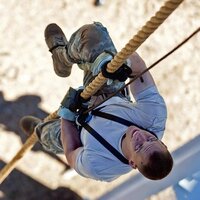
2 inch rope, when you gotta be safer-er

Shadowscape
Been here a while
- Location
- far north
Like ghostice said, they all meet the requirements, but what they are made of and how they are made make a world of difference. Case in point: Samson Voyager 11.7mm double braid, 8,000 MBS. Today I ordered from Bartlett a Samson 11.7mm double braid (Not because I needed it, but only because I like the color. I have a rope fetish.), 6,500 MBS. Except for the whacky color it looks identical to the Voyager. Bartlett is not one to give you much in the way of details about what their ropes are made of, so it is going to be sort of a crap shoot on how I'm going to like it. Might end up being a long rubber band, or like the chrome pole at a Wisconsin bar. Point being, diameter, circumference, or area only applies to like material.
Shadowscape
Been here a while
- Location
- far north
You will notice he has a small rope there to catch him when that 2" manilla one breaks.












New threads New posts
-
test
-
-
-
-
 Light 14 or 16" narrow kerf bar for 200t or 201t
- Started by southsoundtree
- Replies: 9
-

-








