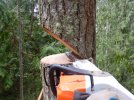
Why 1/3 notch depth?

If Daniel was to come over here to oz and try some of his out the box stuff on our ash, in particular dead ash I’d be afraid that he would be going home in a box.

I have met and worked with some very experienced and well know tree guys from over here and not one of them talked themselves up remotely like this fella does.
In general it is normally the quiet ones whom are great at what they do!!
 
I'd like to know what's up with those high back cuts... I'm thinking there is no need for a hinge, since they are front leaners there is no need for directional control. So they are more of a score cut, basically, just some distance between snap cuts so there isn't much of a hinge. Then finished with the back release. Can you post up some close-ups of the stumps??? Thanks Graeme
Surely you are taking the piss here, snap cut a 70m tall 70t plus tree??
No need for directional control?? Timber is why they are cutting these trees, timber recovery is how they get paid, with no directional control how do you prevent the stems from landing on previously cut stumps and snapping the barrel??
The country the hand fallers work in aus is steeper than a nanny goats forehead, other wise the harvesters would cut it, with no directional control you could easily lay a tree on a previously felled stem and have that tree slide hundreds of metres down hill, destroying itself and anything else in its path.

Some of our best tree workers whether climbers or fallers don’t do the fancy stuff much. By understanding the fundamentals fully and being able to implement them with precision in the correct situation with world class saw control, these veterans of the industry can out perform almost anyone with all the shiny gear and fancy equipment, with nothing but some 3 strand rope.

Those guys are the ones that I aspire to learn from
 
I've done some side of the stream, blade of grass in the teeth ciphering and figured a possible gotcha for my shed roof dilemma.

In the HSE report and the rigging research results thread and my testing it came to light that a spar log achieves a rotational velocity which is built up during the time the log lever pivots about the intact hinge or broken hinge with still being in contact. After it departs and loses contact it rotates at a constant rate till it either hits the Ddirt (:)) or tensions the -ve rig line. A top rotates slower due to wind/air drag on the branches.

So it's possible that because of the existence of the rotational rate the top/log can't traverse the 10 or 12 feet eavestrough to ground height staying parallel to the ground. It's going to rotate some.

At the same time the top/log CofG has achieved a horizontal direction component in the correct direction - away from the shed. But it wants to push against the hinge/spar top all the way to horizontal during the fall. With a decreasing amount the closer it gets to horizontal (short rigid stem, not 150' conifer spring pole with resonance movement).

So the question becomes you want to utilize the horizontal velocity you built up, but ideally you need the top to depart before horizontal and the contact force/push doesn't want that to happen.

Can an aggressive Humbolt (or?) convince the log/top to depart before horizontal. Safely?


Or like the farmer's road directions " Well, ya just caint get there from here..." :)

 
I've done some side of the stream, blade of grass in the teeth ciphering and figured a possible gotcha for my shed roof dilemma.

In the HSE report and the rigging research results thread and my testing it came to light that a spar log achieves a rotational velocity which is built up during the time the log lever pivots about the intact hinge or broken hinge with still being in contact. After it departs and loses contact it rotates at a constant rate till it either hits the Ddirt :))) or tensions the -ve rig line. A top rotates slower due to wind/air drag on the branches.

So it's possible that because of the existence of the rotational rate the top/log can't traverse the 10 or 12 feet eavestrough to ground height staying parallel to the ground. It's going to rotate some.

At the same time the top/log CofG has achieved a horizontal direction component in the correct direction - away from the shed. But it wants to push against the hinge/spar top all the way to horizontal during the fall. With a decreasing amount the closer it gets to horizontal (short rigid stem, not 150' conifer spring pole with resonance movement).

So the question becomes you want to utilize the horizontal velocity you built up, but ideally you need the top to depart before horizontal and the contact force/push doesn't want that to happen.

Can an aggressive Humbolt (or?) convince the log/top to depart before horizontal. Safely?


Or like the farmer's road directions " Well, ya just caint get there from here..." :)

The Humboldt will be the best option in that case, based on my experience. An analogy would be the bottom angle of the face cut being a pitched roof, vs. a flat roof. On a ‘flat roof”, when the hinge closes, the log has to slide beyond the edge of the spar in order to begin dropping, but the tips can continue to rotate until the butt comes off. On a short spar with a big top, this can lead to the tips hitting the ground and the butt landing behind the point it was cut.

On the “pitched roof”, the butt can begin to slide off the spar sooner. Either cut can be made with the same degree of opening, but the orientation makes a difference. Depth will make a difference here too. This is a simple way, at the very least, to prevent the butt from coming behind the plane it was cut from.
 
The Humboldt will be the best option in that case, based on my experience. An analogy would be the bottom angle of the face cut being a pitched roof, vs. a flat roof. On a ‘flat roof”, when the hinge closes, the log has to slide beyond the edge of the spar in order to begin dropping, but the tips can continue to rotate until the butt comes off. On a short spar with a big top, this can lead to the tips hitting the ground and the butt landing behind the point it was cut.

On the “pitched roof”, the butt can begin to slide off the spar sooner. Either cut can be made with the same degree of opening, but the orientation makes a difference. Depth will make a difference here too. This is a simple way, at the very least, to prevent the butt from coming behind the plane it was cut from.
Most of my topping cuts are humbolt, most of my chunking cuts are conventional...
Most of my spar felling notches are humbolt
My felling notches might be evenly split

Most of my back cuts are stepped and straight through to the hinge
Most of my felling back cuts are notched and "reach around" getting the thin side first for the back cut.
Some (evenly split) felling notches dont come to a tight apex the whole way across but snubbed like a blocked out face ranging from half inch to 2" vertical for a little extra holding(longer).
 
Most of my topping cuts are humbolt, most of my chunking cuts are conventional...
Most of my spar felling notches are humbolt
My felling notches might be evenly split

Most of my back cuts are stepped and straight through to the hinge
Most of my felling back cuts are notched and "reach around" getting the thin side first for the back cut.
Some (evenly split) felling notches dont come to a tight apex the whole way across but snubbed like a blocked out face ranging from half inch to 2" vertical for a little extra holding(longer).
I think some youtuber needs to do a remix of your post with cool autotune pitch manipulation. Viral!
 
What do you think of, convincing the physics so to say, by making a somewhat ridiculous lower Humbolt cut at like 60 or 70 degrees real steep and then performing a chase the hinge cut when the top (not a crazy wide top, a more narrow to medium top) gets to about 20 or 30 degrees before horizontal? Ought not to kick much horizontally for the last 20 to 30 degrees and perhaps it would start the slide off the spar before reaching horizontal.

Or is that just crazy talk?

Maybe this recipe needs a tweak I haven't thought of.
 
What do you think of, convincing the physics so to say, by making a somewhat ridiculous lower Humbolt cut at like 60 or 70 degrees real steep and then performing a chase the hinge cut when the top (not a crazy wide top, a more narrow to medium top) gets to about 20 or 30 degrees before horizontal? Ought not to kick much horizontally for the last 20 to 30 degrees and perhaps it would start the slide off the spar before reaching horizontal.

Or is that just crazy talk?

Maybe this recipe needs a tweak I haven't thought of.
Not crazy talk... It's not a fun move, but it can mitigate the fishing pole wobble.. Rarely and very rarely I've been known to do this cutting the hinge off when the top is committed. But I don't allow that much rotation as there is a lack of control and jump.
Basically I use this as a slice cut (aka salami, bias, etc). Steep angle humbolt but very narrow opening -> matched angle back cut -> time rotation -> spear down top planting it as a new tree...
This works a treat when there are obstructions like other trees in the lay of the top, but very few targets to squish. You get enough rotation that the top doesn't pummel you on the way down.
Other wise you risk too much rotation and spearing the top side down and the butt kicking back to the spar or grabbing your tail. Best method I've found to flip a top, is to do a conventional face of about 20-30 degrees, back cut, grab and hold the top, after the narrow hinge breaks give it a lift/push up and outwards.. IT takes perfect timing, and frequently killing the saw and just tossing it off to the side as there isn't enough time to rack it. If the top is small enough you can hold a limb for back weight while you rack the saw then push it up to tip the top over but it adds quite a few dance steps.
 
Not crazy talk... It's not a fun move, but it can mitigate the fishing pole wobble.. Rarely and very rarely I've been known to do this cutting the hinge off when the top is committed. But I don't allow that much rotation as there is a lack of control and jump.
Basically I use this as a slice cut (aka salami, bias, etc). Steep angle humbolt but very narrow opening -> matched angle back cut -> time rotation -> spear down top planting it as a new tree...
This works a treat when there are obstructions like other trees in the lay of the top, but very few targets to squish. You get enough rotation that the top doesn't pummel you on the way down.
Other wise you risk too much rotation and spearing the top side down and the butt kicking back to the spar or grabbing your tail. Best method I've found to flip a top, is to do a conventional face of about 20-30 degrees, back cut, grab and hold the top, after the narrow hinge breaks give it a lift/push up and outwards.. IT takes perfect timing, and frequently killing the saw and just tossing it off to the side as there isn't enough time to rack it. If the top is small enough you can hold a limb for back weight while you rack the saw then push it up to tip the top over but it adds quite a few dance steps.
When the piece is effectively weightless, takes perfect timing as you say, not to be relied on if you absolutely must affect the fall to avoid a high value target.
A nice way to lessen lawn damage and help the groundies get it pointing at the chipper.
 
Not exactly. A Swanson is a narrow angle humbolt with a big ass snipe. Hinge breaks and then then the butt continues pivoting on the upper edge of the snipe sliding off of it.
They are both called Swansons. 14.20 min in about. Curious if he cut them both ways, or if he was doing an old school Humboldt with a steep snipe. Neat article, thanks for linking it. https://www.worksafebc.com/en/resou...andard-video-series/undercuts-8-of-17?lang=en
 
Thanks for the linked vids. It never dawned on me before that a Swanson was on the same continuoum towards a salami cut. With variety of resultant rotation vs vertical drop action.

Still would love to see an example other than a tall skinny conifer.

All this talk is making me hungry :)
 
I haven’t seen many videos for examples. There is a Buckin one where he uses it on a big top to land flat (pinch and snipe style). Play around with it aloft. I sometimes use it taking the last logs where it wont flip but I want 8’ for the log truck, preferably with a big push on the butt it can be pretty flat.
 
That's exactly what I'm doing in the photo I shared earlier, making a very deep face to undermine the center of gravity on a vertical stem. I do it all the time, not to show off, hell I'm usually alone and almost never film, but because it works so well. Great for taking down fir wood (especially bigger stuff) without ropes or wedges. Though they used a rope in that clip. But yes, you certainly need to do it correctly, like anything.

Edit: Jerry Beranek talks about it in the Working Climber series, it is a long tried and true technique.

0 face 04.jpg
 
Last edited:
It just seems like there’s too much that can go wrong but maybe I’m not confident enough to make that kind of a cut. I’d rather put a line in it to compensate.
 

New threads New posts

Kask Stihl NORTHEASTERN Arborists Wesspur TreeStuff.com Teufelberger Westminster X-Rigging Teufelberger
Back
Top Bottom