Minimalist rope walking setups?

You getting complicated now, @Jeninten! xD But yeah, definitely would have lanyard. However, I have a couple little tender options (neck, chest, over the shoulder webbing) that would be lightweight and work just as well. My neck one is paracord in a Calamine cover, so the colors might be a little bright for hunting hehehhe.

Honestly though, since I was using knee and foot ascenders, it really wasn't a big deal at all to advance the hitch by hand; I used one hand on the hitch itself, then the other hand a couple feet above it, as if I was rope walking with a Wrench/Runner (grabbing rope ahead of it to help pull myself and keep me upright). Is that non-kosher for hitch-based progress capture, by the book, having a hand above it?
 
If your not opposed to a little more gear, a pulley to advance your hitch and a way to tend it just like a normal work climb would make it much nicer I'd think, than manually pushing it up the rope. A chest harness or using your lanyard over the shoulder is lightweight and I assume you'd have a lanyard anyways for a more stable shooting position.
Tried the micro pulley with neck tender just now - so, SAKA, foot ascender, prussik to bridge, and neck-tender for prussik; felt just like a normal rope-walking ascent. Pretty neat. Figure 8 to descend worked great. Also, went back up and doubled down (MRS, DdRT, etc.) - didn't even undo my bowline forming the cinching canopy anchor. Just enlarged the loop, brought it down to saddle (around the prussik connection) and clipped it to bridge with a biner, and pulled prussik to descend. So simple/quick.
 
Tried the micro pulley with neck tender just now - so, SAKA, foot ascender, prussik to bridge, and neck-tender for prussik; felt just like a normal rope-walking ascent. Pretty neat. Figure 8 to descend worked great. Also, went back up and doubled down (MRS, DdRT, etc.) - didn't even undo my bowline forming the cinching canopy anchor. Just enlarged the loop, brought it down to saddle (around the prussik connection) and clipped it to bridge with a biner, and pulled prussik to descend. So simple/quick.
An alpine with a tail the length from your anchor to your desired height works really well for single up/double down. Allows you to clip in for double down without having to slack your single up system.

I'll occasionally setup a canopy anchor for a work climb with a short rope that doesn't allow the retrieval leg to reach the ground. So I'll tie it onto my bridge as I'm coming down and finish the last of the descent on doubled rope with either my Runner or Unicender


Single up on a hitch then double down was my introduction to SRT. It works quite well as long as you don't need an emergency descent half way up, but thats where the figure 8 comes in.
 
Oooo - I did have to lanyard in to do the conversion to double, so using the tail is a pretty awesome idea.

I don't quite follow the long tail recommendation though...doesn't just clipping into the tail of the cinching knot mean that the climbing side you ascend on should be 2x the total height of the tie-in point, so you don't run out of rope before reaching the ground?

An alpine with a tail the length from your anchor to your desired height works really well for single up/double down. Allows you to clip in for double down without having to slack your single up system.

I'll occasionally setup a canopy anchor for a work climb with a short rope that doesn't allow the retrieval leg to reach the ground. So I'll tie it onto my bridge as I'm coming down and finish the last of the descent on doubled rope with either my Runner or Unicender


Single up on a hitch then double down was my introduction to SRT. It works quite well as long as you don't need an emergency descent half way up, but thats where the figure 8 comes in.
 
Oooo - I did have to lanyard in to do the conversion to double, so using the tail is a pretty awesome idea.

I don't quite follow the long tail recommendation though...doesn't just clipping into the tail of the cinching knot mean that the climbing side you ascend on should be 2x the total height of the tie-in point, so you don't run out of rope before reaching the ground?
The length of the cinching knot tail plus the working side tail on the ground need to add together to the height of your TIP to be able to descend to the ground. Otherwise, you will have to stop on the way down, pull your tail out and set a new, lower anchor point to continue your descent.
 
Oooo - I did have to lanyard in to do the conversion to double, so using the tail is a pretty awesome idea.

I don't quite follow the long tail recommendation though...doesn't just clipping into the tail of the cinching knot mean that the climbing side you ascend on should be 2x the total height of the tie-in point, so you don't run out of rope before reaching the ground?
Yes, if you switch to doubled rope at the anchor point, which the way you did it you would also need 2X the length on the climbing side. If I'm understanding correctly.

You technically only need 2X the climbing leg from below your friction hitch to the ground at the point where you switch over to double down.

If setup with a retrieval leg long enough to get to the ground, you could tie an alpine at any point on the retrieval leg and clip into your bridge to double down. It would be messy and cumbersome for a work climb, but would work for descent at any point in your climb without a figure 8 should you not be able to make it to your tie in point for some reason.


Edit: I started typing this a while ago and never finished. @Tuebor has since said the same thing as my second paragraph but worded differently.
 
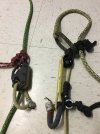
Breaking the rules part one: On the left, 8.9mm Swift Protect, Titan cord hitch with soft shackle on what was going to be called the HH LT, but decided to go to the next level and call it the HH TL, made of plastic and wood.

The Moving system only fits the minimum part, Arbpro and grommet saver, Titan cord Prusik, 10mm low friction ring tender, Sterling’s 6mm XTec.
C6DA8609-119D-44F7-A775-D657804035A5.jpeg
 
Breaking the rules part one: On the left, 8.9mm Swift Protect, Titan cord hitch with soft shackle on what was going to be called the HH LT, but decided to go to the next level and call it the HH TL, made of plastic and wood.

The Moving system only fits the minimum part, Arbpro and grommet saver, Titan cord Prusik, 10mm low friction ring tender, Sterling’s 6mm XTec.
View attachment 72171
For the HH TL, do you have a backup/secondary way of attaching yourself to the hitch cord in case the plastic side plates break?
 
I've not been very active here lately so I only skimmed over this thread, I'd take the following system if I was to try ultralighting my climbing setup (currently going more in the opposite direction though :P ):

- RopeWrench, about 200g, requires a rope 10mm or over

- 8mm hitchcord with sewn eyes (you gotta save that knot weight though ;) !) <60g

- Foot Ascender <100g

-DIY knee ascender with literally just a dyneema sling, 2 mini Carabiners with breaking strength >1000lbs and some bungee cord, <120g

-Your desired length of 10mm static rope, I personally would go with 100 ft/30m. Example: Edelrid Static, 66 g/m, 1.98 kg total (I have used this rope with the RW and Courant Phoenix, I think I used a 6 wrap Michoacan)

Or alternatively, if you dont mind a bit of experimentation and you want to use 9mm or even 8mm rope with the RW, try adding an aluminum bushing around the RW slic pin. I have not tested this but it should theoretically work.

I think the slic pin is 9mm, I'd use an aluminum tube with a wall thickness of 1-2mm.
 
Or alternatively, if you dont mind a bit of experimentation and you want to use 9mm or even 8mm rope with the RW, try adding an aluminum bushing around the RW slic pin. I have not tested this but it should theoretically work.

I think the slic pin is 9mm, I'd use an aluminum tube with a wall thickness of 1-2mm.
I wonder if a Pinto pulley spacer would work?
 
Tried the micro pulley with neck tender just now - so, SAKA, foot ascender, prussik to bridge, and neck-tender for prussik; felt just like a normal rope-walking ascent. Pretty neat. Figure 8 to descend worked great. Also, went back up and doubled down (MRS, DdRT, etc.) - didn't even undo my bowline forming the cinching canopy anchor. Just enlarged the loop, brought it down to saddle (around the prussik connection) and clipped it to bridge with a biner, and pulled prussik to descend. So simple/quick.
Just a random observation that I found amusing while reading your post: we are talking a different language. Seriously, how many people in the world can read this and understand what the hell is going on??? Haha. I absolutely love it though. I never considered going up SRT and down DRT. Perhaps it isn't the solution to my problem but I am much more inclined to try DRT now that you helped me realize how easy it is to switch over.
 
Breaking the rules part one: On the left, 8.9mm Swift Protect, Titan cord hitch with soft shackle on what was going to be called the HH LT, but decided to go to the next level and call it the HH TL, made of plastic and wood.

The Moving system only fits the minimum part, Arbpro and grommet saver, Titan cord Prusik, 10mm low friction ring tender, Sterling’s 6mm XTec.
Dude, where are you posting videos of all your ideas??? I want more than photos :)
 
Ok, after an absolute shit ton of recomendations what do you guys think of this:

1. Foot ascender
2. Wild Country Ropeman (micro ascender) attached to a leg loop
3. ascender on saddle loop
4. carry a grigri

5. Ascend by pushing up the Ropeman with hand and stepping up then bring other foot up (this is called a "frog" system?)

6. if need to descend midline I can attach the grigri under the ascender then stand in my footloop to unhook ascender.

7. at this point I can ascend or descend via traditional rads.


This was my chosen system to try until @Jan_ had to go and talk about a mininalist ropewalking system with a dyneema loop. I am confused, what would push up the knee ascender if there was no stiff piece between my foot and the ascender at my knee?
 
Just a random observation that I found amusing while reading your post: we are talking a different language. Seriously, how many people in the world can read this and understand what the hell is going on??? Haha. I absolutely love it though. I never considered going up SRT and down DRT. Perhaps it isn't the solution to my problem but I am much more inclined to try DRT now that you helped me realize how easy it is to switch over.
Haha man, I try to not sling too much jargon, except when I'm talking with subject matter experts, as are present on this site, and only in contexts that doing so adds clarity. Apologies if the acronyms confound things.

One of the things that I've found to be true in this and also other disciplines, is that the jargon and descriptions are super confusing until a decent base of knowledge and experience are acquired. Then, it becomes much easier to follow discussions. That being said, some folks are more naturally inclined to be able to follow this stuff; I am not one of those.

The only thing the single-up-double-down requires 'extra' from a full SRT setup is twice the rope length to be able to reach the ground from your highest support point...unless you stop halfway down and reset your anchor point to where you are, then finish the descent.
 
Bungee cord or retracting reel to bring the knee ascender up. The knee ascender can also be strapped to the leg alone, or with something rigid between foot and ascender, this is sometimes harder to get the rope to feed into the ascender, though.
 

New threads New posts

Kask Stihl NORTHEASTERN Arborists Wesspur TreeStuff.com Teufelberger Westminster X-Rigging Teufelberger
Back
Top Bottom