How Small a Diameter is Safe to Climb High (Conifier)

Location
Medford
I am a relatively new recreational climber. Most of the very tall trees in my area are conifers (Northern White Pines.. I think). Some of the best ones, with the best views, are about 1 ft in diameter (3.1 ft in circumference at base) and look to be just over 100' tall. Most of them are nearly perfectly vertical with no lean.

Would it be safe to climb trees of that diameter (to such tall heights)?
What should my min diameter vs height criteria be?

Thanks!
Stephen
 
I'd say its hard to give a specific diameter at which a tree stops being unsafe. A rule of thumb for your TIP diameter is that it should always be bigger than your biceps, I'd apply this to the stem as well.
Now it's difficult to say how this changes on long, skinny trees, but if the tree starts rocking back and forth every time you move, you are probably too high.
 
I’m familiar with Eastern White Pine. Soft and brittle in my experience. Also very messy, bleeds pitch like crazy and you don’t need saws or spurs to wound them, the bark can be damaged by harder soled boots like Vibram lug soles on most logger boots. Softer soles hiking or arborist boots are probably best or you’ll have pitch on everything.

Use caution and bounce test with two people. I’ve seen small tops break with 3:1 MA before when tensioning to fell. Hard to say what a good minimum diameter is. If everything looks healthy and straight I guess I’d be pretty uncomfortable under 5 or 6 inches.

Quite beautiful though, I do like the look of a lot of them. I’m speaking of eastern white pine keep in mind, it may be quite different than what you’re asking about, I’m not sure.
 

If your 1' dbh white pine passes inspection at the base, clean no rot, no carpenter ant dust, good root flare, no soil compression abuse etc. in the root zone and the main trunk is solid you're good to go in theory. Challenge is getting a good anchor/TIP, on such a young white pine. you want minimum 3" diameter side limb/branch, the rope MUST be at the branch/trunk union or very close and you MUST have multiple branches captured in the base anchored rope path, do not fully isolate the upper anchor. When you do a bounce test just off the ground it should feel solid as a rock. It's not a guarantee but it's one more data point in your safety protocol.

Don't worry about 2:1 loading using a base anchor, be aware of it but with what I've described you're good. Keep your lanyard around the trunk as you go up. Take it off and move it around obstacles as needed. It's the dynamic loading as you're moving up that is the most problematic. Smooth out your motion and climb light on your first ascent until you get up there and verify security.

On the younger pines yep you'll get some chafing at the TIP SRT with SRT/base anchor so pitch will be in your life. All good. People around here know white pine is my favorite New England tree. See if you can find some bigger older ones, the bark is thicker, the limbs heavier, life is grand in them, especially in the woods where they are less pitchy because they've never been pruned. Fall winter and early spring is the best time to climb them, pitch hardens up and they bleed less when you scratch them ;-)

Listen to intuition always, abort the climb if things don't feel right even if everything else I've described checks out.
-AJ
 
Last edited:
If your 1' dbh white pine passes inspection at the base, clean no rot, no carpenter ant dust, good root flare, no soil compression abuse etc. in the root zone and the main trunk is solid you're good to go in theory. Challenge is getting a good anchor/TIP, on such a young white pine. you want minimum 3" diameter side limb/branch, the rope MUST be at the branch/trunk union or very close and you MUST have multiple branches captured in the base anchored rope path, do not fully isolate the upper anchor. When you do a bounce test just off the ground it should feel solid as a rock. It's not a guarantee but it's one more data point in your safety protocol.

Don't worry about 2:1 loading using a base anchor, be aware of it but with what I've described you're good. Keep your lanyard around the trunk as you go up. Take it off and move it around obstacles as needed. It's the dynamic loading as you're moving up that is the most problematic. Smooth out your motion and climb light on your first ascent until you get up there and verify security.

On the younger pines yep you'll get some chafing at the TIP SRT with SRT/base anchor so pitch will be in your life. All good. People around here know white pine is my favorite New England tree. See if you can find some bigger older ones, the bark is thicker, the limbs heavier, life is grand in them, especially in the woods where they are less pitchy because they've never been pruned. Fall winter and early spring is the best time to climb them, pitch hardens up and they bleed less when you scratch them ;-)

Listen to intuition always, abort the climb if things don't feel right even if everything else I've described checks out.
-AJ

Hi AJ,

Thank you soooo much for this level of detail! If I may ask a few more:

As I mentioned before, I'm a self-taught overly-cautious recreational climber. White Pines are my trees of choice and the best trees in my area (I live in Boston MA). I mostly climb SRT (Akimbo, foot ascender, saka knee ascender, and a chest roller which allows me to climb hands free so as to move my flipline up the tree as I climb). This may sound crazy, but I often place a second line in the tree on a different anchor netowrk and trail a Petzl ASAP on it next to me in case the first anchor fails.

Here are my questions:
1. If I am SRT climbing with a flipline wrapped once around the trunk of a white pine (lets say 6' in circumference) and the anchor above fails -- starting a fall -- would the flipline save me (or would I simply fall down the tree). I think a lot about this scenario. It would seem that if the flipline was shortened rather close to the trunk that it would catch and stop me -- albeit after getting a bit scraped up). Does anyone have experience with this?

1b. I know that if you wrap the lanyard/flipline around the trunk 2x, it will catch you. This, however, becomes nearly impossible to advance on larger diameter trees.

2. I also, while climbing SRT, like to take an ART Snake Anchor and use it as a cinch anchor whcih I continutally advance as I climb white pines with sketchy TIPs and few branches up the trunk. I attach the cinch to my harness bridge and have a backup SRT setup on it as well to self rescue in case the main rope breaks and I find myself hanging on the cinch (I hope that is clear). The problem again is advancing the cinch on large diameter trees. Its hard (if not impossible) to get the "back" side of the rope/anchor to slide up the trunk. Any ideas?

3. Is their a good book or video that can teach me the nuances of tree inspection? You mentioned ". . . inspection at the base, clean no rot, no carpenter ant dust, good root flare, no soil compression abuse etc. in the root zone and the main trunk is solid you're good to go in theory." Is there a good resource for that (seeing that i"m self taught and do not know any other climbers)?

Thanks
Stephen
 
Last edited:
Stephen, I think your commitment to safety is admirable. You should do what puts you in a zone of your capabilities and awareness. That said, you might better invest some of your safety mindset in pursuits that have higher odds of causing you issues - maybe a safer car, riding the bus, or seeing the doctor regularly. You are doing great. Keep on it.
 
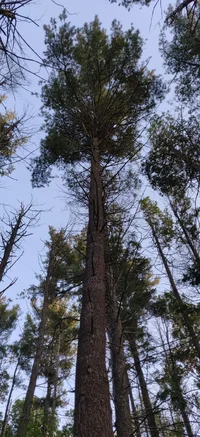
BTW... Here is a photo of one of the trees I want to climb. Its about 1.5 ft in diameter at its base and appears to be a little taller than 100 ft. I noticed that the top moves around a good bit in strong winds. If you zoom in on the canopy, you can see that the limbs are quite small. I'm not sure I want to trust my life to them. Therefore, I will be climbing with the ART snake anchor cinch as I ascend the first time.

How would you approach climbing this tree?

2019-10-15-055926.webp
 
Stephen, I think your commitment to safety is admirable. You should do what puts you in a zone of your capabilities and awareness. That said, you might better invest some of your safety mindset in pursuits that have higher odds of causing you issues - maybe a safer car, riding the bus, or seeing the doctor regularly. You are doing great. Keep on it.

Thanks! It mostly stems from a distrust in small limbs being utilized as a life supporting anchor.
 
Your flipline will probably catch you when you fall, try rappeling with it on and you'll see what catches and what doesn't. This of course depends on the stem diameter too, so you might slide down a couple of feet/inches until you hit the next branch.

On a different note: it seems as though we rec climbers are a little more safety concious in general, I too feel a lot better when I have a second TIP. I guess this might be due to the absence of stress and pressure: I tend to take a lot of time just taking in my surroundings while climbing alone. I can also recommend you to find somebody to climb with: it'll make you a better climber.
 
Try to get a grouping of limbs. I see a easy shot mid way up the live canopy. Easy SRT tree with a base anchor. You could easily nab 3-4 limbs for the PSP and have half the crown as backups if your PSP broke out.

From there advance DdRT by going around the stem. You could be good upto 4” but stick with 6” diameter wood till you learn more
 
Try to get a grouping of limbs. I see a easy shot mid way up the live canopy. Easy SRT tree with a base anchor. You could easily nab 3-4 limbs for the PSP and have half the crown as backups if your PSP broke out.

From there advance DdRT by going around the stem. You could be good upto 4” but stick with 6” diameter wood till you learn more

Evo,

Thank you for your response.

Sorry for being dense.. but when you say "nab 3-4 limbs for the PSP" does that mean having to rope hanging over 3-4 limbs simultaneously (or have 2-3 limbs below the one you are looped over)?

Also, what do you think about shooting a long throw line completely over the entire canopy (centered on the stem) and use a base anchor? I would think that would capture the maximum number of potential backup branches? Does anyone do this?

Thanks
Stephen
 
Hi AJ,

Thank you soooo much for this level of detail! If I may ask a few more:

As I mentioned before, I'm a self-taught overly-cautious recreational climber. White Pines are my trees of choice and the best trees in my area (I live in Boston MA). I mostly climb SRT (Akimbo, foot ascender, saka knee ascender, and a chest roller which allows me to climb hands free so as to move my flipline up the tree as I climb). This may sound crazy, but I often place a second line in the tree on a different anchor netowrk and trail a Petzl ASAP on it next to me in case the first anchor fails.

Here are my questions:
1. If I am SRT climbing with a flipline wrapped once around the trunk of a white pine (lets say 6' in circumference) and the anchor above fails -- starting a fall -- would the flipline save me (or would I simply fall down the tree). I think a lot about this scenario. It would seem that if the flipline was shortened rather close to the trunk that it would catch and stop me -- albeit after getting a bit scraped up). Does anyone have experience with this?

1b. I know that if you wrap the lanyard/flipline around the trunk 2x, it will catch you. This, however, becomes nearly impossible to advance on larger diameter trees.

2. I also, while climbing SRT, like to take an ART Snake Anchor and use it as a cinch anchor whcih I continutally advance as I climb white pines with sketchy TIPs and few branches up the trunk. I attach the cinch to my harness bridge and have a backup SRT setup on it as well to self rescue in case the main rope breaks and I find myself hanging on the cinch (I hope that is clear). The problem again is advancing the cinch on large diameter trees. Its hard (if not impossible) to get the "back" side of the rope/anchor to slide up the trunk. Any ideas?

3. Is their a good book or video that can teach me the nuances of tree inspection? You mentioned ". . . inspection at the base, clean no rot, no carpenter ant dust, good root flare, no soil compression abuse etc. in the root zone and the main trunk is solid you're good to go in theory." Is there a good resource for that (seeing that i"m self taught and do not know any other climbers)?

Thanks
Stephen


Richard Mumford (@yoyoman, Climbing Innovations) stuck this up a while back and I've used it a few times when nervous about my PSP on the initial ascent, for whatever reason. Works really well, especially on long vertical ascents like the pines you speak of provide (I have a yard - and a state - full of 'em). Your fingers won't like it if it ever actually comes in handy, but you'll be not dead xD

Edit: I am dumb - you mentioned doing this already, so you obviously know about it. Apologies. It still works well on fairly large-ish diameter pines, in my experience (2' or less).
 
...would the flipline save me (or would I simply fall down the tree)...?

If you follow your instincts and try to "hug the tree", you're in for a painful lesson. You need to have a plan and teach yourself how to react correctly. The lanyard, to work, needs forces in two directions... down, and out (away from the tree)... the down is easy, since gravity is happy to help you with that one. It keeps your gaffs properly sunk into the tree, stopping downward travel enough that the lanyard or flipline can stop the really heavy part of you from having to wait for that sudden stop at the end of a long fall.

The out part requires input from you. It shifts the downward force of your weight onto the lanyard and gaff and tree triangle... the holy triangle of climbing poles and pole-like structures like trees... and YOU are the hypotenuse of what is nearly a right triangle. That lower angle formed by you and the trunk of the tree is critical... you need to find the correct one for climbing and work positioning that is right for you and the tree you're on.

When you gaff out and panic, you will likely either do nothing constructive or try to hug the tree, which turns you and the tree into two parallel lines, and the triangle disappears. Then gravity tries to send you and your lanyard to the sudden stop at the bottom of the tree. You need to keep the triangle, because even if it hurts a little, it will stop you.

On a tree (it's a little different on a telephone pole or dead spar with no bark) you need to take advantage of other instincts you have... clench your fists (an instinct in scary situations), rotate your fists outward so the back of your hands and forearms are toward the tree, and form a 90 degree bend at the elbow (a semi-fetal positioning of the arms, also instinctive) and push outward. The skin on the inside of your arms is nowhere near as tough as on the outside, and the major veins and arteries are right underneath of there. Splinters can do serious, even life-threatening damage.

This action will put tension back on the lanyard, and in combination with forcing yourself to reform the triangle immediately with your feet and legs or even your crotch, allows the lanyard to grab the opposite side of the tree. The friction created, in combination with the friction created by your legs against the tree, will stop you almost immediately. But, it's something that you need to try and practice a few times until it sinks into your brain that it will save you.

Easiest way to do that is to put on a leather jacket and try it on a few trees of various sizes... at about three feet off the ground. On poles, and trees smaller than about 15 inches, you may only have to push away from the tree with your hands and squeeze the tree with your legs at the same time. The important thing is leaning back and pushing back to reform the triangle.

 
I don’t think he’s wearing gaffs, Jeff.

Is the top already broken out of the tree in the pic?
Problem with shooting a line over the tippy tops usually is that they’re too small to support you, and you’ll break them.
If the tops will support you though, it’s a good way to do it. If not, isolate something stronger and if there’s more sturdy limbs under it, it’s some good insurance :)
 
Also, what do you think about shooting a long throw line completely over the entire canopy (centered on the stem) and use a base anchor? I would think that would capture the maximum number of potential backup branches? Does anyone do this?

Thanks
Stephen

I did this a few times early in my career. I stopped after coasting 25 feet to the ground for a gentle landing after one of the branches supporting me snapped. It was a dying granddaddy live oak that I didn't know was dying. The branches were brittle. Out that far, the branches are pretty small. Setting a line like that goes against your predisposition for safety because you can't verify what it is set over, and it's probably set over some really small diameter stuff. I'm sure you have arrived at this conclusion in your subconscious. Hopefully this helps formalize it a bit...
 

Richard Mumford (@yoyoman, Climbing Innovations) stuck this up a while back and I've used it a few times when nervous about my PSP on the initial ascent, for whatever reason. Works really well, especially on long vertical ascents like the pines you speak of provide (I have a yard - and a state - full of 'em). Your fingers won't like it if it ever actually comes in handy, but you'll be not dead xD

Edit: I am dumb - you mentioned doing this already, so you obviously know about it. Apologies. It still works well on fairly large-ish diameter pines, in my experience (2' or less).

If you follow your instincts and try to "hug the tree", you're in for a painful lesson. You need to have a plan and teach yourself how to react correctly. The lanyard, to work, needs forces in two directions... down, and out (away from the tree)... the down is easy, since gravity is happy to help you with that one. It keeps your gaffs properly sunk into the tree, stopping downward travel enough that the lanyard or flipline can stop the really heavy part of you from having to wait for that sudden stop at the end of a long fall.

The out part requires input from you. It shifts the downward force of your weight onto the lanyard and gaff and tree triangle... the holy triangle of climbing poles and pole-like structures like trees... and YOU are the hypotenuse of what is nearly a right triangle. That lower angle formed by you and the trunk of the tree is critical... you need to find the correct one for climbing and work positioning that is right for you and the tree you're on.

When you gaff out and panic, you will likely either do nothing constructive or try to hug the tree, which turns you and the tree into two parallel lines, and the triangle disappears. Then gravity tries to send you and your lanyard to the sudden stop at the bottom of the tree. You need to keep the triangle, because even if it hurts a little, it will stop you.

On a tree (it's a little different on a telephone pole or dead spar with no bark) you need to take advantage of other instincts you have... clench your fists (an instinct in scary situations), rotate your fists outward so the back of your hands and forearms are toward the tree, and form a 90 degree bend at the elbow (a semi-fetal positioning of the arms, also instinctive) and push outward. The skin on the inside of your arms is nowhere near as tough as on the outside, and the major veins and arteries are right underneath of there. Splinters can do serious, even life-threatening damage.

This action will put tension back on the lanyard, and in combination with forcing yourself to reform the triangle immediately with your feet and legs or even your crotch, allows the lanyard to grab the opposite side of the tree. The friction created, in combination with the friction created by your legs against the tree, will stop you almost immediately. But, it's something that you need to try and practice a few times until it sinks into your brain that it will save you.

Easiest way to do that is to put on a leather jacket and try it on a few trees of various sizes... at about three feet off the ground. On poles, and trees smaller than about 15 inches, you may only have to push away from the tree with your hands and squeeze the tree with your legs at the same time. The important thing is leaning back and pushing back to reform the triangle.


YES! This is what I have been thinking about lately. I too had come to the conclusion that trying to "hug the tree" would result in a near free fall to the bottom. I agree that the key to getting it to work is to focus on the "out" as you have mentioned.

Since I never use spikes, the next problem would be "how do I get down" after my primary SRT anchor fails and my flipline/lanyarrd/triangle save works? For that, I do the following (jump to 6:45 to see it ):


BTW.. just to be clear.. that is not me in the video.. I just found it while doing some research.

Thanks again for the detailed response!

Stephen
 
Last edited:

New threads New posts

Kask Stihl NORTHEASTERN Arborists Wesspur TreeStuff.com Teufelberger Westminster X-Rigging Teufelberger
Back
Top Bottom