












Navigation
Install the app
How to install the app on iOS
Follow along with the video below to see how to install our site as a web app on your home screen.
Note: This feature may not be available in some browsers.
More options
You are using an out of date browser. It may not display this or other websites correctly.
You should upgrade or use an alternative browser.
You should upgrade or use an alternative browser.
Sticht Hitch
- Thread starter Brocky
- Start date

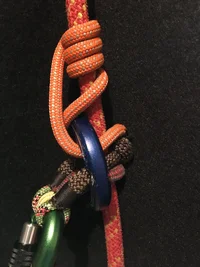

climbstihl
Branched out member
- Location
- Germany
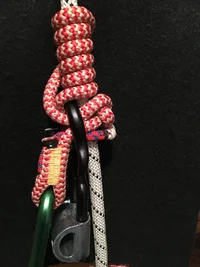
Alright, what exactly is going on in this picture? I can usually tell immediately from one picture how something is set up/works, but I'm lost here. Does the orange cord have a cover starting at the cross in the back? Why are the eyes a different color? Can you post a picture of the components disassembled?
The cord is an attempt to make it more flexible. The larger cover at the ends allows the expanded core of the splice to not be restricted. The small cord is used in place of a pulley. Thanks to John’s picture of the Totem, when the slots of the plate are vertical the tender cord can go inside. 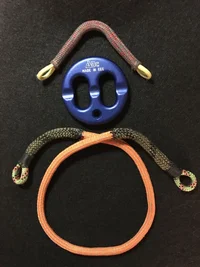
climbstihl
Branched out member
- Location
- Germany
So the eyes are formed with the core of the orange cord, but a larger cover is used near the eyes. Or is the larger cover slipped over the original cover? How does splicing that work, wouldn't it slip with such a loose cover? Sorry for my ignorance about splicing double braids (or anything other than hollow braid and 3 Strand).The cord is an attempt to make it more flexible. The larger cover at the ends allows the expanded core of the splice to not be restricted. The small cord is used in place of a pulley. Thanks to John’s picture of the Totem, when the slots of the plate are vertical the tender cord can go inside. View attachment 59521
Sorry, forgot about the eyes, they have a separate cover. The core is Sk99 dyneema, with locked brummel and bury, with an orange polyester cover from some accessory cord. The larger ends from 9.2mm dynamic rope are sewn to the orange.
This is how the eyes get covered, the tails get cut off or buried before being buried.
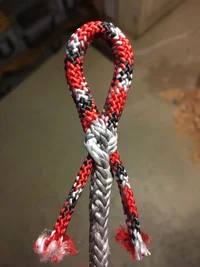
This is how the eyes get covered, the tails get cut off or buried before being buried.
climbstihl
Branched out member
- Location
- Germany
Cool, even I could splice that, although I'm not ready to trust my life to my own splices.Sorry, forgot about the eyes, they have a separate cover. The core is Sk99 dyneema, with locked brummel and bury, with an orange polyester cover from some accessory cord. The larger ends from 9.2mm dynamic rope are sewn to the orange.
This is how the eyes get covered, the tails get cut off or buried before being buried.
View attachment 59522

rope-a-dope
Branched out member
- Location
- Asheville
Wtf brocky is your house made out of dyneema and aluminum? Do you dress in a rainbow cloak of cords?

climbstihl
Branched out member
- Location
- Germany
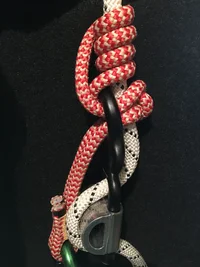
So you just add the extra friction for long descents? Will this still work with shorter tails than you have there? Does the lower part of the robot get in the way? I like the idea of being able to add more friction without adding additional hardware, as I am not a fan of using the sticht hitch for long descents because of the wear on the hitch. however, I like running a micropulley under it, that isn't an option with the robot it seems.Another fortunate coincidence, got the Kong Robot because it was on sale and needed to reach the free ship threshold. Didn’t have this in mind, but it works very good.
Dangling Robot
View attachment 59592
Descending Robot
View attachment 59593

John@TreeXP
Branched out member
- Location
- Bainbridge Island
I like the look of that a lot. The added friction is a great way to ensure a safer descent, while extending the life of the hitch cord. What's the actual diameter and length of the cord? I'm guessing 10mm and maybe 30" in the photo. I'm also curious to know how long the hitch cord would need to be in a 5 or 6 wrap configuration, using the Kong Robot.Another fortunate coincidence, got the Kong Robot because it was on sale and needed to reach the free ship threshold. Didn’t have this in mind, but it works very good.
John@TreeXP
Branched out member
- Location
- Bainbridge Island
With my XL size a 6 wrap Sticht Hitch using 8mm may become problematic. But using a 9mm or 10mm hitch cord with a length of at least 32" or more, depending on the amount of stitching in the sewn eyes would be my preference. From a practical standpoint, I'd either need to order a 32" Eye&Eye, or get a special order/custom made 34" sewn Eye&Eye of 9.3 EpiCord. Not sure which would work better, but I would get the Kong Robot too, if I were wanting to fully adopt this device for SRS on say a 50' lanyard.
climbstihl
Branched out member
- Location
- Germany
What about tying the 10mm cord? Would it fit through the robot with plain ends?I don’t think a cord larger than 8mm would fit through the 1” diameter hole on the Robot. Something just as easy to use would be a carabiner brake bar, for larger diameter cords.

treebing
Been here much more than a while
- Location
- Detroit, Mi.
I climbed on the kong robot a lot. I think I wore out three or four of them. Great tool. Hollenreich from here pointed me toward that tool when I was messing around with the f8 revolver set up.
Hollenreich had a hitch he came up with called the HRK, that used 5mm Tech cord and a ring years ago. It was my attempt to make his hitch more symmetrical that led to my trying to find a fully functional SRT hitch, which resulted in the Oval VT.
I was able to fit four sections of Mammut’s 10mm static easily through.
I was able to fit four sections of Mammut’s 10mm static easily through.
John@TreeXP
Branched out member
- Location
- Bainbridge Island
It works with the proper combination of rope, eye and eye hitch cord, #wraps, ring size. It may get harder to release after a while on SRT, but on DdRT it'll run all day long.So this works on a single line without any additional friction from a wrench or munter?
Looks to be correctly tied

yes but we still need more testing to know exactly how much friction the rings take from the hitch cord but I can tell you from my testing and others ive seen here that brocky is definatly onto something with this.So this works on a single line without any additional friction from a wrench or munter?
Looks to be correctly tied
if you like hitches then follow that man on here.
if you like hitches then follow that man on here.
I love hitches, there will always be a place for them. A lot of the time I use a hitch over y mechanicals for how fun they can be to mess around with.
I’m currently using a 34mm DMM ring, and a 45mm petzl ring for my testing here in the garage. Trying to make the hitch and the rope touch the ring as much as with different configurations based on the Sticth Hith so that I can help to relieve friction from the rope. It’s tricky.




















