Canopy Achor, Jam Knot on Pinto

shankenstein

New member
Location
Twin Cities
image.webp
It’s very cold outside and I’m stuck in thinking about climbing. Also, in the process of weening myself off of the delta link a bit.

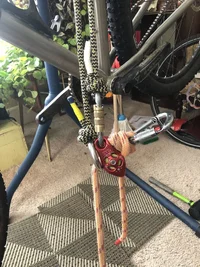
I don’t generally ascend SRS just to switch to MRS. However, we’re all aware of situations where that could be a benefit. Also, considering options that are easily advance able. Not sure I’ve seen others use a jam knot up against a pinto pulley. Also, what do you think about jamming a fisherman’s knot? It looks pretty bombproof to me and changeover to MRS at the anchor couldn’t really be any simpler.
 
Looks fine to me. I think a spliced or stiched eye with the carabiner in it would work fine too. The metal on metal or the carabiner to the pinto might be undesireable, but one could always put a stopper knot in just below the eye. I keep trying to find an excuse to use my spiderjack.
 
I just don't know if I could go swinging around on that setup personally., maybe with a fatty rope..could be safe ,but call me over cautious .... I couldnt do it.. never been a fan of pinto in that configuration
 
I just don't know if I could go swinging around on that setup personally., maybe with a fatty rope..could be safe ,but call me over cautious .... I couldnt do it.. never been a fan of pinto in that configuration

It’s not a setup I would swing around on, basically just for ascent. I would either switch to ddrt or advance the tie in and set a ring-based anchor for working off of.

You don’t like the pinto with a jam knot specifically? Or you don’t like pinto pulleys in canopy anchors? Curious what specifically you mean by “pinto in that configuration.” Is this setup something you’ve seen people using before?
 
It’s not a setup I would swing around on, basically just for ascent. I would either switch to ddrt or advance the tie in and set a ring-based anchor for working off of.

You don’t like the pinto with a jam knot specifically? Or you don’t like pinto pulleys in canopy anchors? Curious what specifically you mean by “pinto in that configuration.” Is this setup something you’ve seen people using before?

Jammed pintos or rings are 100% bomber. Spiked Alpine butterfly (butterfly with a carabiner through the loop) physically cannot go through a reasonably sized ring or pinto.

I've seen guys set canopy anchors that way, except they would use a doubled Fig 8 with both tails exiting through the canopy anchor, giving them a retrievable canopy anchor with 2 separate working ends of line. Some will use 1 rope end as their working line and leave the 2nd standing line as the Access / Emergency line.

Classic Tree Buzz... thanks for the feedback.

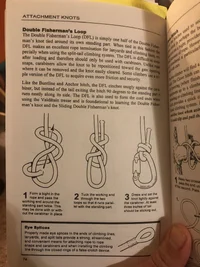
Is this from the Tree Climber's Companion? I don't recognize the particular sketch
 
It sounds like from your description that you are setting this from the ground with a throwline, it seems to me that the pinto could cause issues with that as the throwline could get between the pulley sheave and the cheek plates. I haven't looked at my pinto to see how much space is there, but I'm sure its a possibility. For your use I would use a regular ring and ring friction saver, there's no doubt that a ring can withstand a stopper knot as they are used together frequently and a small ring is smaller than a pinto making it easier to set in a crotch from the ground.
 
It sounds like from your description that you are setting this from the ground with a throwline, it seems to me that the pinto could cause issues with that as the throwline could get between the pulley sheave and the cheek plates. I haven't looked at my pinto to see how much space is there, but I'm sure its a possibility. For your use I would use a regular ring and ring friction saver, there's no doubt that a ring can withstand a stopper knot as they are used together frequently and a small ring is smaller than a pinto making it easier to set in a crotch from the ground.

At least compared to a Buckingham ring and ring, it seems the pinto hole is about the same if maybe a little smaller than the small ring. An XSRE carabiner cannot get stuck in the pinto from any orientation. You make a good point, however, this system would be faster to advance if necessary. As well, I was primarily wondering if a cinching termination knot could also be safe for a jam. If I had no intention of switching to Ddrt or advancing my tie in, I'd select another canopy anchor.
 
Jammed pintos or rings are 100% bomber. Spiked Alpine butterfly (butterfly with a carabiner through the loop) physically cannot go through a reasonably sized ring or pinto.

I've seen guys set canopy anchors that way, except they would use a doubled Fig 8 with both tails exiting through the canopy anchor, giving them a retrievable canopy anchor with 2 separate working ends of line. Some will use 1 rope end as their working line and leave the 2nd standing line as the Access / Emergency line.


Is this from the Tree Climber's Companion? I don't recognize the particular sketch

Yes, that's a page from the Tree Climber's Companion.

I really like that idea of having the jam knot between the rings, thanks for sharing that. I am trying to get more into the habit of having an access line for AR and that sounds like a great method that would be easy to work around. Just have to make sure that the TIP and gear is bomber to support both climbers. "Emergency Access Line Solutions" could be a very worthwhile thread.

About the scaffold knot vs alpine butterfly... AB makes a great jam knot because more pressure from either leg squeezes the knot tighter and a spiked carabiner is only there for backup. However, because the AB is not a cinching knot, it shouldn't technicaly be used to attach a terminating carabiner for a Ddrt system. Hence, why not use a cinching knot as the jam and have that carabiner ready for connection as soon as you reach the TIP. Because the scaffold knot is cinching, it's basically a kind of slip knot. All of the pressure pulling the knot into the jam is directly transferred to the carabiner trapped in the loop. Really, that's no different than a carabiner in a splice, jammed against a ring or pinto. If i have to tie a terminating knot for a Ddrt system, I'll generally go for an anchor-hitch, because it's easier to untie. That's not what I was first drawn to for this system though because it's less bulky than the scaffold knot.
 
Jammed pintos or rings are 100% bomber. Spiked Alpine butterfly (butterfly with a carabiner through the loop) physically cannot go through a reasonably sized ring or pinto.

I dissagree. The knot can indeed pop through the ring at a relatatvely low load. Approximately 1200lb. The ring then jambs on the carabiner untill the rope parts.

In some testing presented at TCI EXPO 2017 we found that the jamb knot configurations to be the weakest. The knot often slipped under less than 1000 lb and the rope parted below the 5000 lb threshold.
These numbers are with Sterling Scion
alpine butterfly jammed on small ring of separate friction saver
Rope failed at knot/bend of ring. 3,835lb / 17.06kN

Sterling HTP 10mm
alpine butterfly jammed on small ring.
Rope failed at knot/bend of ring 4,811 lb/ 21.4 kN

Way better ways to accomplish the canopy anchor task.

Tony
 
Was this information posted somewhere that I missed? Discovered potential hidden failure points, seems important and a good thing to address, once known.
 
I dissagree. The knot can indeed pop through the ring at a relatatvely low load. Approximately 1200lb. The ring then jambs on the carabiner untill the rope parts.

In some testing presented at TCI EXPO 2017 we found that the jamb knot configurations to be the weakest. The knot often slipped under less than 1000 lb and the rope parted below the 5000 lb threshold.
These numbers are with Sterling Scion
alpine butterfly jammed on small ring of separate friction saver
Rope failed at knot/bend of ring. 3,835lb / 17.06kN

Sterling HTP 10mm
alpine butterfly jammed on small ring.
Rope failed at knot/bend of ring 4,811 lb/ 21.4 kN

Way better ways to accomplish the canopy anchor task.

Tony
Ring size?
It is my understanding that the rope we use is to be rated for the strenght it is partly to account for the loss of strenght when knotted. So the 3800 lb breaking point would be acceptable to me.
 
I dissagree. The knot can indeed pop through the ring at a relatatvely low load. Approximately 1200lb. The ring then jambs on the carabiner untill the rope parts.

In some testing presented at TCI EXPO 2017 we found that the jamb knot configurations to be the weakest. The knot often slipped under less than 1000 lb and the rope parted below the 5000 lb threshold.
These numbers are with Sterling Scion
alpine butterfly jammed on small ring of separate friction saver
Rope failed at knot/bend of ring. 3,835lb / 17.06kN

Sterling HTP 10mm
alpine butterfly jammed on small ring.
Rope failed at knot/bend of ring 4,811 lb/ 21.4 kN

Way better ways to accomplish the canopy anchor task.

Tony

Can you show some evidence of these findings?
 
Was this information posted somewhere that I missed? Discovered potential hidden failure points, seems important and a good thing to address, once known.

There was an article in TCI magazine and a presentation at Expo. This is also info we use in training programs and other venues ie lectures, etc.

I am not trying to pass it off as scientific, just putting it out there. It is valid and accurate. There are some pretty big assumptions being made that are just not true.

Every anchor point matters. I am not implying that these anchors have failed. On the test bed yes. In the real world I do not know.

If any reading this consider using an anchor configuration that may be less stout than the line or hardware they are using, he or she needs to ask themselves why and look for some type of bias. It is a poor decision

Tony
 

New threads New posts

Kask Stihl NORTHEASTERN Arborists Wesspur TreeStuff.com Teufelberger Westminster X-Rigging Teufelberger
Back
Top Bottom