Positioning on the cheap

samsquatch

Participating member
Location
SE MN
Hi gang. I spent a while just now searching Google and this site for a positioning lanyard adjuster that I saw that uses a thimble (or was it an xring?) and a prusik - and I can't find it again.

In addition to my climbing line on a proper TIP in the canopy, I'd like to run a positioning line out to natural crotch on a long limb - intention is to start at the ground, climb up my primary line and over on the adjustable lanyard to get me out to the end of the limb.
Few questions for doing this safely and economically: can I get away with non-life support line in the limb positioning crotch?
And does the prusik & xring or thimble or whatever do this economically? Does anyone have pics available of that sort of setup?
I also already have a hitchclimber pulley that I suppose could fit that bill - but in the spirit of being budget conscious I will ignore that.

Thanks for any advice!
 
Never use a non life support rated line as a lanyard. If your primary fails then you will want your backup to be life support rated.

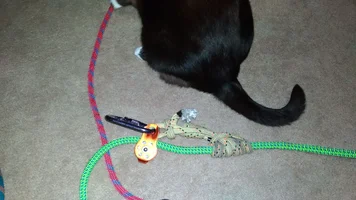
If you pass the rope through a ring and attach a prusik ahead of the ring you can then attach the prusik and the ring to your side D with a single carabiner.
 
Thanks Santiago.

This is called double-crotching, and what I'm trying to determine is: if one of the crotches is life support rated, who here thinks it is necessary that the other is life support rated? I suppose the ultimate danger is when the limb crotch fails, I pendulum-slam into the spar under the primary crotch?

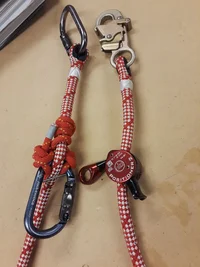
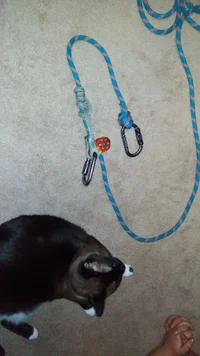
And then, given that I have a reliable ascending/descending mechanical hitch on the primary crotch, I'd like to reduce the costs and implement a simple lanyard adjuster on the limb crotch side. Does anyone have a photo of a clever, cheap, & easy one-handed lanyard adjuster?
 
If your trying to minimize gear, you can use a carabiner to tend your hitch like I did on the tail end of this lanyard. The positioner is my primary use, but the hitch is very smooth as well.

Also bulk cord with stopper knots instead of sewn eyes will also cut down on cost.
 

Attachments

  • 20180208_095524.webp
    20180208_095524.webp
    300.6 KB · Views: 185
Last edited:
I will post some pics later. If you have a ring, a carabiner and hitch cord you have all you need to set it up. I personally would never attach to a system that is not built from rated components. If you do decide to go the non life support route, and I recommend you don't, you won't be able to unhook from your main system to advance it.
 
There are so many light weight and rated pieces of gear that it doesn't make sense to drag any others along. The exception is accessory key chain biners.

If I ever use a second crotch it's either for life support or balance. Using one for balance is in the same arena as one handing a chain saw. (Stop...we're NOT derailing! ). I consider what might happen if the balance setup fails

A second friction setup can be made out of what others suggested. It doesn't have to be as efficient or spends as your primary
 
I will post some pics later. If you have a ring, a carabiner and hitch cord you have all you need to set it up. I personally would never attach to a system that is not built from rated components. If you do decide to go the non life support route, and I recommend you don't, you won't be able to unhook from your main system to advance it.
Good thoughts here, thanks.

You can get these pulleys for about $10 on eBay. The pulley is not used for life support, only hitch tending. You can use a ring instead of the pulley.View attachment 51222 View attachment 51222

The pictures are close to what I'm thinking of. How could one use a ring in that system instead of a pulley? I'm not seeing that yet.
Thanks!
 
Not sure if this adds to it, but there is this available:
http://www.treestuff.com/store/catalog.asp?category_id=223&item=2076
But anything else, I personally use is rated . . .
It is really interesting for me to see the differences between US arb gear development (often no ASTM/ CE/ etc. certifications but hot dawg the stuff works) and European/ UK requirements for CE, etc. rated gear.
In former working lives in chemical plant process safety (HAZOP), we used to say, "If it can happen, it will . . . . "
I am fascinated by the risk "judgements" made in the arb world/ TRAQ and also those that I often see in YouTube videos even by some really experienced folks v.s. the approaches taken in large industry/ SPRAT etc. In actual fact I'd say, you're safer working in a hydrogen plant than in a tree by a lot of what I see . . .
So for me, rated stuff everywhere . . . strangely except the TIP/ tree anchor, as Richard Hattier said.
 
The ring tender is in the tips and tricks thread. As Tom said, there are so many lightweight options that there is no reason to use non rated gear. For a minimalist lanyard you can use 9mm htp and use Teufelberger maxim rated 5mm cord for a hitch. Btw, that can still incorporate the ring if you desire. Many use a simple boat/dog snap as a tender, too, dropping the price even more.

I think an important point is that specialty must exist somewhere in the system. Specialty gear can help many do the work. Minimal gear requires specialty of skill and understanding. I enjoy hardware, and I enjoy getting crafty without hardware. If you’re choosing to approach your work without throwing hardware at a problem (good on you), make sure you’re committed to throwing your mind, study, and skill at it instead. The difference between minimalist and underequipped is commitment. Commit to understanding the situations you will face, understanding exactly what is needed in those situations. If you don’t want your body to do the heavy lifting (with a million trinkets), then your mind has to do the heavy lifting.

Know the limits of your equipment (and knots).

Know the needs you will face during a climb

Know your personal limits in knowledge, physical ability, and experience. The only way to know our limits is to plug in to community with a learning attitude and be willing to change (not easy, but good).

Now I don’t intend any of this to be personal criticism- just a public exposition of my thoughts that have been formed and influenced by working with so many quality arborists who balance incorporating technological advancements and preserving “old school” techniques that truly deserve to be called advanced.

Rainy day ramblings.
 
The ring tender is in the tips and tricks thread.
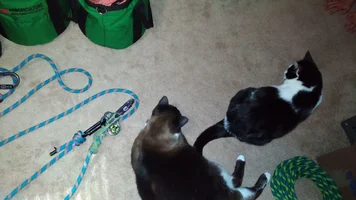
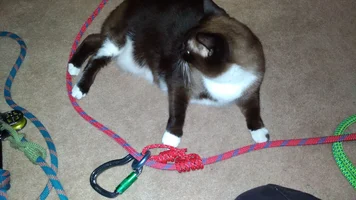
One more- I bought a couple of the tiny x rings a couple years ago, and haven’t really found a good use for them till now. Here’s a lanyard for my rec (read: retired) saddle. I used a length of hitch cord, a biner, and a ring to make the adjuster.
Found it! Thanks!

If you don’t want your body to do the heavy lifting (with a million trinkets), then your mind has to do the heavy lifting.
Exactly my sentiments, but I will also add - even when using the trinkets your mind must be sharp - two items of hardware (while beneficial on their own) when used in conjunction can change the geometry or friction at any particular point, so you must always be mindful!

Knowing my limits is what I do best, and that includes learning from communities such as this! I am the type with an open mind, eager to learn from the experienced, for: "the man whom travels the trails of others arrives with more rations" :)

Cheers
 
Last edited:

New threads New posts

Kask Stihl NORTHEASTERN Arborists Wesspur TreeStuff.com Teufelberger Westminster X-Rigging Teufelberger
Back
Top Bottom