Yikes!!!

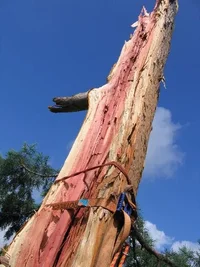
The job we did yesterday was pretty scary... a sequoiadendron that had a history of dropping limbs, lost it's top a couple of years back, right between two buildings was struck by lightning on wednesday. We were supposed to fell it the next day. That same afternoon a gust of wind blew the rest of the top out... we're talking big bits here. The remaining tree must measure a good 20m, the tops it lost another 10m or so.

What phazed me was wondering "would I have climbed to the top to fell the tree?" and have the tree fail underneath me or would I have realised that the tree was structurally seriously damaged and close to failiure. Ho-hum.. we'll never know. Just shows how important it is to really look at the tree before you climb it.

The remaining half stem was still long with a couple of branches up top that I had to get before I could take it down, so I strapped the whole thing up and up I went.

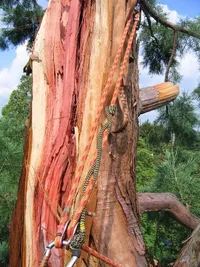
Here's a shot of the base of the damaged part, 20m up...
 

Attachments

  • 26737-IMG_0443.webp
    26737-IMG_0443.webp
    107.2 KB · Views: 300
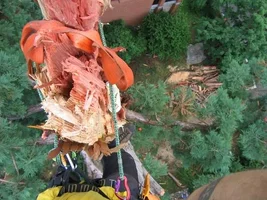
Having put in three straps and deciding the stem so be stable enough to climb - here's a shot from the very top. Yikes! /forum/images/graemlins/crazy.gif
 

Attachments

  • 26739-IMG_0456.webp
    26739-IMG_0456.webp
    75.1 KB · Views: 254
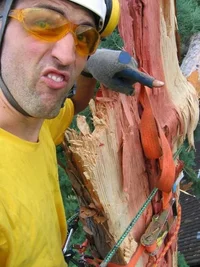
I'll happily admit to sh***ing bricks at this point. Just before lunch and we'd decided to drop the top before making a break.

This shot: "Watch my lips!"
 

Attachments

  • 26740-IMG_0458.webp
    26740-IMG_0458.webp
    59.9 KB · Views: 272
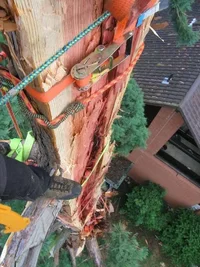
Here you can see just how tight it all was.

You can also see how the stem was strapped up: two straps top and bottom of the bit to be dropped, one under the cut to avoid a barber chair situation.

All went well... I was knackered by the end of the day. Storm damage really is terribly dangerous. The power of lightning strikes I find almost incomprehensible. The wood is literally blown to smithereens... awesome. Not for the tree, mind you.

 

Attachments

  • 26741-IMG_0460.webp
    26741-IMG_0460.webp
    73.4 KB · Views: 264
Man Mark,

That and even less would have made my orange Pfanner turn brown :-0

I bet you were the oldest guy on the team over there at the site.
We have a saying here: finish of the old stuff first /forum/images/graemlins/crazy.gif

Wolter
 
Norm, the spar must have been about 80cm dia, and maybe 8m tall, split in half (the bit that's missing) and the remaining half split again.

I don't really think it's a guts or any other parts of the male anatomy issue. It's about assessing the situation, taking actions to reduce risk and communication in the team. That's what makes it do-able, not deciding to chance it! I think in a situation like this that would not be wise at all.

MB, yes no spurs. I find spurs are a great tool, but for me only when they're absolutely necessary. I find they can be restrictive otherwise, especially in a situation like this, where there's a lot of line up the tree: pull-off line, lowering line, climbing line, three straps... it's a lot of stuff to damage inadvertently with the gaffs! I used the spurs afterwards for optimum positioning to face the piece. If I have sufficient branches or stubs to position myself with as an option to spurs I'll often prefer to use them.
 
Mark, I agree with a risk assesment. The more I learn about tree function,biology and how they work it seems like I am doing more hazardous work now then ever before. I am lucky that on most of our hazardous work I have the chance to assess the tree and site before we go to do the work. That gives me time to come up with a plan and get the right people and equipment.
 
Yup, Tod, that's the way it is. If you're freelancing and don't have the opportunity to see the tree and assess the risk that the job entails, I think it's very important to have a mental escape route layed out. /forum/images/graemlins/vroam.gif

You would use this escape route for instance if you turn up on site for the company that hired you in and you find a tree that's totally shagged and you're supposed to climb it. In this case it might be saying "No" and walking away. Or demanding changes to the planned work method or extra personell or or or...

Often as not jobs can be as dangerous as we make them ourselves. Having said that - like with the job with the lightning damage - there always remains a percentage of residual risk that's impossible to eliminate completely. We're talking risk management here, not 100% risk free. Don't get me wrong: 100% safety is the target but it's hard if not impossible to achieve in inherently chaotic systems such as trees are. There's always an unknown element that's hard to quantify we have to factor into the equation.

In view of this probably the most sensible thing to do is to leave yourself high enough safety margins - in every situation - when working at height.
 
As part of the pre-climb inspection, what about tossing a line up there and shaking the hell out of the tree to see how it moves before deciding to climb it?
 
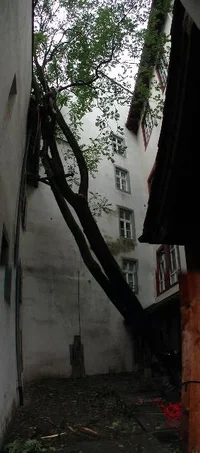
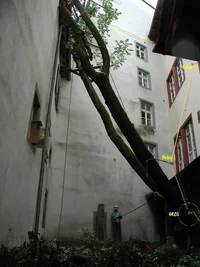
Here's another one that was interesting. A very narrow location in the backyard of a museum in town with an ailanthus grown wild diagonally across the yard, leaning on the wall and the actual crown starting above the roof, adding another 8m or so. The reason for felling the tree was structural damage to the building it was leaning against. On top of that our feeling was that the base of the tree was shot.

Here's a shot of the situation we encountered when we arrived on site.
 

Attachments

  • 26826-museum1.webp
    26826-museum1.webp
    38.7 KB · Views: 162
To reduce the risk for the climber doing the take-down we cranked the whole tree up on itself, i.e. from a point in the top of the tree we had a line running back to a point fixed to a steel girder in the stair well of the museum, then back to a pulley on the stem and then onto the GRCS. With this rig we could winch up the whole tree and increase the safety factor for the climber.

Easy?

Of course. But you have to keep a broad view of the job to spot these potential problems and to implement actions to reduce the risk. You also need a team able to work and communicate in a complex situation such as this was.
 

Attachments

  • 26827-museum-1.webp
    26827-museum-1.webp
    45.3 KB · Views: 150
[ QUOTE ]
As part of the pre-climb inspection, what about tossing a line up there and shaking the hell out of the tree to see how it moves before deciding to climb it?

[/ QUOTE ]

MM, i think a careful climb gives better feeling of the trees stability. When pulling a rope i am afraid that you might pull the tree down or get wood falling. The pull force is very different of the climbing force as that is vertical down the trunk.
 
Once we had the top off and the stem off the building and removed the line to make the final cut at the base of the tree the whole thing keeled over, by the way. /forum/images/graemlins/shocked.gif
 

New threads New posts

Kask Stihl NORTHEASTERN Arborists Wesspur TreeStuff.com Teufelberger Westminster X-Rigging Teufelberger
Back
Top Bottom