What special training is required for the use of small diameter lines?

Winchman

Carpal tunnel level member
I noticed this in the information for some ropes smaller than 1/2" in the Wesspurr online catalog:

drenaLINE 11.8mm meets ANSI Z133-2017 standards, so long as the user has been trained in the use of smaller diameter lines.

I don't have a copy of the standards, and I didn't see anything about the subject in the National Tree Climbing Guide. What is covered in the special training?
 
It doesn't say much that would clarify what that specific training is. 8.2.4 gives standard 1/2" climbing description and specifications with the exception that, "a line of not less than 7/16 inch (11 mm) diameter may be used, provided that the employer can demonstrate it does not create a safety hazard for the arborist and the arborist has been instructed in its use" also "shall meet or exceed the standards for arborist climbing lines and be identified by the manufacturer as suitable for tree climbing"
 
  • Like
Reactions: ATH
These smaller diameter ropes have less surface area, and therefore run much faster and provide less friction when running through climbing devices. I've always taken this faster handling to be what is implied in that standard.

Rock climbing ropes are getting outrageous. Rapelling on a 8.7mm line is quick! You'll see those tiny ropes come with warnings stating they're for experienced users.
 
Rock climbing ropes are getting outrageous. Rapelling on a 8.7mm line is quick! You'll see those tiny ropes come with warnings stating they're for experienced users.
Clearly I’ve been out of the rock world too long, 8.7 is crazy! That’s a string, not a rope! I remember when 11s were the latest, smallest ropes. I’ll bet those little things are quick, probably scary fast!
 
I think there are actually smaller ropes now rated as single lines! (as opposed to twin or double rated lines)

9.5 seems to be the new rock climbing standard, not many 11mm offerings out there these days. Don't even know anyone with a >9.8mm dynamic line.
 
You could use almost anything for hitchcord on the old 12 and 16 braid 1/2” climbing lines including another piece of climbing line and make it grab reliably. Newer smaller diameter ropes and slick tighter braided jackets require much more experience to be able to select cordage and knot that will grab reliably . For example oceans would grab on true blue all day long with some tolerance to conditions or choice of knot, on 11 mil htp or km111 it better be perfect condition and perfect knot and length or after ascent or advance you would sit back and there would be nothing there.
 
That's an excellent point and certainly something to keep in mind. Anything new will get checked out low and slow.

I'm considering the Drenaline as a replacement for the Voyager on my 3:1 if I ever feel the need for new rope. I'm confident it would be compatible with the ZigZag and double-handed ascender I use. It's hard to imagine anything could work better for what I'm doing.
 
Are you doing something different from all the rest of us that are climbing trees with 1:1 or 2:1 systems and only use a 3:1 as a temporary assist in positioning?
 
I have been a professional tree climber for over 50 years and fully understand about becoming old a weak. There is no way in hell I would still be doing this job if I had to use a 3:1 hand and arm strength based system. A 1:1 leg based walker system is as easy as it gets.
 
OK, you fellows are making progress dragging me away from my beloved 3:1.

I was already planning to swap the rope end-for-end, so I decided to change it to a 2:1 instead by getting rid of a pulley and some hardware. There's now a Petzl ball-bearing pulley at the top with the ZigZag at the bottom. I'm still using the two-handed ascender with a footloop.

I set up in the yard tree with a 78' TIP, and made several short climbs to see if I was comfortable with the increased effort and to get familiar with how the ZZ feels with more load. All was good, so I went all the way to the TIP with no problem at all. I even had some strength left over to deal with several dead limbs that were beyond reach with the 3:1. It was a fun climb.

I'm going to stick with this for a while before making the investment in new hardware I need to make the switch to SRT.
 
I got to work with Bob Webber a few years back, he came to do some contract climbing for the company I was working for at the time. Incredibly grateful I got to spend a few days with him.

After he set his line with a crossbow and threaded rods (he changed the weight by adding or subtracting nuts), he pulled his raptor out of his bag and said, "I earned this, damn it!"

And that was at the young age of 66! He also said I'd have to show him about all this new SRT swinging around everyone was doing.
 
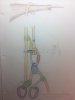
This is a system I came up with awhile ago, I drew it with the friction hitch on the right, which needed to be advanvced, and later realized putting it on the left section of rope, made it self tending.
40E30A07-A0BD-485C-BBF5-7BC27F404227.jpeg
 
OK, you fellows are making progress dragging me away from my beloved 3:1.

I was already planning to swap the rope end-for-end, so I decided to change it to a 2:1 instead by getting rid of a pulley and some hardware. There's now a Petzl ball-bearing pulley at the top with the ZigZag at the bottom. I'm still using the two-handed ascender with a footloop.

I set up in the yard tree with a 78' TIP, and made several short climbs to see if I was comfortable with the increased effort and to get familiar with how the ZZ feels with more load. All was good, so I went all the way to the TIP with no problem at all. I even had some strength left over to deal with several dead limbs that were beyond reach with the 3:1. It was a fun climb.

I'm going to stick with this for a while before making the investment in new hardware I need to make the switch to SRT.
You can make a branch into a rope wrench, the incarnation between a steel box-end wrench and the steel zk1.

people have used the triangular-plate Hinge materials with bolts and a bushing.
 
I got to work with Bob Webber a few years back, he came to do some contract climbing for the company I was working for at the time. Incredibly grateful I got to spend a few days with him.

After he set his line with a crossbow and threaded rods (he changed the weight by adding or subtracting nuts), he pulled his raptor out of his bag and said, "I earned this, damn it!"

And that was at the young age of 66! He also said I'd have to show him about all this new SRT swinging around everyone was doing.
You were priveleged indeed. I've known Bob for over 30 years. There is another gentleman you need to meet some day. His daughter lives where you do so he visits pretty often. We are making plans to travel to Legends together this year. His name is Kris Edson.\, a very good friend of mine and awesome arborist.
 
I'll have to meet him quick, putting on my respirator and relocating to CA end of October.

Bob had a lot of great stories. I love hearing the older generations, arborists, or rock climbers for that matter, talk about their early days (or anything involving helicopters!) Back then I was not the tree climber I am today, and it was inspiring to see someone more than twice my age, and older than my parents, gracefully dismantling huge southern reds. I've also never seen anyone
with a torso-mounted handsaw before or since.

EA624458-3BF3-4174-B85F-DDF38F1EC1F0.jpeg
Oh man don't miss my Ecrin Rock.

Winchman, sorry for the derail. Another thought I had regarding skinny ropes: they are great for crane work where it's almost all descent, and the rope gets pulled and stuffed back in the bag many times throughout the day- a lot lighter and fits better in the bag.
 

New threads New posts

Back
Top Bottom