Tying climb lines together

I'm curious if a heavy item would cut into your pulling power. No evidence to back it up, but I'd imagine a weight in the middle of the span would be similar to someone sweating the line. Therefore actually increasing the pull. By very little, I'm sure.
I don't know. As thought experiments go, I like to take things to their extremes to really test a concept. If I'm pulling a rope horizontally along the ground and I lay a thousand pound weight on the rope, I will lose all ability to pull harder, and my current amount of pull will be effectively "captured", assuming that the heavy weight keeps the rope locked in place, pinched on the ground, unable to slide one way or the other.

Another way to think about it is what if the rope itself was very, very heavy. Like tensioning a length of line that weighed 100 lbs vs. a length that weighed 5 lbs. Its going to take a lot more pulling power to tension up the heavier rope.

Not trying to derail this thread at all. Also, I have always liked the Zeppelin Bend for joining lines.....
 
Of course if you mean applying the weight *after* the rope is already full tensioned, then yes I agree, it would slightly increase the pull..........
 
Of course if you mean applying the weight *after* the rope is already full tensioned, then yes I agree, it would slightly increase the pull..........
I tend to add the weight after at least enough tension to get the line off of the ground.

Interesting thought process on the 1000lb weight. I'm not sure I know the answer.
 
Am always trying to show the geometry view.
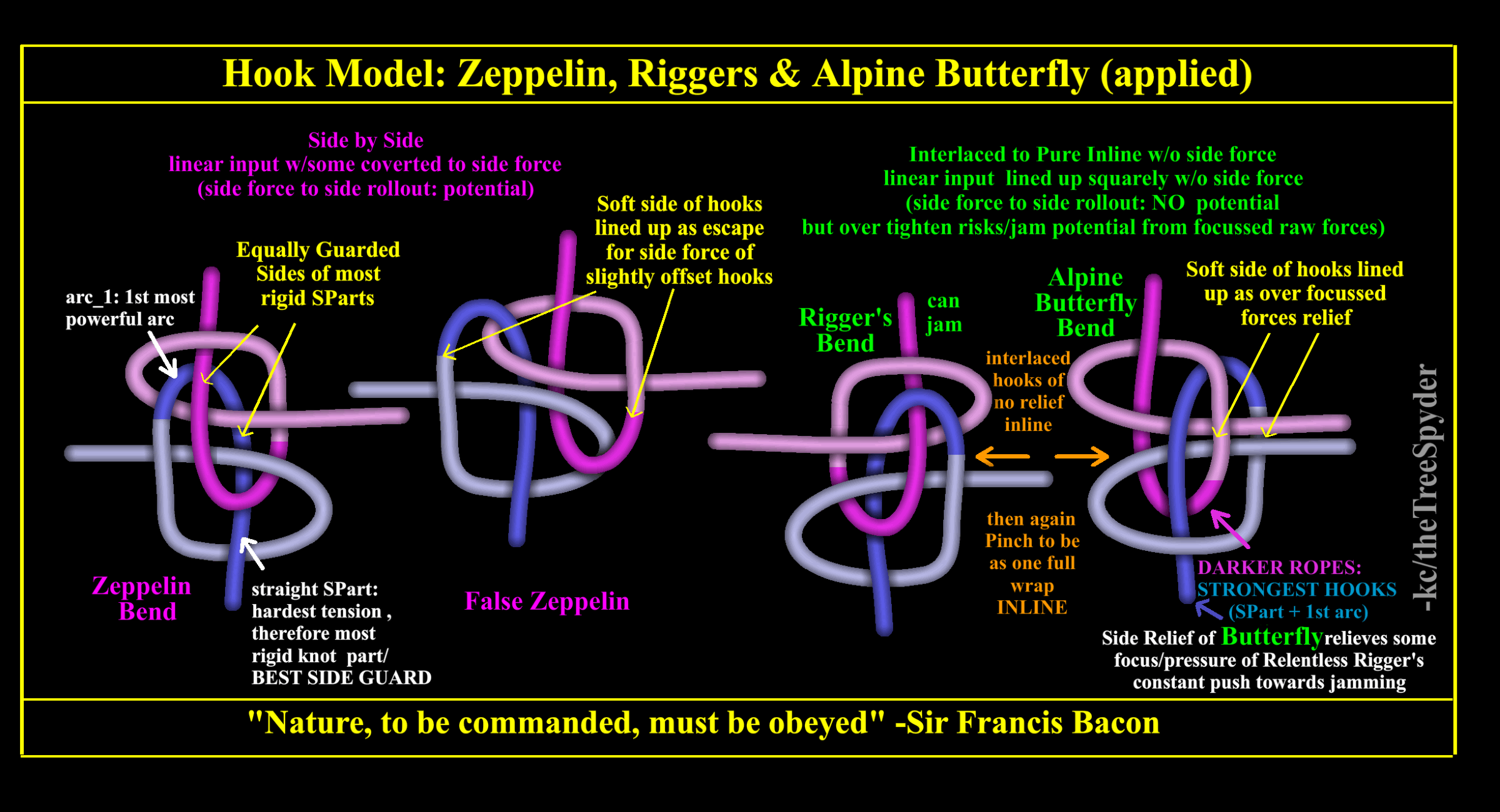
Here this is shown in the Overhand of own self to me is a 90degree device, horrendous therefore if wrenched hard to it's worst axis 90degrees more to make straight line with Overhand in it. Rope as loaded onto a great ship and formed, but in loaded use a line(of force I think is implied). Around another host can further see output Bitter End (BE)90 degrees from input Standing Part(SPart), unless purposefully wrench BE flat opposite SPart to a Half Knot by capitalizing on host as structure to do so in contrast to wrenching Overhand flat w/only own self as host.
.
But, Overhand is more friendly then in a doubled input90/output90 halves to make a loaded line line of force instead using each other as host to be more like Half Knot geometry. We see this pattern achieved in EDK, Bfly, Zeppelin, Rigger's, using each other as non self host.
.
Rigger's in my imagery over concentrates/like overly purely aligned relentless high force w/o 'fault'/relief to most likely of set to jam. By contrast false Zepp gives double relief fault to most likely to fail. i try to show Bfly, Zepp, False Zepp and Rigger's models.
.
Hook-model-zeppelin-riggers-alpine-butterfly-applied.png

i look for a hook as input to any Hitch/termination node interruption in a line of force, and then dual sided hook input and hook output as continuance node /Bend. These 4 similar forms exemplify to me in both their similarities and then too their defining contrasts as well as to these theories.
.
i think these models are the most raw, deep, pivotal considerations in design, to then be followed in making individual specimens , as the best workmanship points to groom to. To extrude/evaluate the best value from the material as any artisan working any other material. There are rules that must be followed especially as a high loaded beyond nominal self structure, but then one that also is non rigid so can get more byproducts that give control like friction, nip and grip without added tools like rigids.
 
Last edited:
Gotcha. Want to use something heavy enough to do the job but not so heavy that it cuts into your pulling power

This will not actually decrease the tension applied to the object/tree being pulled or take away “pulling power”. If you put a weight midline on a rope, it creates 2 vector forces and each side will have amplification, depending on the angle (at 120 degrees is where all tension is equal) For a simple example, if you had a taut rope between a rigging point and a tree and applied force in between the puller and the tree, whatever the vector magnification is of that weight, it will be applied to both sides of the rope equally. Now, that would change some based on the height difference between the two attachment points, but it isn’t going to be the pulling power minus the weight added.


-Pierce V


Sent from my iPhone using Tapatalk
 
I’m about to derail this a little bit hopefully we can still stay close to the op question.
Scenario: you are pulling a tree with your masdam rope puller and you don’t want to attach the 3 strand directly to the tree and have installed a dedicated “get smashed rope”. Now you need to connect it (midline on the smash rope) to the end of your 3 strand. What knot would you use?
In those instances where I can keep a more or less constant tension on the bend I use a carrick. Holds fast as long as you don't slack it and it's ridiculously easy to break no matter how much tension you apply. Never tried it w/dissimilar diameters, or diss. types of rope. I'll have to look up a Zep bend - don't think know that one
 
I’m about to derail this a little bit hopefully we can still stay close to the op question.
Scenario: you are pulling a tree with your masdam rope puller and you don’t want to attach the 3 strand directly to the tree and have installed a dedicated “get smashed rope”. Now you need to connect it (midline on the smash rope) to the end of your 3 strand. What knot would you use?
I’d likely tie a bowline in the junk rope and use a doubled cats paw to attach the three strand to the loop.

For climbing a backed up sheet bend or fig 8 follow through. With a sheet bend I make long tails and tie together with double fisherman’s. With a fig 8 same backup but obviously slightly different.
 
Last edited:
Scenario: you are pulling a tree with your masdam rope puller and you don’t want to attach the 3 strand directly to the tree and have installed a dedicated “get smashed rope”. Now you need to connect it (midline on the smash rope) to the end of your 3 strand. What knot would you use?
This is how I've always run my Maasdam, I have 25 ft of 3 strand on it, with an eye splice in the end. I attach to the pull line with a biner and prusik cord off the eye splice.
 
We usually run our Masdaam with a 50 ft short line through the pulley and tie onto a drop line in the tree. In most cases I will tie a sheet bend and back it up with a half hitch on the three strand side. We are usually tying into our drop line midline and a zeplin bend is not really practical. I have not had this slip.

If we are going to do a more intense pull, I might upscale the knot. But if we are using the Masdaam we are doing something comparatively lighter anyway.

Back to the original post. For climb lines I have generally preferred joining them with a zeplin bend. For obvious reasons, this only really works with SRT, and usually only use this knot with a base anchor. If my line is too short and I am on DDRT, I just recrotch but this makes me a little uncomfortable. I don’t want to have to recrotch in an emergency to reach the ground, so I generally avoid it. And if my SRT line is canopy anchored, I will short tail my retrieval leg and just tie on an extension to the retrieval leg with a sheet bend as it is non life support. When I climb in white pines, I generally canopy anchor over base anchor due to the poppy nature of pines and the extra forces of a base anchor. So adding length is more on the retrieval side and I usually just tie a sheet bend.
 
Last edited:

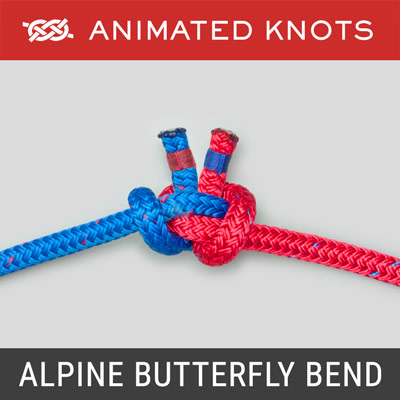
Ok that is a cool knot. I probably will keep tying a Zeppelin just because it is familiar.


Sent from my iPhone using Tapatalk
 
Hello 'TheTreeSpyder',

RE: Your post #25

Your image of a 'Riggers bend' is incorrect - thats not a Riggers bend.

However, it is an interesting structure that I am right now investigating....might be worth your while posting on the IGKT forum to see if its an original creation of if its already been tied. It has a geometry that borrows 50% from the Zeppelin bend and 50% from the true Riggers bend. It looks like it might be jam resistant - testing is required to fully determine to what extent.
 
I like the ring idea- keeps a carabiner gate out of the equation. keeping them all in the arsenal, thanks everyone
 

New threads New posts

Kask Stihl NORTHEASTERN Arborists Wesspur TreeStuff.com Teufelberger Westminster X-Rigging Teufelberger
Back
Top Bottom