Troubled limbs

BRT

Participating member
Location
VA
Good evening. This is my first post, but I've been reading on this forum for some time. I've learned a lot from many of your posts.

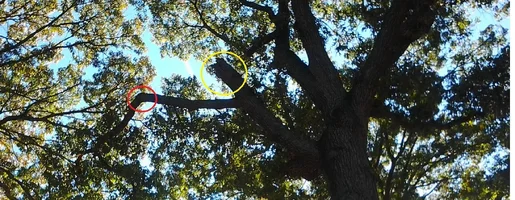
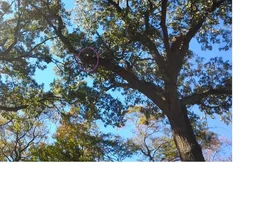
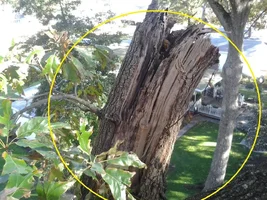
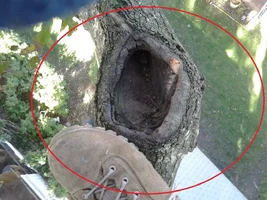
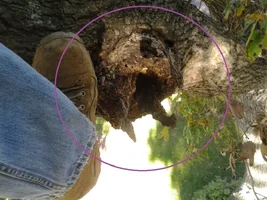
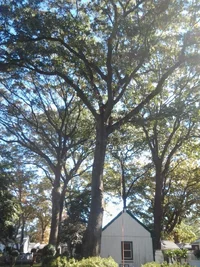
I have a strategy in mind for the limbs in question, but I would like to get some of your opinions. A customer has a large red oak which dropped a limb several months ago. She said the torn section that landed contained carpenter ants (pic of tear in the tree will follow, circled yellow). The smaller limb attached at that fork has a decayed hollow on top at the elbow (circled red). On another large limb, there is decay; most likely where a smaller limb detached (circled purple). I'm not sure how deep it goes, but I plan on probing it later this week.

I took a few dead limbs out of the canopy, but the overall condition of the tree is excellent. The canopy, trunk, foliage, bark, and balance are all healthy. No carpenter ants to be found at any of the troubled areas. Underneath these troubled limbs are the homeowner's shed, and the neighbor's utility building. Removal of these limbs would leave some pretty big wounds. Penny for your thoughts.
 

Attachments

  • 376032-redoak.webp
    376032-redoak.webp
    267.7 KB · Views: 115
No circles, this tree is fine
wink.gif
 
Re: Troubled limbs (cont.)

broken
 

Attachments

  • 376035-brokenlimb.webp
    376035-brokenlimb.webp
    379.8 KB · Views: 104
Re: Troubled limbs (cont.)

decay
 

Attachments

  • 376036-decay.webp
    376036-decay.webp
    216.5 KB · Views: 91
Re: Troubled limbs (cont.)

yellow
 

Attachments

  • 376037-yellow.webp
    376037-yellow.webp
    217 KB · Views: 73
Re: Troubled limbs (cont.)

red
 

Attachments

  • 376038-red.webp
    376038-red.webp
    164.8 KB · Views: 72
Re: Troubled limbs (cont.)

purple
 

Attachments

  • 376039-purple.webp
    376039-purple.webp
    168.4 KB · Views: 88
Off to the left of the tear (in decay pic). Discovered it after climbing up there. To me it looks like it has the potential to create the next tear, ie. limb through the sheds.
 
I'd systems cut off the yellow stub, reduce the red limb to reduce rotational load. But purple makes me nervous, probably should go.
Disclaimer; I know nothing about trees
confused.gif
 
Thanks for the thoughts BW. What do you think about doing some serious load reduction to purple, and then monitoring every few years? Would cost the customer a bit more in the long run, but may reduce the chances of introducing bugs and crud to the trunk, or sudden death due to major amputation.
 
The large patch of bark ( sized by you foot) missing and the dead shoot protruding from it would have me seriously wondering what's going on when shoots near by seem +\- normal.
 
Thanks for the thoughts BW. Hopefully the probe will tell more of what's going on inside. But, like you suggest, if the problem is too deep, it will have to come off for the safety of people and structures.
 
YOu can reduce the load on the weak part of the limb by doing reduction cuts. Are you familiar with crown reductions? It doesn't take a lot of length reduction to reduce the load.
 
Thanks Tom: Yes, familiar with reduction--No need to take a great deal of length from the limb, just selectively pruning from its entirety.

If I go that route, I will need to let the customer know that it will need ongoing monitoring. Increased cost in time/ money, but it may be best for the tree.

The customer is really attached to it. She said she cried when another red oak was removed from the same back yard a few years ago.
 
if you prune out the torn piece reduce the crown of the limb for load and sail that will have the most affect. If the rotten spot still makes you nervous measure it and probe it, in detail right it down and keep it on file and recommend annual checkups.

Also an option because of the targets use cables to guy up the tip of the limb so in can't deflect to low. You could also put a guy to the limb just past the rot or from just past to just before incase it fails, but if it's bad enough for the butt cable I'd remove the limb.
Unless you remove it I do usually recommend check ups every year or 2 to be safe, it helps cover your butt.
 
Thanks Kevin. Fail-safes might be a good idea. I'm definitely with you on the regular monitoring.
 
[ QUOTE ]
Thanks Kevin. Fail-safes might be a good idea. I'm definitely with you on the regular monitoring.

[/ QUOTE ]

Yeah the monitoring is when the learning happens. Trees are so dynamic, they can only be truly assessed over time.

"Disclaimer; I know nothing about trees"

Me neither; I'm just guessing.
ooo.gif
 
The limb that failed was growing into the open aka overextended. Should have been reduced as normal mtc.

"-No need to take a great deal of length from the limb, just selectively pruning from its entirety."

Yes from the outside in. 15% off the end can take off 50% of the load-Goodfellow.

"If I go that route, I will need to let the customer know that it will need ongoing monitoring. Increased cost in time/ money, but it may be best for the tree. "

re increase in cost, it's a helluva lot chapter than removal, even without accounting for lost tree value. but yeah monitoring every 9 months would be good, aerial every 18(?)

"The customer is really attached to it. She said she cried when another red oak was removed from the same back yard a few years ago. "

Did she cry when all those lower limbs were removed, increasing load and risk in the remaining limbs? Overraising is bad for any tree. Plus, the removal of that one red oak increased the load on all the others.

O and on that purple canker, if the probe finds depth that is one datum, but quality of response growth is more significant.
 

New threads New posts

Kask Stihl NORTHEASTERN Arborists Wesspur TreeStuff.com Teufelberger Westminster X-Rigging Teufelberger
Back
Top Bottom