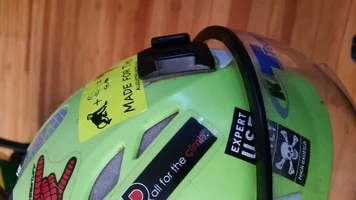
Without the visor present, I like the position of top center of the forehead, looking down a bit. Keep the attachments to a minimum, or none at all besides the clip that holds it into the curved mount. When you start adding extensions or articulating arms to the setup, it invariably gets bumped out of position, and you end up with useless footage.
Don't ask me how I know this.
The position of center of forehead, looking down a little, will show what your hands are doing, and what your climbing setup looks like. You can tilt your head back to show a wider, higher view, when you feel the need.
I do not have a good answer to your question if you feel you must keep the front of the helmet clear for the future arrival of the visor. It means you'll have to anticipate the entire arc of motion of the visor, and put the mount in an area that does not interfere. This might require the use of the articulating arms I was warning you against, in order to just see beyond the curve of the helmet. Maybe you'll figure out a way to fabricate something stiffer, that won't get knocked about by branches.
Good luck with your new camera, and I hope you have fun with it. The really hard part for me, and something I have not yet learned how to do adequately, is the editing of video. It is another whole skill set.
Tim