- Location
- healdsburg, CA
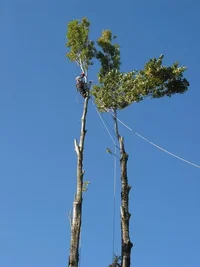
Worked out a large dead rotten valley oak Quercus lobata the other day.
I set a speed line (SL) 3/4" attached to the main stem pretty high and attached the end to a capstan attached to a pickup on the road below and to the side.
The branches ubove the SL and the branches all around the SL (pretty wide canopy) were all far away from the SL. Some of the branches had to be winched up and away from the trees below.
My problem with the SL was all the branches had to be either dropped down and lowered to be within reach of the SL or had to be winched around the tree and up to the SL.
I need some sort of trick to raise branches up to or down to the SL and then lock them off so they can then be released to slide down the SL. I thought of a fiddle block or just buy another GRCS capstan ($)
Any tricks or techniques you all could share?
Thanks
Frans
I set a speed line (SL) 3/4" attached to the main stem pretty high and attached the end to a capstan attached to a pickup on the road below and to the side.
The branches ubove the SL and the branches all around the SL (pretty wide canopy) were all far away from the SL. Some of the branches had to be winched up and away from the trees below.
My problem with the SL was all the branches had to be either dropped down and lowered to be within reach of the SL or had to be winched around the tree and up to the SL.
I need some sort of trick to raise branches up to or down to the SL and then lock them off so they can then be released to slide down the SL. I thought of a fiddle block or just buy another GRCS capstan ($)
Any tricks or techniques you all could share?
Thanks
Frans