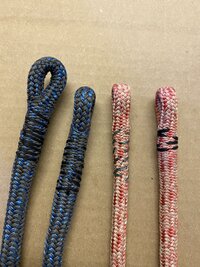
Round stitching question.

I've begun experimenting with sewn eyes and have decided to use the info from Practical Sailor as a starting point. However, for some reason I don't quite fully understand "round stitching" as described and pictured in the article https://www.practical-sailor.com/sails-rigging-deckgear/stitching-instead-of-splicing

I sewed one test eye but I just don't understand the part about starting on one side at the throat of the splice and work towards the bitter end, then stitch up the other side and work towards the throat. Now my first attempt I started at the throat but by the time I reached the bitter end my stitches visually looked like the examples I can find yet I only stitched from the throat to the bitter end and not back up to the throat. Please help me see what I'm missing here. Since none of the example pics of round stitching show an "X" pattern or any crossing of stitches I am confused as to how you can stitch down and then back up without crossing. Does the second pass of stitches fit in between the first pass? I'm half Polish and all out of ideas!
 
So you used round stitching instead of lock stitching after a Class I or II splice--was a there a technical reason beyond personal preference?

How did you terminate the stitches so as to avoid them loosening with use?
 
I think I figured out what I was doing wrong. If you form an eye and lay the rope flat on a table I was running the needle North to South but once I ran it West to East I could see that I would be able to "stitch down towards the bitter end and then stitch up towards the throat of the eye". Plus, once I corrected my technique I could see the zigzag stitching that the Practical Sailor article alluded to. I did make and test one "dogbone" using my wrong technique and the stitches were very, very strong and didn't distort visibly. This sewing is pretty simple once you have the stitch mechanics straight in your head--still gonna' be a long while before I sew anything for life support.
 
I think I figured out what I was doing wrong. If you form an eye and lay the rope flat on a table I was running the needle North to South but once I ran it West to East I could see that I would be able to "stitch down towards the bitter end and then stitch up towards the throat of the eye". Plus, once I corrected my technique I could see the zigzag stitching that the Practical Sailor article alluded to. I did make and test one "dogbone" using my wrong technique and the stitches were very, very strong and didn't distort visibly. This sewing is pretty simple once you have the stitch mechanics straight in your head--still gonna' be a long while before I sew anything for life support.
I have been using the saddle stitch with two needles to make sewn eyes on climbing line and eye to eyes following the Moss method with three passes. I have tested the sewn eyes using my skidder winch on my tractor? The rope has broken every time and not the sewn eye?
 
I bring both ends together, tie an overhand, and bury it.
I've been bringing both ends together, tying a square knot, and then trying to bury the ends and knot. The knot usually doesn't bury very well. I think it's because the two ends don't come out of exactly the same spot. Maybe if I'm more finicky about that I can get the knot to disappear. When the knot's exposed a bit, it seems like it could possibly (hasn't happened yet) catch and start to pull the buried ends out. It would probably be better if I can pull the knot completely below the surface of the cover.
 
The second end should exit out of the same opening as the first, and both in the intersection of four strands. Tie the two together a little above the rope so the knot can go inside a little to get fully buried.
 

New threads New posts

Kask Stihl NORTHEASTERN Arborists Wesspur TreeStuff.com Teufelberger Westminster X-Rigging Teufelberger
Back
Top Bottom