Pulldowns on lanyards

moss

Been here much more than a while
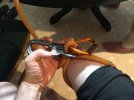
I use lanyards in SRS mode for positioning quite a bit, gives me exact no slip positioning when I want that. Every once in a while I want remote removal getting out of a tight spot, do it like so....


51215374571_57dd3b5c32_c.jpg

Cover strength Dyneema eye with rated micro-biner stopper/remote retrieval

51207420630_05fab323e9_c.jpg

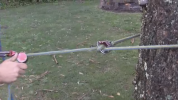
Using a choked lanyard to do a stable bailout off the top of a leaner, remote retrieval was very helpful.
-AJ
 
Choked, non-vibranium 'biner....you gon' die, boiiiiiii!!!!!!!!!!!!!!!!!!!!!!!!!!!!!!!
I assume you're implying that the choking biner should be made out of unobtanium (what he's got isn't beefy enough for a little side-loading). I've felt uncomfortable when using an aluminum biner for choking configs unless the stem is big enough that the pull is more aligned with the axis of the biner. Am I right to feel that way? I prefer something made out of steel that won't break from a strong side-load.
 
I assume you're implying that the choking biner should be made out of unobtanium (what he's got isn't beefy enough for a little side-loading). I've felt uncomfortable when using an aluminum biner for choking configs unless the stem is big enough that the pull is more aligned with the axis of the biner. Am I right to feel that way? I prefer something made out of steel that won't break from a strong side-load.
I'm mostly just joking, because I know @moss has probably only addressed side-loading biners about 10k times, over the past years xD At this point, I think everyone knows it's against mfg's recommendations, it places non-ideal loading on the carabiner, and there's been at least one vid of a break test videoed, showing a branch breaking prior to the aluminum carabiner (whether it's meaningful or not is up for debate).

I employ long lanyards in this mode a lot- tree diameter at the point of choking is mainly what determines how comfortable I 'feel' about it, exactly as you've said. I keep at least one quickie, usually a Pinto, and have enough knot knowledge at hand to have several options if I think the aforementioned method is questionable.
 
Yeah I'd rather have steel also...but moss I'm sure also has his climbing line. So all he's weight may not be on the lanyard. I'd do it.

It uses alot of your lanyard. But I usually throw my lanyard around a limb. Have it down easy to reach then just throw a couple wraps on the carabiner. Just uses alot of your lanyard which is sometimes nice and sometimes not so much when you need that extra ft.
 
I use lanyards in SRS mode for positioning quite a bit, gives me exact no slip positioning when I want that. Every once in a while I want remote removal getting out of a tight spot, do it like so....


51215374571_57dd3b5c32_c.jpg

Cover strength Dyneema eye with rated micro-biner stopper/remote retrieval

51207420630_05fab323e9_c.jpg

Using a choked lanyard to do a stable bailout off the top of a leaner, remote retrieval was very helpful.
-AJ
That is a good idea I like it. Curious how fast it would use up your lanyard though. How high was that limb you choked on from your work position?
 
...btw - good idea for retrieval, @moss; very trim. Question though: are you using this arrangement in a situation where anchoring at the desired point requires a choke? I'm asking because otherwise - unless a choke was required - you could just use the typical MRS lanyard configuration and not be any worse for wear on length of line required, correct? Retrieval with a choked config still requires a length of lanyard 2x the distance to the anchor point.

When I use a choking config, I usually do it because I need more length than my lanyard would otherwise allow, so I end up going back for retrieval.

The following, using an Eashook Open's eye, is what I end up doing for the sake of expediency, sometimes. Namely, treating the eye of the Eashook as if it's a ring. As you can imagine, rope doesn't exactly slide through there like a normal choking configuration would allow, so it's mainly a problem of adjusting the length the cinch to being about the size of the stem being choked.

95108723_10107253824709049_7789460869661851648_o.jpg
 
Choked, non-vibranium 'biner....you gon' die, boiiiiiii!!!!!!!!!!!!!!!!!!!!!!!!!!!!!!!
I learned this from the ART positioner promo video, take another loop of the rope in the biner and it dramatically reduces crossloading. I wouldn’t do this for a primary TIP but it works great for those lanyard-as-a-choked-SRT kind of days.

The video for that is here- they pull that out at 2:30

I dig the method, Moss, you one of those long lanyard climbers? I’ve kept mine short which disqualifies this. Was blaking off my tail today!
 

Attachments

  • 32BBAD49-8A46-453E-80A5-64829D47C6CF.png
    32BBAD49-8A46-453E-80A5-64829D47C6CF.png
    441.5 KB · Views: 34
Last edited:
I learned this from the ART positioner promo video, take another loop of the rope in the biner and it dramatically reduces crossloading. I wouldn’t do this for a primary TIP but it works great for those lanyard-as-a-choked-SRT kind of days.

The video for that is here- they pull that out at 2:30

I dig the method, Moss, you one of those long lanyard climbers? I’ve kept mine short which disqualifies this. Was blaking off my tail today!
Yeah that's what I do
 
Yeah, choke required, positioning aid not primary life support. The carabiner will never ever break in this use. Lanyard is 18’ so this arrangement gives me 9’ of movement which is more than I needed in the situation to make the move onto my primary system.

In this configuration gate always opposite the direction of load, position the carabiner rotationally in the choke for optimal loading on the spine.
-AJ
 
Worth noting that if you severely crossload the spine on an alloy carabiner it does not “shatter” it bends. If it keeps bending the gate pops first. In more extreme bending scenarios say against a hard corner the alloy starts to split and break. If you somehow bent the spine say .5 degrees in a limb choke the gate would no longer function. If your gate is otherwise well functioning but ceases to lock in to the nose that’s a great inspection indicator that you’ve bent the spine some small amount and the carabiner should be retired.
-AJ
 
I learned this from the ART positioner promo video, take another loop of the rope in the biner and it dramatically reduces crossloading. I wouldn’t do this for a primary TIP but it works great for those lanyard-as-a-choked-SRT kind of days.

The video for that is here- they pull that out at 2:30

I dig the method, Moss, you one of those long lanyard climbers? I’ve kept mine short which disqualifies this. Was blaking off my tail today!

Remeasured the lanyard, 15’, so not really a long lanyard, it was a little longer (with the double eye carabiner and ring combo in the end) but I nicked it good with my hand saw and reduced the length further. I do use my lanyard a lot off my bridge whether for positioning or advancing, D’s are more for takedowns or positioning when it’s the best option.
-AJ

 
Here’s one yesterday, releasing a hung limb and cleaning up the ragged stub on a multi leader birch (big limb tear out from another tree smacked the birch). The choke gave me strong positioning for the task, my lanyard choke is above the cutting area which is a nice safety aspect.
Then ease myself back to vertical hang on my primary system.
A double or triple wrap (for very small diameter wood) before choking significantly reduces loading on the carabiner but is not remotely releasable if you want that function. Most of the time I’m not implementing a remote release choked lanyard but it comes in handy when I do.
-AJ
 
Last edited:
I assume you're implying that the choking biner should be made out of unobtanium (what he's got isn't beefy enough for a little side-loading). I've felt uncomfortable when using an aluminum biner for choking configs unless the stem is big enough that the pull is more aligned with the axis of the biner. Am I right to feel that way? I prefer something made out of steel that won't break from a strong side-load.
See my comments above in regard to how alloy auto locker carabiners break along the spine. Just for grins try taking an old carabiner, clamp it in a heavy vise and bang it to 90 degrees bending it at the middle of the spine, it’s pretty interesting to see how it fails at different points along the way.
-AJ
 
I would think that the worst that would happen is it bends ever so slightly but just enough that you can't open the gate.
 
That is a good idea I like it. Curious how fast it would use up your lanyard though. How high was that limb you choked on from your work position?
It's only for short moves where you want to back out of a work position and then retrieve the choke. If there's a union available I just put the tail of my main rope through it and back out with my hand on the tail. There was no union to work with in this situation.

My main rope was basal anchored and through a union at about 50', the attached limb tearout was on a smaller leader at about 35', I swung over, grabbed on, installed the choked lanyard and took the hung limb out (that was a few steps), then lowered back on the choked lanyard to the main leader to a vertical plumbob hang and remotely released the lanyard choke.

Nothing earthshaking here, these are minor conveniences that can make your work go smoother and keep your body happier in the long run.

Here's the sequence:
https://www.flickr.com/photos/naturejournal/albums/72157719379120375/
-AJ
 
I'm mostly just joking, because I know @moss has probably only addressed side-loading biners about 10k times, over the past years xD At this point, I think everyone knows it's against mfg's recommendations, it places non-ideal loading on the carabiner, and there's been at least one vid of a break test videoed, showing a branch breaking prior to the aluminum carabiner (whether it's meaningful or not is up for debate).

I employ long lanyards in this mode a lot- tree diameter at the point of choking is mainly what determines how comfortable I 'feel' about it, exactly as you've said. I keep at least one quickie, usually a Pinto, and have enough knot knowledge at hand to have several options if I think the aforementioned method is questionable.

Ha, yes I'm a broken record. The test you refer to was performed by Georgio Fiori in Italy and was stopped because the entire tree was coming over. The carabiner used in the choke was tested after for functionality and the autolocking gate operated perfectly demonstrating that no deformation of the spine occurred. It's been a while but I think the load cell readout they had on the MA pull line was up in the 4600 lbs range. Please correct me if someone knows better but suffice to say the load was much much higher than what a climber body puts on a positioning choke.

I'm not against manufacturer recommendations but skilled tree climbers need to understand what's going on with their gear configurations no matter what they are and make smart decisions based on facts.

I also understand that climbers working in specific legal rules-based context have to operate within manufacturer recommendations. Luckily some of us have the freedom to legally or otherwise operate in trees based on our well researched and experiential knowledge. It's a great opportunity to push tree climbing technique forward and find useful improvements when we can.
-AJ
 
Last edited:
Thanks for sharing this “trick” and the discussion involved here. I feel completely comfortable side loading in this situation because everything that could be happening with the carabiner is close and visible. SRT lanyard configuration is fantastic for lateral movement when you are getting level or above your main TIP. Also helpful to use your foot ascender on the tail of your lanyard in this situation for balance when there isn’t a good foot hold and/or a webbing strap will be too high or doesn’t have a good placement.
 
Thanks for sharing this “trick” and the discussion involved here. I feel completely comfortable side loading in this situation because everything that could be happening with the carabiner is close and visible. SRT lanyard configuration is fantastic for lateral movement when you are getting level or above your main TIP. Also helpful to use your foot ascender on the tail of your lanyard in this situation for balance when there isn’t a good foot hold and/or a webbing strap will be too high or doesn’t have a good placement.
Yep, I constantly use my foot ascender on my lanyard tail to stand on. Thx!
-AJ
 
In an extreme situation of awkwardness I've actually stood a foot on my SRT line, with my foot side/angled braced against part of the tree. The side pull at my bridge was forgivable in favour of putting some of the load to my foot and leg and more stability.

Good stuff as always Moss.
 

New threads New posts

Kask Stihl NORTHEASTERN Arborists Wesspur TreeStuff.com Teufelberger Westminster X-Rigging Teufelberger
Back
Top Bottom