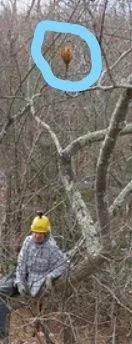
It is sad that you literally need to hide.
imagine an accident occurred and you needed help. There’s an argument to be made that high viz even when rec climbing is extremely helpful in that situation.
I climb in the woods because that's where I want to be, not to hide.
There's liability around everything so any town, city, county etc. "manager" is worried about an injury lawsuit. If they have doubt and ask their legal department's advice, the answer 99.9% of the time is no-go. Doesn't matter how safe we know the activity is. The reaction of the town employee encountering a person in a park tree is often simple fear. In their mind they put themselves up in the tree and think "Wow, this is highly risky!" If you're lucky you encounter a chill town/city/county/state etc. employee with a balanced understanding that humans are engaging in semi-risky activities on a constant daily basis and this tree climbing activity seems pretty reasonable and healthy (fresh air, exercise, interaction with nature) in the scheme of things.
As far as rec climbing accident potential goes, a lot of us climb solo when we're rec climbing. I wouldn't be a climber if I hadn't gone out into the woods and learned to climb solo. I was reading everything I could on the techniques and talking to people on tree climbing forums and in my first year of climbing decided to go visit Peter Jenkins/TCI in Atlanta and take his basic tree climber course. After the course I had a safety protocol for my climbing and a good understanding of basic tree climbing techniques but I still had a LOT to learn about being in trees on rope.
I had some arborist friends who were flat out: "Never climb alone!", and... "Tree climbing is dangerous, get in and out of the tree as quickly as possible!". Their perspective was legit from a tree work point of view. Running chainsaws or handsaws, rigging or throwing down wood, takes a lot of skill and experience (obviously) to narrow risk to the minimum possible and get to go home in one piece at the end of every day. Rec tree climbing is a very different animal, the climber gets to assess and choose the tree they climb. There's no time pressure to "Get it done!!!" except for "Yeah, I want to be home for dinner". My goal rec climbing is to stay in the canopy as long as I can. Taking a canopy hammock nap is an option. Just chilling in a light breeze at the top of a fine tree is nice way to be living. Climbing solo sharpens focus. It's like talking a hike in the woods alone, you tend to focus more on where you put your feet and you're not counting on anyone to drag you out of the woods if you twist your ankle or worse.
What I've always practiced and what I tell new climbers about solo climbing is: "Stay within your skill set, think every move through before you do it, understand the risk when you're making decisions." and at the same time try new things, push on the edges of your limitations, read and research, talk to other climbers when you can and debrief when weird things happen on a climb, get another perspective to fully understand why something went wonky during a climb.
Most humans are amazing at understanding where the edges of danger are and when to push at those edges and when not to.
This is probably a little controversial for work climbers (which I am also): I don't carry a hand saw on my harness when I'm rec climbing on public land. I'll have it in my pack on the ground, it has come in handy for many things. Hell if you get stuck in the woods overnight in the winter you can make firewood much more easily with a handsaw. If you're not carrying a hand saw rec climbing in a tree you're not throwing wood around and you're not waving sharp edges around your skin or climbing lines. It's a great way to deescalate risk on a rec climb. If there is hung wood that presents an immediate danger just throw it down. Or if there is attached deadwood that is presenting immediate risk to you, just break off what can be broken off and throw it down. It is not a rec climber's job to alter trees in any way on public land no matter what good you think you might be doing.
Working climbers have very drilled in and necessary protocols for their climbing activities. It can't be "turned off" when you rec climb and most of your safety protocols shouldn't be turned off. On the other hand it's worth recognizing that rec climbing can have a completely different approach. There's no job quote pressure, there are no saws and chipper running, there should be zero power lines anywhere near you and the tree, and you shouldn't be in a sketchy tree 'cause why would you choose a sketchy tree to rec climb?
That's my brain dump for some of the differences between rec and work climbing and why it's useful to be aware of those differences.
-AJ