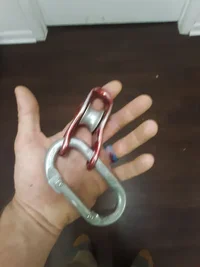
Pinto pulley rating

Not in that plane... the danger for all of them isn't that the sideplates will break at forces below the rating (that may or may not be true), but that deformation of the sideplates will cause the axle to be pulled out of (or pushed through) the sideplate with usually catastrophic results.

That's the bonus advantage of pulleys with a support strap or becket (whether rated or not)... the resulting deformation from sideloading or shock loading isn't as catastrophic if the forces aren't actually extremely excessive. If the axle/sideplate interface is broken, the becket catches the sheave and rope, giving a sort of 2nd chance. If it holds, you or a non-living load still have a reasonable chance to reach the ground safely, albeit with quite a bit more friction and a less than smooth ride.

It's also a stronger design against sideloading... with other designs, you can only match that with lots beefier sideplates and axles (like an OmniBlock pulley or a block) to get the high MBS ratings.

Personally, I use pulleys for MRT canopy anchors, but only OmniBlocks, Rook, Pinto/Rig or the much cheaper Petzl Fixe style that at least have the support strap (non-rated becket). I broke a bunch of those and axle failure and some deformation (elongation) of the sideplate carabiner holes occured first. In other words, it was ruined before it broke... but all of them broke above their rating. Most of the better ones with bearings and slightly heavier construction broke at around 30kN, even though they were rated at 20kN. Mind you, they experienced the expected axle failure at around 23-27kN, but didn't actually catastrophically fail until a bit higher. Two huge spikes on the curve.

At the time, I was planning on writing up an article with pics... halfway through that project I got sidetracked with a series of unfortunate events and I never saw it through. I think breaking stuff is extremely educational and enlightening, though, and maybe Richard M or somebody will break a bunch of them.

 
I guess that didn't answer your question. I don't know if the Pinto Rig is actually rated for sideloading at all... nothing I've seen listed it. I'm absolutely certain that sideloading it is a bad idea, though. They're pretty tough, I wouldn't be surprised if a sideloaded Rig held up to forces that would break the rope, without dropping the load... but I'd also expect it to be ruined.
 
If we're talking about side loading in the sense of a pinto cinch canopy anchor, I've heard it's a no go at dmm... if you're looking for one that seems to be ok, the art cocoon, with a stopper gate and a trapeze is ok (you've got to look far and wide for the parts, and dig really deep into the twin line manual to find it)
 
I'm not sure what Tom's application was, but I don't use the pulley for the cinch keeper... I use steel rings for that... I use the pulley for the MRT line attachment (I like the low friction and bend radius).

Those canopy anchors with the pulley cinching the anchor or rope against the tree seems like a bad idea, to me. But, there's so much friction between the sling and tree, the forces on the pulley certainly wouldn't be anywhere near the total load on the climb line. Who knows? Might be perfectly safe... it just looks a bit janky, to me.

That ART Cocoon looks like an undersized, weak device... but I can't see ART making anything for that application that isn't 100% golden, as they make quality stuff. I bet it's a dream for a lightweight, backpack into the woods kind of climbing setup, if you're using MRT. I don't know if anybody is still doing that, though.
 
There is thisan SRT climbing style that adds redirects all through the tree then retrieves the whole works from the ground. In order for this to work every redi has to be 'frictionless' which means using pulleys. A fella claimed that he was told that the Pinto was rated for sideloading. That sounded fishy since I have a little understanding of how gear is bench tested to breakage. I asked if he would site chapter and verse with no reply. That's what took me to the instruction sheet Iinked.

That's what brought me home to ask.

My style agrees with what's been shared here. I don't believe the Pinto has any sort of 'rating'. IN the small pulley selection it is one of the most

Maybe. Still, I wouldn't use it if I expected to crossload.

The Cocoon might be a good choice too.

But, going back to this style of multiple redis seems way too complicated adn likely to get gear jumbled or jammed.

There is this thought process of having one solution to one problem. Like using a 5'8" rigging rope all of the time. It's problematic in my way of thinking.

Maybe my thinking is too firmly anchored in the styles that I used for so long. Never needed full-on frictionless redi systems. A delta screwlink for a choked redi works fine without a concern for sideloads.
 
Yeah, it sounds like BS to me. Most of my rigging is with 1/2" gear, and I use OmniBlocks... I still have to plan the redirects to keep the rigging line from following a path that zigzags around too much. Even with the swivel, as soon as the rope path deviates from a straight path in the horizontal plane, the angles cause friction on the sideplates... so you start losing the "frictionless" advantage fairly quickly as soon as those angles get past about 120 degrees. The rope starts deforming up out of the sheave and rubbing on the sideplates. This isn't a problem in the vertical plane, but certainly has to be considered in the horizontal plane.

I can't imagine redirects for a climbing line lining up in the horizontal plane, since the tree's limbs are all over the place. So, I'm already at a loss as to how the pulleys are going to help, or how you're going to pull on the climb line and get all that hardware to follow it back down to you without the whole works ending up as a clump of rope and hardware stuck in a tree. I'm having trouble visualizing this.
 
I agreed that it’s not to be side loaded. However I take 3B to mean not for use with asymmetrical carabiners. Which indeed is a type of side load.
 
I did this to my trusty pinto that I have used for light rigging for years.
There was more stretch in the rope than I expected, the load was a cracked water oak lead that was sitting on the ground, and the tear was around 12" in diameter. A small negative load by one end of the branch fell into it as the stretched 12 strand bounced and I guess shifted it enough to take the load partially against the spine. The pulley held, but it is stuck here forever.

Not quite relevant, except to point out that when you start separating these side plates and loading them strangely, this material moves fairly easily.
I estimate it saw something like 8-10kn which is well within the "should not deform" range for this 10kn wll pulley.
 

Attachments

  • 20191030_203716.webp
    20191030_203716.webp
    148.5 KB · Views: 38
I agreed that it’s not to be side loaded. However I take 3B to mean not for use with asymmetrical carabiners. Which indeed is a type of side load.

Do you mean 6B Evo? The 3B picture I'm seeing shows that usual edge/cliff side loading scenario almost all our gear gets the skull & crossbones for.. Regardless, your comment about asymetrical biners is just a important.. It's not just a friendly warning either, Treemagineers published a post about this a while back showing exactly what can & will happen if the wrong biner is used. It was quite an eye opener as it showed the poor pinto rig with one of the ears completely sheared off after being rigged by an arb with oversized D or something to that nature. Either way, it wasn't loaded correctly & catastrophic failure incurred.

I was also recently able to hear Taylor H answer a question relating to acceptable biners for use in the Pinto in regards to a climbing comp gear check overview. He went onto say the obvious about Ultra-O's but added that you could use a BOA or a symetrical HMS if wanted. This may be all known 101 to alot of us, I'm just parroting for those who don't.
 
@JeffGu Yes...too many pieces to try and clear out. My climbs are planned differrently. If I have more than two redis I rebuild. IF I'm not going to climb back to a redi I change plans

My upbringing included bend radius of rigging ropes. For anything bigger than 2" diamater cuts I'd use 2: plock/pulleys at a minimum. What the heck are people using these mini pulleys for rigging?! We're not free-soloing bigwalls where grams count. The beauty of using an inexpensive 2" pulley with plain old flat sheet metal cheeks is that they are CHEAP, durable and forgiving. Using gear like this DMM kit for our rigging makes NO sense.
 
@JeffGu Yes...too many pieces to try and clear out. My climbs are planned differrently. If I have more than two redis I rebuild. IF I'm not going to climb back to a redi I change plans

My upbringing included bend radius of rigging ropes. For anything bigger than 2" diamater cuts I'd use 2: plock/pulleys at a minimum. What the heck are people using these mini pulleys for rigging?! We're not free-soloing bigwalls where grams count. The beauty of using an inexpensive 2" pulley with plain old flat sheet metal cheeks is that they are CHEAP, durable and forgiving. Using gear like this DMM kit for our rigging makes NO sense.
Personally, I was in a pinch for some MA one day and used my pinto for a big enough pull to make the sheave not rotate easily. Strangely enough, it got better. I wasn't climbing on it after that.
I found it really handy for light rigging and keeping it on a little dyneema sling if I thought I might need it. I also used it for some span rigging of fairly small stuff.
Light stuff has its place, but the care required is much greater. Still, it handled the piece with no issue besides destroying my pinto.
 
Personally, I was in a pinch for some MA one day and used my pinto for a big enough pull to make the sheave not rotate easily. Strangely enough, it got better. I wasn't climbing on it after that.
I found it really handy for light rigging and keeping it on a little dyneema sling if I thought I might need it. I also used it for some span rigging of fairly small stuff.
Light stuff has its place, but the care required is much greater. Still, it handled the piece with no issue besides destroying my pinto.
I've often thought of using my P-rig for span rigging as well.. not crazy stuff, just scenarios to make the job at hand easier.. so simple to just wrap a sling & slip right on the line.. is that outside its limitations? I mean it's a Pinto "Rig" pulley from a quality manufacturer.

Shit.. i remember Nick Bonner blocking on one of them with his infamous original rig-saver.. obviously outside the pulleys recommended use.. but point is, I've always thought it was a pretty stout peice of kit, for the little bugger it is.
 
I've often thought of using my P-rig for span rigging as well.. not crazy stuff, just scenarios to make the job at hand easier.. so simple to just wrap a sling & slip right on the line.. is that outside its limitations? I mean it's a Pinto "Rig" pulley from a quality manufacturer.

Shit.. i remember Nick Bonner blocking on one of them with his infamous original rig-saver.. obviously outside the pulleys recommended use.. but point is, I've always thought it was a pretty stout peice of kit, for the little bugger it is.
I did some stuff to this pulley before I found its Achilles heel. It needs some sort of keeper to ensure that they pulley can't move on the carabinier or it needs a steady load. Span rigging <500lb pieces in a system that is pretensioned should be fine. Loaded properly, any aluminum carabinier is the weak link.
 

New threads New posts

Back
Top Bottom