Large black walnut options

semifnordic

New member
Location
Northeast OH
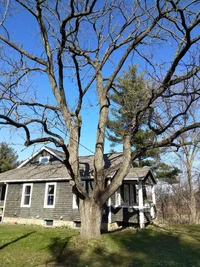
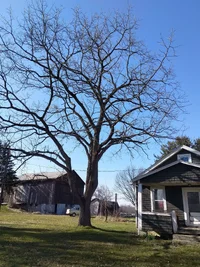
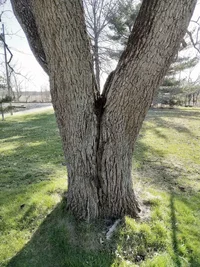
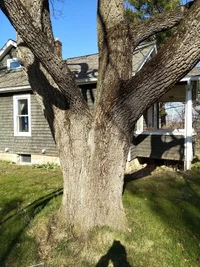
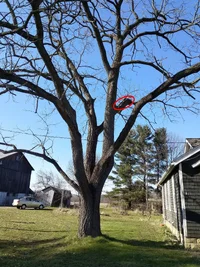
Inspired by the recent few "case studies" threads, I've got a tree looking for options. The tree is large black walnut at my father's house, it's a nice shade tree but is quite close to the house and kind of looks like it wants to split in half. It's also on the west side of the house, which means it provides good afternoon shade but also means it would fall on the house and do some serious damage if the prevailing west winds took it down. My dad has been talking about removing it, but I think it's a nice tree (but it's also not my house getting squished.) Could we reduce some of the branches overhanging the house and reinforce the split area somehow? (stick a big bolt through it?) Or is it definitely on its way to pancaking something?
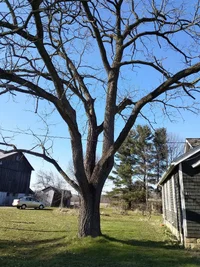
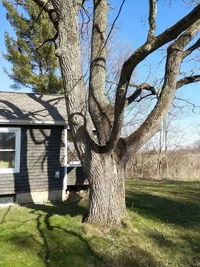
IMG_20180408_171207.webp IMG_20180408_171142.webp IMG_20180408_171250.webp IMG_20180408_171129.webp IMG_20180408_171115.webp IMG_20180408_171151.webp
 
Am I looking straight east in Picture 5? I'm having trouble getting an exact bearing on the orientation of the split (pics 5 & 6).

Assuming so, the likelihood of that tree falling to the west doesn't appear to be real high. It is far more probable that it would split and fall north and south.

To mitigate the potential harm to the house from such a failure, you'd want to look at any limbs on the west side of the tree that would catch the house as they are attached the the trunk on its way to the ground. Can those be pruned back? Some - especially on the south side look like they'f likely fall clear of the house.

The limb I circled looks like it may have some decay problems that you want to deal either way....at least get a closer look.

Kinda looks like if you remove that, there isn't much left that would strike the house with a N/S "banana peel" split is there?

walnut.webp
 
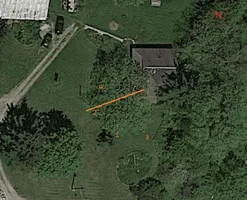
Yeah, the crack is almost perfectly oriented to NOT hit anything if it split cleanly. Here's a satellite image of the site -- The orange line is the approximate plane of the crack. I've also added notations of where the first four photo angles are from. Photo 5 is taken from near the house, facing west (it shows the east side of the tree / crack). Photo 6 is taken from the west side, facing east (showing the west side of the tree / crack). The north half of the tree, with the exception of the branch you highlighted, would probably miss the house entirely if it failed cleanly at the crack. The south side has more branches that overhang the house, but again if it failed *cleanly* the house would probably be fine. But, if that half twisted or fell to the east, it'd do some damage.
Screenshot 2018-04-09 10.15.46.webp
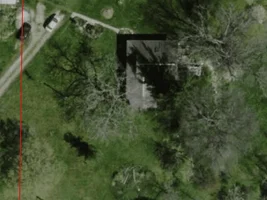
And another aerial from a different source, with pretty poor resolution -- Kind of makes me want to buy a "drone"
Screenshot 2018-04-09 10.23.49.webp
 
Bear in mind that in a worst case failure scenario, lower branches with a more narrow arc of travel will contact the roof first and greatly reduce the force with which remaining elements impact the building. Many people erroneously remove that natural "cushion", leaving longer lever arms with much more mass and more travel distance, meaning they'll hit a lot harder.

Think about photos of crane failures over residential buildings, where the crane has basically cut the house in half, because there was nothing to mitigate its impact.
 
I was thinking it is so valuable that if he needed it removed, somebody would pay them $3500 to remove it, clean it up, grind the stump, and roll out new turf under the entire canopy (since the juglone killed everything that ever lived under it). ;)
 
Entrenchment pruning of the higher more out reaching branches can reduce load drastically. Look at Ed Gilmans work.

Reduction with cabling, or bracing is another way to help reduce the load.

I’ve seen this situation reduced with non invasive cabling up top and bolts through the trunk or steel cable right above the crotch.
I know I know a cable that low defeats the purpose but if you look at it more as a bolting process it makes sense as an assist to lessen codom split wiggle.

I know cobra is loved by some and bashed by other but even if you eye bolt the tops and use rope with some stretch like a rigging line it avoids girdling etc but this becomes a tree that should be kept an eye on once you start.

Lots of outside the box non standard applications if you get looking into it. This helps keep the shade and beautification. Fact is beyond arb community as long as the lower and spreading factors are there if the tree is reduced only half the people that see it will even notice.
 
REtrenchment pruning, better known as regenerative pruning. Not sure if Ed has ever done any work like this, but he has talked about it. Beware central-leader mania!

Pruning might be enough, but with a crack like that I would still cable. I'll be in NE OH in a few weeks, with climbing gear...happy to give a bid!

I don't see a veneer log in that tree so all you seeing $$$$ may be overoptimistic. More value appreciating where it is.
 

Attachments

  • Like
Reactions: ATH

New threads New posts

Kask Stihl NORTHEASTERN Arborists Wesspur TreeStuff.com Teufelberger Westminster X-Rigging Teufelberger
Back
Top Bottom