Interesting...create-a-TIP

Tom Dunlap

Here from the beginning
Administrator
By now I shouldn't be surprised with what google finds for me when I go looking.

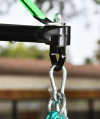
Take a look at this tool and the tree house too. Considering the complicated production the prices on both of these are quite reasonable. Maybe not for arbo work but for play. Or, maybe it could be for arbo work...hmmmm???


Curious how it would handle weight at a constant angle. I could see it being helpful on a removal with multiple leaders but no TIP. Set it up on the ideal spar and work from there. But that could mean constant pressure from varying angles.
 
Interesting idea, but I don’t personally see a great lot of call for it. Nor am I crazy about trusting my life to a pair of ratchet straps.
 
Sharp idea anyways.
If they’re still in business in a decade it’d speak volumes to their quality.
I’d trust the straps more than I’d trust a stranger’s welds and craftsmanship.
 
I can imagine a few specific situations where it could be useful. 500 pounds isn't a ton of weight, but something like that would be easy enough to backup on the spar above where it's attached to improve safety incase of failure. Or the main tie-in could be on the spar higher up, and that would just act as a redirect taking a smaller percent of the load.
 
You'd have to climb at least once to install it, so its usefulness depends on how many climbs you need to make to that same place. Having the TIP away from the trunk would be nice. Moot points until we know it's rated for life support, though.
 
Interesting gizmo. It did make me cringe, though, when I saw how the connection is made with the swing. That metal to metal clip where it will arc back and forth from a swing will cause wear on the softer of the two metals. When I was a math teacher we had a swing set up in the gym to demonstrate the length/period relationship of a pendulum. The kids loved it. After about 10 classes of use we took it down for the year, and noticed that we had worn half-way through the attachment ring on the ceiling of the gym. Scary!

1612529912777.png
 
Last edited:
When I was a math teacher we had a swing set up in the gym to demonstrate the length/period relationship of a pendulum. The kids loved it. After about 10 classes of use we took it down for the year, and noticed that we had worn half-way through the attachment ring on the ceiling of the gym. Scary!
I need a separate thread on pendulum physics, specifically as it relates to climbers taking swings.
 
It was a fun unit we did with the kids. They all assumed that the period would vary based on how heavy the "bob" was (in this case the kid on the swing), as well as how big the arc was. They were surprised to find out that neither one made a difference in the period. Here's a pretty good explanation from "YouTube University".


Once the initial angle of the swing gets large (like more than about 45 degrees from vertical), then the angle starts to make a measurable difference. In class the kids could never push a kid on a swing with an angle greater than that. In tree work that could happen, but the difference in the period is still very small. The "big impact" for a climber (pun intended) is not the period, but the velocity on impact. That's where the initial angle combines with the length of the pendulum to make big changes in the velocity from one side of the swing to the other. Between any two given points in a tree, the higher the TIP the lower the max velocity.
 
Somewhere in this world you just made a GRCS cry a little.
Good point. That’s a little different though, as a 4” ratchet strap is a lot stronger than the little ones on that thing. Plus, there’s always someone near the GRCS to watch the strap, and it’s not life support, at least not technically.
 
It was a fun unit we did with the kids. They all assumed that the period would vary based on how heavy the "bob" was (in this case the kid on the swing), as well as how big the arc was. They were surprised to find out that neither one made a difference in the period. Here's a pretty good explanation from "YouTube University".


Once the initial angle of the swing gets large (like more than about 45 degrees from vertical), then the angle starts to make a measurable difference. In class the kids could never push a kid on a swing with an angle greater than that. In tree work that could happen, but the difference in the period is still very small. The "big impact" for a climber (pun intended) is not the period, but the velocity on impact. That's where the initial angle combines with the length of the pendulum to make big changes in the velocity from one side of the swing to the other. Between any two given points in a tree, the higher the TIP the lower the max velocity.
Okay, that video was helpful to see the side-by-side comparisons. I was trying to envision the relationship between length and tangential velocity.

To start with, suppose two climbers were in a tree, using the same TIP and standing on the same limb that gives them a displacement from vertical of 30º. They will have the same pendulum length and so, regardless of weight (mass), if they step off at the same time, they will have the same period and swing back to arrive at the limb at the same time. (1:32 in the video) Their velocity should max out at the bottom of the swing (neglecting aerodynamic drag, rope stretch, TIP friction, etc).

If they both move to a lower limb that doubles the length of their pendulum, but keep the angular displacement at 30º, the swing period will increase (but not necessarily double), and again, they will both return to the starting limb (or target limb) at the same time. Their velocity should increase, because they are "falling" farther, but they have a longer arc distance to swing through. So what the video showed me (1:48) is that just because they are traveling faster, that doesn't make up for the farther distance they swing, and so the period of their swing will still be greater.

To me, it always feels like I am going faster in a swing when my TIP is only a few feet above me compared to when it's much longer. Must be the reduced period that I have to "experience" the swing that causes the illusion.

Now, what happens when you change the pendulum length during the swing, like when it shortens as your rope strikes an interfering limb between you and your TIP?

 
Now, what happens when you change the pendulum length during the swing, like when it shortens as your rope strikes an interfering limb between you and your TIP?
I dont know the exact math on how much stress the TIP takes, but I know I feel MUCH higher force on my harness when my line hitch a higher branch on a swing, I assume its the same at the TIP, always better to assume the worst possible factors on stuff like this, i.e it could be the same force at the TIP, but treat it the same as your harness TIP, which has much higher force
 
Lots of things to consider to calculate the change in force, but you're correct. The force on the rope above and below the branch would be equal, ignoring the friction of the rope on branch. The friction would reduce the force on the TIP by an unknown amount, but it may not reduce it by much. You are correct (IMO) to treat it the same as the force you feel on your harness. It's a safe assumption.

If this happens in kind of an extreme case, some interesting (scary) things could happen. If the pendulum is long (distance between you and the TIP), the starting angle is relatively large (more than 30 degrees from vertical), and the branch you hit is directly below the TIP but not very far over your head, you could theoretically flip all the way around the branch you hit (like a throwbag if you catch the throwline at the wrong time). Don't try this!
 

New threads New posts

Back
Top Bottom