Help with shortening my balancer

John Paul sold me a great balancer. Nick from W. did the splicing for it. It is I guess 12'. The tool has really helped me with lowering limbs horizontal to the ground. In the kind of jobs I have been doing this is essential for protecting the well developed plantings and ornamentals underneath these trees.
When the balancer is too long I have been using a knot that is essentially a couple of half hitches that gather two bights in the tenex line. I dont know the name of it but it is tricky for me to tie and takes a while to take up all the slack.
So I switched to a bowline in a bight and tie my sling to the loop. Workes just fine but am wondering if there is a better knot to use.
Any help with this would be great.
Thanks
Frans
 
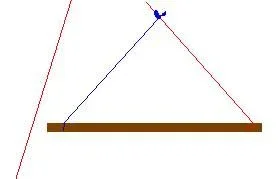
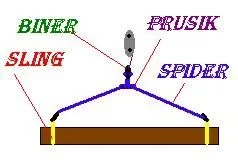
If that's the spider leg off the main lowering line, I use an adjustable hitch which allows any slack in the sling to be taken up on the main line.
The other end of the sling is girth hitched to the limb.
 

Attachments

  • 4987-spider.webp
    4987-spider.webp
    3 KB · Views: 78
Snarf,

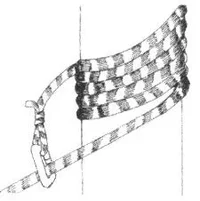
I,m not sure if we are using the same terminology or not. The balancers that I use are just lengths of Tenex with an eye that is large enough to tie a pursik-type knot. The length is then attached (with a pursik-type knot) to the lowering line. I usually tie a clove hitch to the limb with the free end and then slide the hitch up to take out the slack. This is the method Pete Donzelli was working on before his accident.

Are we talking about the same rope tool?
 
Frans,

I think you are describing a sheepshank knot. view it here:
http://www.mistral.co.uk/42brghtn/knots/42ktshep.html

If that's not what you're using, you might try it, though it is somewhat difficult to tie quickly in an awkward position. Otherwise, I'd just tie a bowline in one leg of the sling at the length you want and let the excess hang.

I've been getting by with a running bowline (or carabiner clipped around the rope) in my lowering line at one end of the branch and a webbing sling at the other, clipped into a midline knot. This is still not a really fast method, but works without much extra gear to carry up.

good luck,

Keith
 
Stick with the bowline...

Frans-
I hope that thing's working out for you! I think I would stick with the Bowline (normal, or on a bight). It's quick to untie, especially if you tie it slippery. With the Sheepshank, don't you need to keep tension on it to keep it tied. I don't think this is a knot I'd like to see in rigging situations.

love
nick

ps- Another alternative is to have "someone" make you up a whole bunch of spiderlegs in all different sizes!!! <pre><font class="small">code:</font><hr> </pre><hr> <pre><font class="small">code:</font><hr> </pre><hr> [/list]
 
Kevin Wrote:
"If that's the spider leg off the main lowering line, I use an adjustable hitch which allows any slack in the sling to be taken up on the main line.
The other end of the sling is girth hitched to the limb."
REPLY:
Yes it is the spider leg off the main lowering line. However the branch in question was very close to the lowering block, which did not allow any slack in the spider line to be taken up onto the lowering line. So I needed to take up slack on the spider line itself.
Kevin why do you girth hitch the spider line to the limb?
I mean then you would have to tie the sliding hitch (I use a swabish) onto the lowering line EACH TIME you tied off a limb. Is'nt that excessivly slow and inefficient?
I like using a bowline on a bight to "adjust" the length of the spider line (balancer). the only complaint I have is the Tenex tends to lock up on just about any knot. Sooo I am looking for quick to tie alternatives (or maybe "someone" will be asked to make up more of them for me. Maybe Tenex comes in different colors for easy i.d. purposes?)

Kevin, You mentioned girth hitching the limb to the spider line. The spider line is made of Tenex that I have and my experiance with this fiber is that it wears quickly. Why not use slings for attaching the limbs?
I have been using slings of various sorts now for a while and my ropes and rigging have much, much, much less wear and tear on them.
 
I seldom have a need for it in my line of work.
Does it take longer to tie a simple hitch than a bowline on a bight or place a sling ?
You might be splitting hairs there.
 
Kevin Wrote:
"I seldom have a need for it in my line of work.
Does it take longer to tie a simple hitch than a bowline on a bight or place a sling ?
You might be splitting hairs there."
REPLY:
Sorry I dont understand which one of your three questions refer to what.
Lets See if I understand right;

I can tie a bowline on a bight in my sleep. No problem with that knot but it does cinch up tight with the 3/8" Tenex which is what my balancer is made of.

The half hitch idea is good for shortening the balancer but it is problamatic for me to get the balancer tight and shortened using it.

Using slings either out of webbing or heavier strapping is, in my opinion, the only way to go.
Exposing your ropes to the heavy sap, rubbing and what not of day in and day out, real tree work really tears them up.

Of course here in CA I do alot of removals and work with really sappy wood so the slings are great.
I also have eyes spliced into my load lines so I dont need to tie a knot to attach the strap to the load line. I just throw the sling around a limb, click on the locking snap or the carab. and away I go.
I can have each limb ready to lower much faster to the point that I am always way ahead of the ground crew.
Do you tie on limbs with each lower you do?
After about 50-60 bowlines it gets kinda old.

I dont think that is splitting hairs at all.

The balancer is indespensible. How many times have you flopped a limb over using one tie in point with the load line? And then had to pull the tip over to the work zone?

30'-40' limb over hand crafted redwood newl posts on the stairs below? Stained glass green house?
No this balancer is one essential tool. It also allows me to let the limb "set" gently into my rigging so any junk does not get knocked off to fall below.

It really helps to have the GRCS in preloading the rigging.

Not a question of splitting hairs at all (in my opinion).
Fransnarf
 
Snarf, will the structure of the trees aalow you to tip tie and raise the limbs up to a more vertical position allowing more control for the ground guys to pull the butt end down instead of the tips first? just woundering
 
I work in a jungle and everything gets dropped.
The bigger the crash the better I like it.
Try the attachment above ...
 

Attachments

  • 5013-try this.webp
    5013-try this.webp
    6.9 KB · Views: 100
Snarf, I had a similar problem. I took a length of webbing let's say 20 feet. I made and endless loop with a beer knot then put overhand knots every six inches or so. With me so far? In effect, I made a poor man's "daisy chain." This I tied to the end of the spider leg. Just pick two loops along the length of the daisy chain, insert a biener and presto your in buisness. Naturally the system has its limitations which should be obvious ie. strength, the sling does not "noose" down to the piece, etc. but to point all those out is to preach to the choir. Good luck, let me know what you think.
 
Tod K.
When you tie a bowline with a longer tail, and then tie the tail to your sling, think about what happens to the limb when it is cut.
the limb would flop down with the heavy end first. In other words the tail of the bowline would not act as a balancer, it would behave like a half hitch tied before the bowline on a bight set up such as for big wood lowering.


Tony
I think your idea is great!
As always I try to pick things apart but your idea seems sound. (except for big wood)
Frans
 
Tony;

By "...'noose' down to the piece..." do you mean choked? If so, couldn't this be accomlished by taking one end of the sling and passing it through the tightest 'link'? The end of the sling may need to have a slightly longer link (i.e. a slightly longer section without a knot) so that the slng won't hang up on the knot when it is cinched tight.

Mahk
 
I'm surprized that nobody has suggested the Tensionless hitch for this application. This would be quick and use up the long tail.
 

Attachments

  • 5041-tension.webp
    5041-tension.webp
    7.7 KB · Views: 48
Mahk, Yes I do mean choke when I say "noose." And while I never tried your sugestion, it seems like it would work. Although, I found keeping all the overhand knots spaced evenly led to the most flexability, which is what I was after. The few times I tried to choke my daisy chain with a biener, it seemed the overhand knots got in the way . Since I was balancing pieces any way, I found that a choked sling was uncessary. You just have to make sure the piece is actually balanced or it may slip. Placing the sling in or near a branch union or other suitable area also helps.
 
Frans,

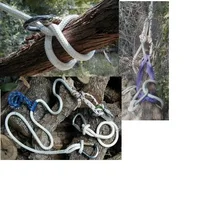
I've been working on ideas for this awhile, and I have a few thoughts. I'm not saying these are the solutions, but I'd like to hear others' thoughts.

For the most length from a given sling, you can clip one end into a sling, the other end into a midline rope (the end of the lowering rope becomes the second leg).
Next comes clipping both ends to slings.
Then the ends can be girth-hitched around the limb with a biner.
Then there are knots that will use up some excess rope.
Finally, you can clip one end to the branch and install a sling at the other. Then the other end of the spider leg is tied to teh sling by a MT/distal type hitch, and excess can be pulled out that way.
 

Attachments

  • 5223-spiderleg1_2003_5_8.webp
    5223-spiderleg1_2003_5_8.webp
    34.5 KB · Views: 49
another idea

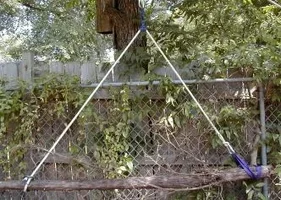
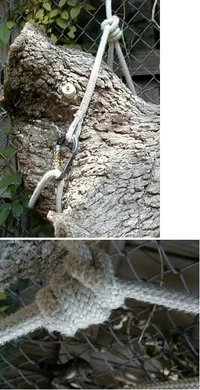
one more idea is a knot I "invented" (I'm sure someone has tried it before, but nobody taught it to me). It's basically a variation on a hangman's noose. The noose loops around the log. A biner clips it back into the end of the rope. The loop can be bigger or smaller to use up more rope. I loaded it pretty hard to see what would happen. The knot moved, which could be bad in many riggin situations, but probably not a problem in a spider-leg setup. It was really tight from the load (see pic) but easily untied when I was done. I'll try to get a pic for how to tie it soon.

k
 

Attachments

  • 5225-MYKNOT.webp
    5225-MYKNOT.webp
    70.1 KB · Views: 50

New threads New posts

Back
Top Bottom