Hand held GPS for tree inventory

Tom Dunlap

Here from the beginning
Administrator
I'm researching hand held GPS units to be used for the tree inventory on campus.

What features should be on the 'must have' list?
What features should be on the 'it would be worth paying extra for" list?

Can anyone recommend a specific unit?

I don't need to be able to integrate the locations of the trees into another database. The locations will be manually entered into the work order maintenance program that is used though out the university.

At some time the GPS will be used to locate other assets on campus like buildings, utilities, signs, etc. Being able to take the chip out and download the data into a GIS system will be a mandatory feature. How do I find out which GPS collect data that is compatible with the various GIS systems?
 
The environmental commission here and the meadowlands commission use the Trimble handheld units. They run about 5-6k but do everythin you need. While you may not need the integration at this time it will be a good feature for future use.

I'll find out which model.
 
On my campus I use a Dell Axim with a little GPS unit on the side-it connects to the handheld via bluetooth. The handheld is running a version of ArcGIS called ArcPad-it's really easy to use. This was the cheapest option (important!), but I like the flexibility. Anything that runs ArcPad would probably be fine. You might even consider a tablet computer, or maybe even just a cheapo netbook, and get a GPS unit to hook up with it. Using ArcPad in the field is WAY easier than a seperate GPS unit, and all the hassles of importing data.

It's not going to do much for your work order program, but you can certainly print maps to attach to a work order-that's what I do when needed.

Does your campus have a geography department? OUrs is a huge help, and I can generally wrangle some student help when I want-it's a fun class project.

See our map at http://blogs.middlebury.edu/middland/treemap/.

Tim
 
Locating the tree is the most important issue. IN order to do this I'll have to stand right at the trunk. Then the database can track the information. The campus is divided into 9 zones so any data crunching will relate to the zones.

Tim---thanks for the geography tip. I'm sure that I can find a resource...hmmm...just the other day we were finishing up a root excavation and a geography prof stopped to talk with us...I'll track him down tomorrow!
 
I worked for the National Park Service on the Grand Canyons Hazard tree crew a few years ago. They had all the hazard trees gps'ed . The information was pretty much useless because of the gps they used. Most of the data points were up to 1/4 mile off. Nowhere near accurate. I think you need a gps with a backpack antena to get spot on info.
 
GPS data has gotten a lot better in the last couple of years, much more accurate. That being said, some parts of campus is more accurate than others, and even weather can play a role in how well the satellites get read.

On a campus like that, I wouldn't get too worked up about a superaccurate GPS. Using ArcPad, I've got a good aerial photograph where i can make out tree canopies, so i can place the dots myself without waiting for the GPS-after all, the trees aren't moving. The gps helps me from having to scroll the map too much, and it helps when it comes time for someone else to relocate the tree. Most of the country has good aerial maps, particullary in urban and suburban settings.

Tim
 
I would also reccomend using GIS. Depending on what the quality of the aerial photos are you may not need a GPS. To be the most accurate a combo of GIS and GPS works the best, you could probably get within 1 meter accuracy.
 
Tree ID tags-alum. or plastic-nail or screw?

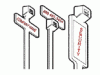
When I do start the inventory I will need to tag/label each tree. The usual mode is to use round aluminum disks with ID numbers stamped on them. Another tag option, especially for young trees, is to use cable ties with tags on them like in the attachment.

For larger trees that don't have small, low limbs, the disks seem to make sense. Too often the discs get enveloped by the tree. Using sheet rock screws that can be backed out as the tree grows makes sense. There is a concern that the tag/screw/nail become enveloped and years later during a takedown the sawyer hits the nail which could turn into shrapnel. This is such a small chance that it hardly bears discussion. using aluminum nails is a possibility but all that does is save the chain, the pieces could still injure someone.

Long term durability is an issue. Plastic tags UV degrade or get vandalized. Putting a screw/nail into a small diameter trunk doesn't sit right with me either.

Any suggestions?
 

Attachments

  • 217044-Cabletielabel.gif
    217044-Cabletielabel.gif
    2.5 KB · Views: 35
Re: Tree ID tags-alum. or plastic-nail or screw?

I just spoke to Laura at a chip manufacturer. She is forwarding me some info on the different chips available! I see this as the wave of the future, assuming the cost can be kept down!!!
 
Re: Tree ID tags-alum. or plastic-nail or screw?

Tough, I have been working on this for MONTHS!!!
grin.gif
 
Re: Tree ID tags-alum. or plastic-nail or screw?

Injectable chips like they use for pets and kids have been around for a years. There are systems that use them for trees.

The catch for us is that tree tissues get thicker so the signal from the chip to the reader is missed.
 
Re: Tree ID tags-alum. or plastic-nail or screw?

You have a link or name to share Tom????

On the depth issue, I would think they may have to go back and develop a different protocol for implanting the chip then!
 

New threads New posts

Back
Top Bottom