Friction saver for advance climbing

Hey guys I have been debating about something for awhile. Here’s the thing I usually use a launcher to get my line set at the top of the tree. I go up srt to set friction saver to work the tree using ddrt. But I know it’s not always that easy. Some trees I can’t set my line that easily. So if I want to start low and keep on advancing my tip as I go using ddrt. What would be the fastest and most efficient choice for friction savers? The weaver leather one? Or the dan house tubing one? Which is better for the rope? Thanks guys
 
Just choke it if can, RB or if you're into it, a Quickie or steel biner (minding the orientation. Save the friction saver for when you have moving, weighted rope.
 
Dan House...for soooo many reasons.

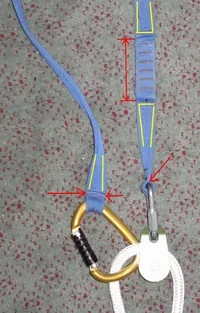
Here's what I used for many years

Made from a 1" tubular webbing sling

First I'd tack the ends to make a snug eye to hold the screwlink and biner. Then I'd run a line of stitching up both edges of the sling to keep it flat,,,the yellow lines. The stitching was NOT meant as life support. If you keep the bar tacks on the right like in the pic the end with the biner is easy to whip up to the next TIP

With this setup you never disconnect from your rope and never have to worry about fumbling any gear.

False crotch 1 inch webbing homemade closeup arrows for sewing web.webp
 
Wait. There is an easy solution there. The dan house rope sleeve is my favorite friction saver for advancing ddrt. It is pretty smooth, adds weight to the end of the line, and just really works well at the thing it does. If you can reach (or even almost reach) the next fork, you grab the carabinier and clip it back in, or if you can't, it is easy to whip slack even if it barely clears the union. Pull a little slack, tie a slipknot, and set it in the next one. It's very efficient.

Edit: I could have read the thread first, but I still stand by the thought that the edge that the rope sleeve gives you in advancing is enough to make up for the trouble of setting it.
 
I'm talking about no friction saver.

The Dan house will work with a minimum diameter of branch. If climbing a conifer, you are often looped over a small bend radius, on the far side of the trunk over a limb, or over a couple small limbs. I frequently climb into wood much smaller than 6".


"Will bend over a limb as small as 6" thick"-treestuff.com
 
I'm talking about no friction saver.

The Dan house will work with a minimum diameter of branch. If climbing a conifer, you are often looped over a small bend radius, on the far side of the trunk over a limb, or over a couple small limbs. I frequently climb into wood much smaller than 6".


"Will bend over a limb as small as 6" thick"-treestuff.com

Don't believe everything treeStuff says ;-) I roll my own with I believe the same spec Dan uses, Anaconda Sealtite M 3/4" ID Type M.T.C., at least that's what I recommended to Dan a few years back after I detected poor wear issues with the spec he was using ;-) For the use described by the OP I recommend cutting the stock sleeve down to 18", that length works super well for DdRT advancing in conifers and deciduous treess for that matter if you happen to DdRT in them.

For smaller than 2.75-3" go around the spar and let the small branch act as a "stop".

43236382005_dff8e9c8c7_c.jpg


-AJ
 
For conifer advancing SRT/SRS I frequently choke with a carabiner, quick and effective. Remember this is not a remote canopy anchor, it's always within reach and visual inspection. You can go around the spar or larger diameter limb, always gate up or opposite the load direction. You're not going to lever the carabiner spine, it's well past the time to bury the myth of crossloading in this choking scenario. You can alternate with your lanyard, if carabiner terminated not rope snap, and main rope, and quickly move up.
-AJ
 
I think that you can cross-load, but don't have to.

A choke doesn't have to be super-duper snug, as it would be if set in front of oneself.

When I am going to lower off of choke, and have a pull-down/ retrieval line, I will lower down the tree with my lanyard a bit, and weight the climbing line when the choking eye is somewhat open. I'll test that it doesn't want to tighten from my direction of load, and then continue down. Its easier to pull down.

A looser choke is less likely to cross-load.

A screw-link is tougher/ burlier as a metal connection. A small wrench is easy to have on the harness.
 
I'll often carabiner-choke the climbing line in larger wood, remotely. As I get to skinny wood, I'll change to a running-bowline choke, if I need to. If you're down to 3" wood, a RB is preferable, IMO.
 
I'll often carabiner-choke the climbing line in larger wood, remotely. As I get to skinny wood, I'll change to a running-bowline choke, if I need to. If you're down to 3" wood, a RB is preferable, IMO.

Two or three quick wraps on the 3" wood then choke, carabiner acts as a keeper, sees very low load in a choke because of the friction, again this is for advancing or work positioning, not an anchor you won't be close to.

Not to beat a dead horse... screwlinks, Quickies, Runing Bowline etc. are awesome anchoring tools/methods, I'm talking about when you're on the go advancing or setting up work positioning to make a cut, you want the quick and precise anchor location (for work positioning), spinning a delta nut can seem an eternity ;-)

That said, for advancing your main rope in a stationary system, Quickie on a tight eye choked is pretty awesome.
-AJ
 
Last edited:
....Some trees I can’t set my line that easily. So if I want to start low and keep on advancing my tip as I go using ddrt. What would be the fastest and most efficient choice for friction savers? The weaver leather one? Or the dan house tubing one? Which is better for the rope? Thanks guys

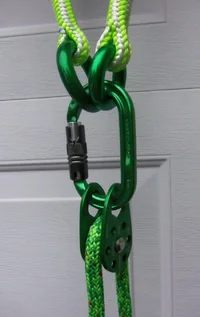
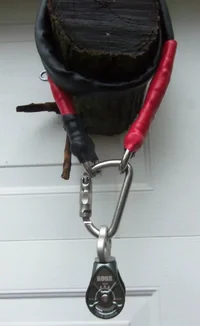
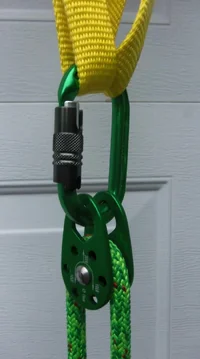
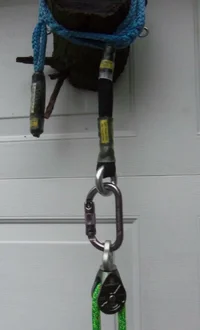
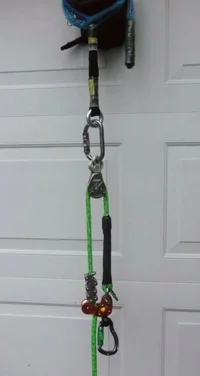
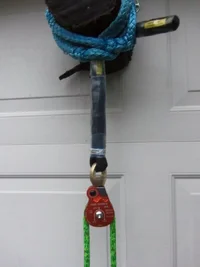
The conduit sleeve (Dan House) is easy on the rope and the tree, also keeps pitch off your rope. The ring/ring with a pulley of some kind as shown in the photos above is also very easy on the rope. It's a few more motions to install than just flipping your rope over a branch, and stuff to drop potentially. There is more play in the system (distance between you and the anchor) compared to a short sleeve, that can make a difference. Sometimes just closing 5" between you and the anchor makes it easier to acquire the next anchor, trees are like that.
-AJ
 
The trouble I've experienced is with ground retrievals of cinched TIPs. I've never had issues using them in the canopy for advancing or positioning.

I almost always use a limb or trunk cinch TIP to access or exit the canopy on SRT. Once I'm back on the ground, I use a pull down line/rope/cord to pull the cinch out of the canopy and back down to the ground. If the limb cinch is set high and too snug, I can have trouble breaking the friction to free the cinch and pull down the works. In extreme cases this has required me to climb back up to the TIP to re-set the cinch to better facilitate a ground retrieval. Since I've started using a version of the Texas tug with a pulley, the pull down chore from the ground has gotten much easier and is almost always successful.

Aha, yes, makes sense. I try to keep clarity in this kind of thread, a canopy anchor being a completely different animal than an SRS/SRT anchor for advancing per the original post.
-AJ
 
... I think the important thing is that some form of friction saver is used. If not for your rope's sake then at least for the tree's sake...

For just advancing up the tree, on most trees, this is a bit overcautious IMHO. A couple of pulls in a DdRT configuration should not hurt either the tree or the rope.
Of course, using SRT would be better still.
 

New threads New posts

Kask Stihl NORTHEASTERN Arborists Wesspur TreeStuff.com Teufelberger Westminster X-Rigging Teufelberger
Back
Top Bottom