












dmonn
Branched out member
- Location
- Port Washington Wisconsin
The last time I did force vector analysis was in 1971, so I'm a little rusty. I'm actually working on some rigging for my friend's 45 ft sailboat, but figured you guys could check my analysis.
I'm trying to figure out a reasonable length for a bridle. A second line will be attached where it can slide a very small amount along the bridle line. The second line will carry an essentially static load of 600 pounds (the log in the sketch). We'll be using Amsteel lines. We want to make the size of the bridle line as thin as would be safe because of what it will be attached to.
By adjusting the length of the bridle, the angle at point C changes, and that effects the tension on the bridle line. Have I done the calculations correctly? Conclusion: A longer bridle reduces the bridle tension.
Next consideration is the attachment at points A, B and C. Points A and B will be the sides of a stainless steel U-bolt. The diameter of the bolt is not known yet, but looks fairly small in the photo I've seen. Maybe 3/16 or 1/4 inch. If I splice eyes in the end of the bridle, I'm concerned about the bend radius around the bolt. Do I need to put bushings on the bolt to increase the bend radius? If the bolt only gives me a 1:1ratio, there could be a 70 - 80 percent loss of strength for the Amsteel. (Marlow Rope tech info if I read the Dyneema chart correctly).
The attachment at Point C is the next consideration. Movement along the bridle will be minimal. I was thinking of using a spliced eye with a stainless steel thimble, a rigging ring, or ? Whatever is there might bang into the fiberglass hull of the boat, so steel or anodized aluminum would not be the most desirable substances. If either of those are the best or only good choices, we could probably come up with some way to prevent it from banging into the hull.
So to sum up my questions, have I analyzed the forces correctly and what should/could I use at Point C?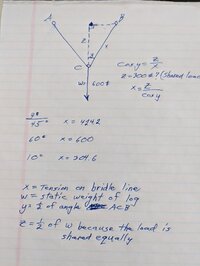
I'm trying to figure out a reasonable length for a bridle. A second line will be attached where it can slide a very small amount along the bridle line. The second line will carry an essentially static load of 600 pounds (the log in the sketch). We'll be using Amsteel lines. We want to make the size of the bridle line as thin as would be safe because of what it will be attached to.
By adjusting the length of the bridle, the angle at point C changes, and that effects the tension on the bridle line. Have I done the calculations correctly? Conclusion: A longer bridle reduces the bridle tension.
Next consideration is the attachment at points A, B and C. Points A and B will be the sides of a stainless steel U-bolt. The diameter of the bolt is not known yet, but looks fairly small in the photo I've seen. Maybe 3/16 or 1/4 inch. If I splice eyes in the end of the bridle, I'm concerned about the bend radius around the bolt. Do I need to put bushings on the bolt to increase the bend radius? If the bolt only gives me a 1:1ratio, there could be a 70 - 80 percent loss of strength for the Amsteel. (Marlow Rope tech info if I read the Dyneema chart correctly).
The attachment at Point C is the next consideration. Movement along the bridle will be minimal. I was thinking of using a spliced eye with a stainless steel thimble, a rigging ring, or ? Whatever is there might bang into the fiberglass hull of the boat, so steel or anodized aluminum would not be the most desirable substances. If either of those are the best or only good choices, we could probably come up with some way to prevent it from banging into the hull.
So to sum up my questions, have I analyzed the forces correctly and what should/could I use at Point C?


 Back to seriousness, if you're concerned about shock loading the lines then consideration should be given to the anchors especially if in fiberglass or carbon fiber. My understanding is that fatigue failure in those is progressively snapping more fibers each load cycle till you get a fracture or tear out. So the benefit/idea of a rigging ring skidding into position and acting as a load spike damper is real. If you want to try something neat and your amsteel is hollow braid, make a skinny football shape from elastomeric material like polyurethane foam etc and put it inside the hollow braid. Voila, inline shock damper.



















