Drop Test Picts

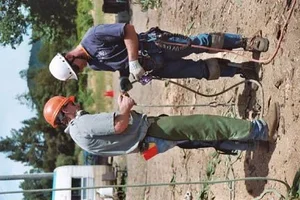
Here is Ken Johnson & Gerri B. checking out the attachment problems on the 99" DBH blue gum euc.
With a large circumferance tree getting the devices tight against the tree is a problem. With using any device, you must make sure it will not walk up the trunk when accepting the load...
Frans
 
A pic. of the log we used to initially test what happens with ropes under severe loading. In the pic.is Ken Johnson, Myself & Bowie my most excellent faithfull dog.
We dropped the log approx 15' using 5/8" &3/4" line. The devices both walked up the trunk. Failures came at the marl. and also when the rope doubled up on itself on the drum it melted and broke within the wrap. Ken called it thermal breakdown.
Frans
 
Sam Noonan telling me about the nick in a 1/2" cable core flip line I've been using for several years. I guess I should replace it before I regret it.
Frans
 

Attachments

  • 11186-3SamNoonan&Me.webp
    11186-3SamNoonan&Me.webp
    34.9 KB · Views: 145
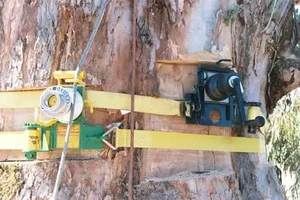
The new Hobbs & the GRCS mounted in tandem on the Euc. After the log drop we moved on to the Volvo.
Frans
 

Attachments

  • 11187-4Hobbs&GRCS.webp
    11187-4Hobbs&GRCS.webp
    35.6 KB · Views: 131
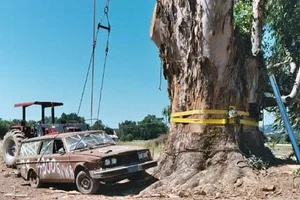
Here is a pic. of the Volvo rigged up and ready to go.
the numbers you see on the side (4300GVWR) are the total vehicle weight capacities. The actual weight of the car is an even 3000 lbs. I wrote the gvwr because the vinyard scale was closed at the time of trailering the car to the drop site
The tractor in the background is a 100 horse CASE we used to pull the car and log up to the yarding block.
The rope used to accept the load is a 2" double braid.
Frans
 

Attachments

  • 11188-5VolvoRigging.webp
    11188-5VolvoRigging.webp
    33.5 KB · Views: 140
Volvo UP and ready to go! We pulled up the car with rigging a 3/4" cable on blocks so the pull was at the bottom of the tree and parallel to the ground. Then we attached a 'unfusable' link from the tractor to the pull up line and chopped it with an axe to release the load. About 10'-15' of slack in the load line
Frans
 

Attachments

  • 11189-6VolvoUP!.webp
    11189-6VolvoUP!.webp
    28.1 KB · Views: 138
Gerri B. put all this together on a DVD. The film is put together really well and tottally reveals the entire test. The main point to remember is attaching these devices properly. Fairleading the ropes is essential to keep the rope from walking out on the drums.
During the second test we bolted the GRCS down to the trunk and it accepted all the loads without a problem. In fact we broke a 9/16" choker cable holding up the yarding block.
During the first test, the GRCS base plate lifted up and caaused a sucking/ pulling action on the drum which pulled off the outer drum. I had it repaired at a cost of $160.00.
I should mention that the inner ratcheting mechanism was tottaly unaffected.
The hobbs also in the same test bent at the arbor and the channel iron of the base plate. I dont know what the repair cost would be for that damage.
Both devices blew out the fairleads which caused the rope to walk out on the ends of the drum. Greg Good told me to attach a rope w/fairlead above where the rope enters the top of the GRCS but I ignored him. He also said to use the fixed drum to drop dynamic loads but I wanted to take the weakest part of the GRCS system and test that. When the GRCS was bolted down it took the load with out any problems whatsoever. In fact the device is in use today.
Frans
 
Frans,

Please let everyone who was involved in this project know that the work is appreciated. It's great to see that the tools we use can stand up to extreme abuse and still function.

I'm looking forward to seeing the premier of the DVD :)
 
First I want to say thanks for letting me see the dvd. Second I am not suprised by anything on the dvd,other than the fact that Ken Johnsons Rope Brake wasn't tested also.let me ask two questions.
1- do you think that the dbh of the tree had alot to do with being unable to get the device straps real tight , and do you think that helped with the damage since the straps were always being yanked and took some pressure off the device?

2- If I was to lower a 1 ton log out on the device I wouldn't set the block at twelve o'clock and the device at six o'clock , the device would be at nine or three , just so the stretch of the rope wouldn't let the log smash my device.If you set the device at three o'clock , what do you think the results of the damage on the device would be, since it would be loaded at a different angle?
 
I just watched the DVD as well, and I was glad to have had the chance. Firts, Jerry, do you think that it will be available for people reading this to purchase it?

I thought that the tests were pretty interesting. Both of the devices can be destroyed, but they sgould be fine in the field if you don't work like a meatball. Sure some things can go wrong, but it takes a lot of force to do the things that you guys did in the video. You had six or more feet of slack in the rope before you tried to catch the load. Crazy!

I think that there were a couple of things that could have changed the outcome. First, it seemed to me that there was a little more slack in the tail of the GRCS when it broke than in the other tests. What I mean is, you had two or three wraps on the drum, and then you took the tail and wrapped it on a stump. In the one drop the unit had more freedom to move and walk up the trunk than in the other drops. I think that having less slack after the unit would have kept down pressure on the end of the spool and probably kept it from being ripped up. Frans?

I would've like to see you guys try a high-tech line of mayb 9/16" (14 mm) instead of the 2". This way you could get five wraps on the drum and the force would stay closer to the base rather than the outter portion of the drum. The rope might not be able to walk towards the end.

Great job putting this together. I am glad to see that people are testing these devices to an extreme level. And hats off to Greg and Ken for wanting to try it and not being affraid of the results getting out. I am impressed by both devices. I now know that when I'm out there trying to capture a falling volvo, I won't give it ten foot of slack!
 
First I want to say thanks for letting me see the dvd.
RIGGS DID GERRI SEND YOU A COPY?
Second I am not suprised by anything on the dvd,other than the fact that Ken Johnsons Rope Brake wasn't tested also.
I WANTED TO TEST THE TWO DEVICES. THE GRCS HAS BOTH THOSE FUNTIONS BUILT IN WHILE THE HOBBS DOES NOT. I COULD HAVE SPENT ALL WEEK TESTING EVERY ALL KINDS OF DEVICES BUT DONT HAVE THE TIME OR THE INCLINATION. I HAVE BEEN ASKED BY NEW ENGLAND TO REDO THE TESTS USING LINE THEY PROVIDE BUT MUST RUN MY OWN JOBS/BUSINESS :)
let me ask two questions.
1- do you think that the dbh of the tree had alot to do with being unable to get the device straps real tight , and do you think that helped with the damage since the straps were always being yanked and took some pressure off the device?
YES WHEN THE STRAPS ARE AT RIGHT ANGLES TO THE DRUM, THE PULLING ACTION AGAINST THE TRUNK OF THE STRAPS IS NEGATED. PROPER ATTACHMENT IS ESSENTIAL.

2- If I was to lower a 1 ton log out on the device I wouldn't set the block at twelve o'clock and the device at six o'clock , the device would be at nine or three , just so the stretch of the rope wouldn't let the log smash my device.If you set the device at three o'clock , what do you think the results of the damage on the device would be, since it would be loaded at a different angle?
WELL YEA, YOU DONT WANT TO DROP LOGS ON THE DEVICE. BUT YOUR QUESTION IS REFERRING TO THE FAIRLEADS. IF YOU HAVE THE ROPE AT AN ANGLE GOING INTO THE FAIRLEADS THEY MIGHT BLOW OUT. SO USE AN ADDITIONAL ROPE/WITH PULLEY SAY, THAT GUIDES THE ROPE DIRECTLY INTO THE LOWERING DEVICE FARILEAD. ALWAYS USE THIS SETUP, BECAUSE NO MATTER HOW STRONG THE FAIRLEADS THE DEVICES MUST BE LOADED IN THE PROPER DIRECTION. LOADING THE BASE PLATES AT AN ANGLE JUST PULLS CATEWAMPUS ON THE DEVICES.
1 TON LOGS ARE AT THE MAXUMUM OF THE RATED SAFE USAGE. YOU BETTER LET IT RUN RIGGS AND SOFTEN THE SHOCK LOAD!

 
Mark,
I think you are correct in saying keep the rope from walking out on the drum. My impression is to always use a double fairlead in the form of a different sling or rope guiding the load line into the device.
These devices can be made with stronger fairleads but for regular work they work great. Stronger fairleads, beefier base plates all make for an overbuilt, much heavier device that is less user friendly. It is not hard to set up a double fairlead around the trunk and maybe a stronger built in fairlead would encourage improper loading I dont know.
The real reason the bottom of base plate lifted up and allowed the rope to suck off the outer portion of the drum is because the tree was so big and the straps could'nt get a good pulling action on the baseplate. Bolting it down solved this problem and probably an additional fairlead would help as well.
 
Don't worry about me trying to hold a 1 ton log , I don't like lawns that much ,plus I got 23 ton crane. I use the Rope Brake for log lowering , I wouldn't want to put my device under that kind of strain . Thats where we came up with the fishing pole , we wanted a direct feed onto the spool. That 2" dblbraid is big rope, never had to work with it , and don't want to either. I have a feeling you'll do more testing, you just got your feet wet. Tell you the truth I've always been more worried about the tree than the device.
 
Monday morning, 5:57 and it's raining. Hey, I might get the day off.

I didn't plan on selling the DVD, but if a demand for it comes,,, I may. Personally I was hoping that if Ken and Greg gave the OK I'd like to have it run at the shows as sort of a demo. That's why I made it 11 minutes long.

I missed out of something somewhere. So someone please steer me straight. Ken Johnsons rope brake is the Hobbs device and we run it through the same tests as the GRCS. Soooo....

I know there are other devices out there and if we had them I sure we would have put them throught he same "Wacky" tests. Thank you Mark. That Volvo drop was ment to do damage. And it did. I'm really impressed with what the devices can handle. Yeah, it was hard to strap them tight on that large of dbh. Even with three guys leaning on the bar. You can see the strap stretch and the device pull away from the tree, causing the rope to pull outward on the fairlead. It's understandable considering the conditions. All in all, I've learned some great things and have a new found confidence in the load handling the devices and the ropes can take.

I have the GRCS that went through the tests and it's all together and working fine. Except maybe for the icky sticky plastic that fused to the spool. Anyway I'm in the process of making a new base plate for it. I'm going to make a few changes and when it's done I'll let you guys try it out.

Later, Jerry B
 
Jerry,
Ken also has a non-ratcheting device called the rope brake. It is like the aluminum bollard that goes onto the GRCS.

Frans said that the car was used to add some visual "wow", and it did! It does look wacky though. Seeing a volvo attached to a lowering device just looks wacky. Great idea Frans- it worked for me.
 

New threads New posts

Kask Stihl NORTHEASTERN Arborists Wesspur TreeStuff.com Teufelberger Westminster X-Rigging Teufelberger
Back
Top Bottom