Richard Mumford-yoyoman
Been here a while
- Location
- Atlanta GA
Follow along with the video below to see how to install our site as a web app on your home screen.
Note: This feature may not be available in some browsers.
There is cognitive dissonance between setting an anchor that I presume can handle 10x my weight/force, then testing it with 1x (pandemic style) or 2x...How often do you abandon a TIP after a load test? For me, never.
If you tension your line to 10x you can no longer climb on it as you have exceeded the safe working load, if you do that to hardware it will likely be deformed and unusable even if it has not failed. I would say the same about a tree, I don't want to damage the tree before I asked it to hold my life in a limb. Seldom would I even approach the safe working load of my gear. To that point I never really considered the tree in terms of SWL and 10x my load and I'm certain many of my anchors will not support 2000 pounds of force or are we saying 5400 pounds like our rope?There is cognitive dissonance between setting an anchor that I presume can handle 10x my weight/force, then testing it with 1x (pandemic style) or 2x...
Might be better if we tested by tensioning our line to 10x with an MA system and RE Enforcer? Very impractical in our current climbing cosmology, but so are things like setting two lines, which has gained traction.
My climbing style I believe makes me feel comfortable with your scenario. It's basically climbing a primary end in SRT that is easy to relocate and using the secondary end in either SRT or Doubled moving rope. Lanyard available and awareness to loads caused by redirects or pulleys.I’ve looked around and not found much in what exactly folks feel comfortable with as a TIP. Specifically in relation to size of branches and their relation to the crown.
for example, are you comfortable on a 2” red oak union that is vertically oriented? What if it’s a 4” union but it’s out towards the end of a branch on a spreading southern red oak? If anyone has minimums they go by other than a load test it would help me. I recently have done some structural pruning on 10-20 year old red maples and needed to get near the branch tips and had some pretty small TIPs 2” and I did not feel happy about it.
It does not take away from your point to mention that I was contemplating testing at 10x, then releasing it before climbing.If you tension your line to 10x you can no longer climb on it as you have exceeded the safe working load, if you do that to hardware it will likely be deformed and unusable even if it has not failed. I would say the same about a tree, I don't want to damage the tree before I asked it to hold my life in a limb. Seldom would I even approach the safe working load of my gear. To that point I never really considered the tree in terms of SWL and 10x my load and I'm certain many of my anchors will not support 2000 pounds of force or are we saying 5400 pounds like our rope?
Again, I think this is where tree climbing is very different than an industrial standard. (two lines)
I assume you're settling a base anchor, up to 2 times the load but relying on backups below with a static rope and dynamic loading.Don't rely on a single isolated tip such as is taught for traditional DRT climbing. Use the inherent advantage of SRT in that you can fire your line over two or more fully sufficient in-of-themselves tips, un-isolated and stack the reliability freak accident odds heavily in your favour.
Don't know why this isn't taught as standard, it's free and a no-brainer.
When forced to climb a single isolated crap tip I concur with cinch-able trunk lanyard advancing, or a second line that's not perfect but will keep you from hitting the ground.
Because canopy anchoring is being pushed hard in the past few years.Don't rely on a single isolated tip such as is taught for traditional DRT climbing. Use the inherent advantage of SRT in that you can fire your line over two or more fully sufficient in-of-themselves tips, un-isolated and stack the reliability freak accident odds heavily in your favour.
Don't know why this isn't taught as standard, it's free and a no-brainer.

Too hard! I’m only just coming around to that.Because canopy anchoring is being pushed hard in the past few years.
I assume you're settling a base anchor, up to 2 times the load but relying on backups below with a static rope and dynamic loading...
True but...One of the nice things with setting your line through multiple crotches, is the potential for improving load vectors and the opening of angles with the resulting reduction of force multipliers when base tied.
It also works very well with standard tree climbing double braids like Yale 11.7 or Samson 11.8 ropes.
In the air I have after converting to MRS from a basal tie...If I can hear my anchor (or TIP) make a noise in a typical setting when load testing, I expect to already have visual cues that my TIP is inadequate. Binoculars are often handy for seeing exactly what I have with my throwline or rope. Like everyone, I do test load my line before climbing. I have climbed on some sketchy TIPs when no good TIPs existed, but with a lanyard (squeeze would be better) and a mentally rehearsed plan for handling a TIP failure.
How often do you abandon a TIP after a load test? For me, never.
I had for a while been canopy tie or bust. But. In the example in this photo, where you have the TIP spread out on the canopy, this seems much safer especially if you’re doing all the work way out on the edge of the tree away from the trunk. I can think of a lot of climbs that are like this. Using an adjacent tree as the TIP for a removal, usually the most advantageous TIP is often away from the trunk. Canopy tying just on that limb arching away from the trunk would subject it to a ton of leverage forces. DSMc put it well. By opening the angle it would reduce all that leverage force and make that TIP safer than if it were canopy tied just to that branch. This is what I’m coming to understand but please, someone correct me if I am wrong.True but...
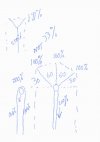
Some doodle from my phone without allowing for unknown friction.
... without allowing for unknown friction.

I think you got it right, Sprouts. While the totality of the forces isn't being reduced versus a straight basal tie over a single primary support point, every one of those forces in Mr. Mumford's pic ARE in a favorable direction on each of the supporting limbs. If the climber was anchored solely on one of those limbs out at the edge of the canopy, the torque on that one limb would be much greater than the near-zero torque presented in the diagram.I had for a while been canopy tie or bust. But. In the example in this photo, where you have the TIP spread out on the canopy, this seems much safer especially if you’re doing all the work way out on the edge of the tree away from the trunk. I can think of a lot of climbs that are like this. Using an adjacent tree as the TIP for a removal, usually the most advantageous TIP is often away from the trunk. Canopy tying just on that limb arching away from the trunk would subject it to a ton of leverage forces. DSMc put it well. By opening the angle it would reduce all that leverage force and make that TIP safer than if it were canopy tied just to that branch. This is what I’m coming to understand but please, someone correct me if I am wrong.
Thank you. This is very helpful.I think you got it right, Sprouts. While the totality of the forces isn't being reduced versus a straight basal tie over a single primary support point, every one of those forces in Mr. Mumford's pic ARE in a favorable direction on each of the supporting limbs. If the climber was anchored solely on one of those limbs out at the edge of the canopy, the torque on that one limb would be much greater than the near-zero torque presented in the diagram.
Even with no friction - if things are as they are presented in the diagram - that's still a much better configuration than the alternative (single edge-of-canopy limb anchor). Friction does indeed reduce the peak loads experienced at each of the redirects (but also slightly changes the vectors' directions - but probably not to a degree that is detrimental).
A base anchored climb line routed over multiple supporting limbs does not reduce overall force down the stem relative to a single primary support point, or even at any single supporting element necessarily. BUT, it does allow for near-ideal load vectors to reduce torque, AND allows for multiple support points to be encompassed, for redundancy in the case of failure. The trade-off is usually in the form of increased load magnitude for better load direction (in compression, that is to say).
I’m imagining a TIP like the one in the diagram taking multiple redirects... The side anchored to my harness will assuredly have 100% load. The section of rope that connects to the next redirect- what amount of load will that be, really? And we know from experience that the last leg of rope, going down to the basal anchor, in a configuration like this, can be near limp even when fully loaded due to the friction presented in the redirects. There’s no way that leg of the rope is receiving 100% of the load. So it’s being dissipated somewhere in the canopy. Just like in a rigging setup.this case friction and multiple other facets, back in during actual real world use, you will have inaccurate and misleading information.