Knot Starting Over!?!

*useless info*

Participating member
Location
usa
i think knotting is important here, in heritage/history.
and was integral to human thought
>>and it's understandings should be carried into the future.
(bucket list item still trying to get rite)
.
The capstan math re-affirming theories enough to try to re-organize and re-state from start;
focusing on the 2 things : lines(how slanted) and arcs(half circles) building from Zer0 of simplest things.
To/thru list KevinS posted in iso-step-by-step-knot-diagrams in it's wake :
Stillson
Swabish
.
Clove hitch
Taut line
Distel
.
Knut
Double fisherman
Figure 8
Running bowline
Alpine butterfly
.
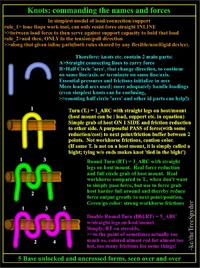
i think these are the most basic building blocks to start from and focus on:
1_knots-commanding-names-and-forces_.webp


.
Over and over again, Round Turn (RT) is the real workhourse;
single turn a minimal hook, purposeful pass of force to rest of chain, lazy get by, quickie, short on materials etc.
RT, the real day to day hero, perhaps make it a dbl.RT, here and there!
 
Worry knot, i'd know no way to tell this story
w/o standard benchmark (to me ) : RT+2HH and it's upgrade Anchor(+HH)
So surely basics as Anchor are on menu, after appeteaser pre-ramble module base, that Anchor is a strong combination of!
Hopefully w/o getting useless-ly tech-ie
.
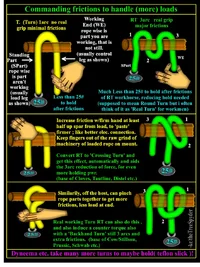
2-commanding-frictions-to-handle-more-loads.webp
 
Last edited:
This was going to be 2 pix, but fell together like this:
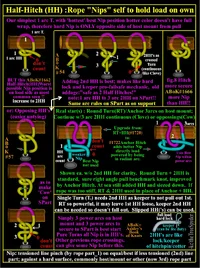
3_half-hitch-hh-rope-nips-self-to-hold-load-on-own_.webp

Round Turn + 2 HH is my basic benchmark rig hitch for right angle pull; easy to talk someone thru it's simplicitys especially if they know HH.
Anchor even more secure, 1 HH built in, secure w/1 more a/n, but not as cleanly simplistic.
Change between them is only, the Bitter End inside the power arc, of the capstan math.
>>Capstan math gives best frictions, grip, therefore Nip points!
.
These can take some side loading from 'lengthwise pull' (ABoK), but prefer HH preceding DBY type config on those
 
Last edited:
A good first step is to organise the various knots into logical groups.
Knots used in life critical applications can be grouped as follows:

[ ] fixed eye ... (eg figure 8 family, bowline family, etc)
[ ] mid-line 'Tiable-In-the-Bight' (TIB)... (eg clove hitch, #1053 butterfly)
[ ] end-to-end joining ... (eg double fishermans, zeppelin, etc)
[ ] termination ... (eg #409 double overhand noose, tensionless hitch, etc)
[ ] slide and grip ... (prusik, klemheist, etc, etc)
[ ] releasable load control ... (#206 munter hitch, mariner, etc)

...

*useless info* (forum member) has done some interesting work... I note a structure you refer to as a 'strangle' can only have that meaning assigned when it is tied around a host so as to 'strangle' it. If there is no host, then it isn't a 'strangle'... it is simply a double overhand stopper knot.
Also, what you refer to as a 'round-turn' really should be described in terms of degrees of arc:
[ ] U turn (180 degrees)
[ ] turn (360 degrees)
[ ] round-turn (540 degrees)
and so on...

All 'turns' setup a relationship with the capstan equation.

Note that for the everyday person, use of degrees is an easy to understand concept. If you wish to scratch your scientific itch, then use radians (but this gets more technical).

Also, the category of 'slide and grip' can be further divided into symmetric/asymmetric hitches and formed from a round sling versus formed from linear open ended.
 
I'm looking to focus on line of force, and half circle arcs;
as basic form that has capacity to 180 to same line axis.
right from the start, trace arcs, with view of Turn + HH as 1 arc w/ends drawn(draw not part of arc count). Find capstan math friction , compression etc. but not seeing the torque in each arc/half circle.
.
Round Turn I think of as 3 arcs, 540 degrees.
Real leverage power of hold over load 10x pick as benchmark nylon on aluminum on chart at .25 CoF.
.
Look to show patterns , to trace into groups as you say. But from base patterns shorthand of familiar components and forces.
.
From force view I look at symmetric friction hitch as 2 half load pulls equal/opposite of each other
vs. asymmetric of single full load pull.
Mainly, the symmetric loop legs are grabbing greater full load host mount/lifeline.
So compensate some with smaller diameter, stiffness as closer hardness match to host.
.
Seems mostly to stand, but then have had good luck and long wearing 3/8Tenex flattening out on 1/2" arbo lines in symmetrical/basket builds.
.
Look to show after killick , as most lengthwise pulls including friction higher show HH right angle to lengthwise pull converter form, very few friction hitch and parent lengthwise pull class work as alternative pattern of Tresse braids I think.
 
*useless info*, I would like to see you apply your theoretical concepts to the following end-to-end joining knots:

1. Zeppelin bend
2. #1425A Riggers bend.

One is totally jam resistant right up to its MBS yield point...while the other horribly jams.

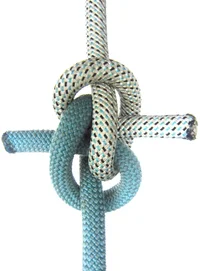
Zeppelin is built from 2 superposed loops of opposite chirality.
#1425A is built from 2 inter-linked loops of same chirality.

The question to you is:
Why is the Zeppelin bend totally jam resistant? (precise explanation please).
Why is #1425A vulnerable to jamming? (precise explanation please).

Note: Supplied images are my intellectual property - due credit to be given if used for not-for-profit activities (eg theoretical discussions). Not permitted to be used in any context where a profit will be made or for any form of business/corporate related activity.
Zeppelin_ZS.JPGRiggers-Bend_SS.JPG
 
Also, the category of 'slide and grip' can be further divided into symmetric/asymmetric hitches and formed from a round sling versus formed from linear open ended.

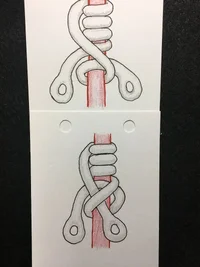
Friction hitches with double eyes, or legs can sometimes be rotated 180 degrees for a different configuration, that may function differently than the original. Another area to look into is that some hitches can switch the functions of the eyes with each other, to form a different hitch, an example would be the Distel and Happy Hands hitches.
B2971EC9-1A14-4950-9097-5C1FC0F85BFA.webp
 
Very nice! knudeNoggin especially, and i believe Agent_Smith are great advocates of dual view!
(mostly i'm too worn out from making front view..)
*************************************.
Agent_Smith quest-ion/puzzle>>
Pre-ramble Note:
These 2(Zeppelin/Rigger's) do show 2arcs each, then half arc
>>half arc to terminate is 'legal' in my line and half circle arcs breakdown
>>Explain this in Sheet, Hitch and here as terminates force flow still in this line of force defined.
If force flow persisted as straight line off that 90 and wasn't a continuing, pinching, pasting turn, would look to call another system, with it's own unique force line.
But, i don't think this answer is in the capstan maths(not sure asking that to explain question)
*************************************.
Best Answer Zeppelin/Rigger's : (perhaps more conceptual than precise)
Linked lengthwise vs. sidewise change, would look for any inline rather than sideways cross to more lend this way..
i've run into this puzzle before with these 2 bulls in pen and troubled theories for some time. Truly think causation is the more most fiercest directly inline of Rigger's to hyper-tighten and fuse close at MBS vs. the near miss, but not seating so to each other but apart some, as the 2 bull forces miss each other more of Zepp/Ros. The cross linked profile of the Rigger's (rather than side by side of Zepp) would seem to pull apart, but pulls more inline. Side by side Zepp architecture lends more of higher amplitude of change of side force.
.
To my 'electrical' schematic force view, Riggers is more of continuous line, Zeppelin; some buffer.
So again, i blame geometry, just not of the matching shapes, but rather their force lines. Was looking so hard at matching form's geometry for so long so intently, had to back off to see the near miss effect. And more pinch across of Zeppelin toward line of force vs. more into line of force in Rigger's. Sine JUMPS sideways in force few degrees deflection from pure inline, change in direction AND impact of change, more prevalent in Zeppelin.
.
i always look to run tough maze backwards for solutions, and cross-verification/parity check of should read same 'sum' forwards or backwards. Here, would say if the 2 bulls (a common farm imagery of raw power forces for me); were charging w/same force only compression, not tension; less jam in near miss! Tension is same, only reverse direction AND side force tries to pull inline (compression push, side forces push out of line).
.
*************************************.


Other useless thoughts:
capstan math worx to compound the inefficiences thru the system.
>>the root number 'e' in math (Euler's) capstan math uses, is same used for compound interest(as the original puzzle built for) etc. in these equations 'e' is root number 2.78_ for logarithmic expansion, everything else is exponent of that trick number!
.
i l-earned BFly as eye first, but am looking to show as Bend first.
.
i really like Blue color of rope, as background contrasting choice, but also found Blue towel background contrasting bg for other color ropes. Liked bright tapes on end too.
>>These ropes kinda look stiff tho for realizing and showing how good (fave)DBY is?
.
Totally understand and extend same intellectual property clause, and have taken to branding s-lightly (perhaps thought for Brocky too add tag in photo editor, years down the line of throwing pix would probably be glad did that..), but also for continuity of looking at same person's theories as this set of pix vs others (not that i'm afraid of someone thinking like me; or even admitting so, jest to help keep these piles fairly sorted!). And thus ask for no changes including sig. Lends credit, continuity to other works as a set, and makes those that don't go along; really stand out! Also, would be service perhaps to name knots as part of pic, especially handy in big pic yrs. later. Easy enough to blot out later a/n.
.
Kinda used old worlde capstan pix to explain effect, but don't look so much for capstan twist on rope, any more than pipe. And see HH as directional converter in Bowline as is as lengthwise Killick effect(ABoK #271 shows same knot as more proper right angle pull for rock as anchor as KILLEG and other names).
>>i think lengthwise pulls is own thread/study, extremes of which are the hitches on tapered host and too Friction Hitches that not only hold like other knots, but slide and still hold. And how further more climbers work these not as occasional slide and hold on tent stake etc. but as main function. Especially to demand so much precision. Then how break form from variants of preceding Half to tresse's (very few) etc. Of these extreme non-right angles to host mount/ lenghtwise(ABoK) usage. So, everyone knows this angle of usage in rope is crossing the line; all precautions must be taken!


edit: Thanx, have edited Strangle reference to notate lack of host mount of log or sack;
as most correct. i originally did have log in there, tried to fade like rest etc. but just couldn't show story. i do define nonBinding knots as the ONLY ones w/o host to form around. Hitch, Bend, Binding knots all imply host mount. Only knot to self, that doesn't bind has proper form w/o host mount of log, hook, bag, other line etc.
wiki_Clove-of-Crossed-Turn-Family_3.png

.
As a Binding Knot type, simple Square/Reef doesn't give an 'input force handle' (or Square comes out of square and capsizes); but binding knots like Bag/Ground line etc. can make great hitches! Clove, doesn't seize self; by Nipping (after RT 3arc reduction and crossing(s)Bitter End , directly to hardened host by main/full load like seen in Binding Knots shown. So Clove is Hitch only, not binding, even tho parent of a few binders!

 
Last edited:
Friction hitches with double eyes, or legs can sometimes be rotated 180 degrees for a different configuration, that may function differently than the original. Another area to look into is that some hitches can switch the functions of the eyes with each other, to form a different hitch
That wasn't my point.
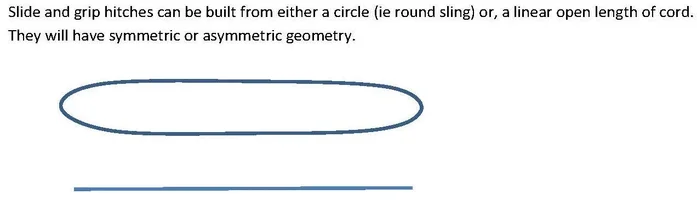
What I was stating is that a slide and grip hitch can fundamentally be built from either of the following:
1. A circle (ie a round sling); or
2. A linear open length.

Within the tree climbing industry, there is a tendency to form slide and grip hitches from linear, open lengths of cord. In contrast, in vertical rescue teams, rope access work and rock climbing, circles (ie round slings) are more common.

Regardless of starting base, the hitch will either be symmetrical or asymmetric.
Example 1: #1763 Prusik hitch is formed from a circle (ie round sling) and it is symmetric.
Example 2: A Distel hitch is is formed from a linear, open length of cord and it is asymmetric.


Slide-and-grip-Hitches_geometry.webp
 
Last edited:
RE: Explaining how a Zeppelin bend works and why it is jam resistant (in contrast to #1425A):
Best Answer Zeppelin/Rigger's : (perhaps more conceptual than precise)
Linked lengthwise vs. sidewise change, would look for any inline rather than sideways cross to more lend this way.
I am unable to extract anything meaningful from this explanation.

The cross linked profile of the Rigger's (rather than side by side of Zepp) would seem to pull apart, but pulls more inline. Side by side Zepp architecture lends more of higher amplitude of change of side force.
This is starting to make a little more sense but, it does not explain why one jams and the other doesn't. You are simply attempting to describe geometry rather than how force is propagated within the knot.

To my 'electrical' schematic force view, Riggers is more of continuous line, Zeppelin; some buffer.
So again, i blame geometry, just not of the matching shapes, but rather their force lines.
I can't extract anything meaningful from this...

Was looking so hard at matching form's geometry for so long so intently, had to back off to see the near miss effect. And more pinch across of Zeppelin toward line of force vs. more into line of force in Rigger's. Sine JUMPS sideways in force few degrees deflection from pure inline, change in direction AND impact of change, more prevalent in Zeppelin.
It seems that you might have mixed up the Zeppelin bend with #1425A Riggers bend?
There is no 'pinch across' in the Zeppelin. I interpret 'pinch across' to imply a diagonal effect. Is that what you had in mind?
Whereas in the Riggers bend, there is a 'pinch across' (diagonal) line of force.
With your 'jumps sideways' reference, which knot are you referring to?
I'm getting lost here...


That wasn't my point.
What I was stating is that a slide and grip hitch can fundamentally be built from either of the following:
1. A circle (ie a round sling); or
2. A linear open length.

Within the tree climbing industry, there is a tendency to form slide and grip hitches from linear, open lengths of cord. In contrast, in vertical rescue teams, rope access work and rock climbing, circles (ie round slings) are more common.

Regardless of starting base, the hitch will either be symmetrical or asymmetric.
Example 1: #1763 Prusik hitch is formed from a circle (ie round sling) and it is symmetric.
Example 2: A Distel hitch is is formed from a linear, open length of cord and it is asymmetric.


View attachment 62280

Understood what you were saying, even without the visuals, and was stating other fundamentals of friction hitches.
 
On friction hitches, I think we should go with loaded legs of connection load/support to categorize.
>> Loop doesn't need eyes, but can't lace as many ways, dual leg.
>>1eye , linear load, single leg
>>2eye most flexible load as 1eye or any 2eye lacing(any loop lacing, plus)
Single leg full load to host mount grabbed of same tension.
Dual leg pull half load grab to full load /higher tension host mount.
>>I think smaller, tighter chord works here to help compensate for lesser grab greater
>>and as Sheet Bend , w/bight as passive mount, active grip of hitch (preferably w/RT) can be equal, lil'smaller for tighter grip, BUT never larger, nor softer, the locking grip should give, not take, any beating!
I think follow force thru architecture, not just architecture.
>> also tension/hardness differences and impacts of change.

As in Turn HH, eye says rope all around,
Need to squint to see U in power arc of best nip via capstan math vs. V of ends drawn together as not same.
*****************************************.

Lengthwise vs. Sideways linking
First arc/half circle each from SParts that form hardest surfaces
(combine SPart and 1st arc to hook imagery each for 2 main loaded hooks)
Riggers hooks coupled, like boxcars on same track, to pull inline more purely.
Zeppelin's hooks more side by side boxcars on different tracks
>>BUT, pulls inline in big picture,so sidecar hooks must pull across,
>> this disposes of some, therefore peak forces
I don't think the effect carries to sister form BFly Bend as more of opposing hitches, Cow , of counter torque Backhand Turn base vs. more continuous direction , 2HHs , Clove walking, self tighten .
.
I try to follow force in comparative, generic models and devices. Rigid to flexible to electrical all as force is force thru conducting w/o overloading, and chasing equal opposites from point to point thru connection. Many times, blurring to generic patterns reveals the simplicity's of what have been staring at too hard. Also, all should cross verify.


Quoting ancient.eu/article/606/greek-mathematics/ a main technique in Euclid's Elements said:
"The technique of abstraction, based on ignoring physical considerations which are seen as merely incidental. Whether it was a rope, a piece of wood or any other physical object was irrelevant. It was all about properties of 'straight lines' connecting at angles, nothing more. These lines are simply mental constructs and the only entity necessary to the solution of the problem. The process of abstraction is about getting rid of all the nonessential elements and considering only what is fundamental."


.
 
On friction hitches, I think we should go with loaded legs of connection load/support to categorize.
That's a different proposition.
Again - what I was stating is that fundamentally, when a person ties a slide and grip hitch, it will be formed either from a round sling (ie a circle), or it will be formed from a linear open ended length of cord.

What you are discussing is actual loading profile (as opposed to tying methodology and topology).
You are correct with your proposition re loading profile.
Slide and grip hitches can be loaded as follows:
[ ] single leg loading
[ ] dual leg loading

When a person ties a slide and grip hitch from a circle (ie round sling) - dual leg loading is nominal. And there is a limited number of geometries that can be achieved.

When a person ties a slide and grip hitch from a linear open ended cord, it is possible to enable single leg or dual leg loading.

Tying with linear, open ended cord also provides more options for different types of geometry.
There will be geometries that can't be achieved when using a round sling.

And this is likely why the tree climbing industry migrated to predominantly using linear, open ended cord - because it enabled experimentation with many different geometries that could not be achieved with a round sling.
Slide and grip hitches are still considered an important component for tree climbers. Other roping industries have gone totally 'mechanical' (ie rope access industry virtually doesn't bother with slide and grip hitches anymore - and in fact, there is a push toward powered ascent devices).
 
Last edited:
Started thread for trying to offer alternate view of remembering, checking, grooming/dressing lacing by it's force flow thru it's members etc., not just topology as possible key.
To finely and purposefully craft, like any other device in wood etc. where artisan follows grain etc. extruding something for specific targeted use, rather than just stamping out blindly looser, misunderstood generics
.
To recognize the U of radian arc/capstan math vs.
V of ends drawn together;
so see Turn w/HH as 1/2 circle power arc and a close, not a full wrap, more open ended.
.
i think that takes us to next level, give to some as start so they can watch those properties all the way thru rope experience. So, they then can see beyond what i do from this hill, to their higher; simply adding mine as the coral, not to be the end, nor peak; but give best support into the future.
.
Thus always thinking frcition hitches etc. would be taught by scouts for mechanical need, not jsut lacing contest; show as machine; really cool frigging machine can do magic with compared to rest of lacings! Also lends more to understanding world around them.

.
i think knotting is integral, root combining properties and powers of, mechanical commanding outside self. Running mouth offline am even more of smart -azz ; and say 'man' was knotting (in peace) before 'she' had language to say he was doing it wrong. Grew up around a lot of rosary beads, almost seems like part of the peace of them now was handling ancient device... i think lacing for shelter and clothing pre-dated commanding fire,numbers, lever, wheel nor language. And first idea of linking properties and their potentials to larger unit outside self. Linking together commands to combine their powers, makes computer program etc.
 
Last edited:
Started thread for trying to offer alternate view of remembering, checking, grooming/dressing lacing by it's force flow thru it's members etc., not just topology as possible key.
Yes - I understand your underlying motive for starting this thread.

What I am struggling with is how to interpret what you write - in the context of slide and grip hitches employed in tree climbing applications.

To recognize the U of radian arc/capstan math vs.
V of ends drawn together;
so see Turn w/HH as 1/2 power arc and a close, not a full wrap, more open ended.
The construction of this paragraph and the manner in which language is used makes it difficult to ascertain precisely what you are saying.
The first part is the "U of a radian"
1 radian = 57.3 degrees
By 'U'... I assume you mean 180 degrees?
180 degrees = 3.14159 radians (Pi radians).
360 degrees = 6.283 radian (2 Pi radians)
There are 2 Pi radians in a circle.
I assume that you are defining a 'turn' as 360 degrees?

...

I would comment that your analysis does not appear to take into consideration the following:
1. The % ratio of the hitching cord diameter in relation to the host rope diameter.
Have you conducted peer reviewed testing to determine the effect of changing the % ratio?

2. The frictive properties of the sheath of the hitching cord interface against the frictive properties of the host rope.

3. The effect of load on the host climbing rope - that is, what effect does a loaded climbing rope have on the performance of a slide and grip hitch?
Perhaps you may only have considered situations where there is zero load on the climbing rope?

4. The fall-factor that triggers a total burn-through of the hitching cord against the host climbing rope (assuming 100kg drop mass). At what FF magnitude do various slide and grip hitches suffer catastrophic burn-through / disintegration?

For example, I already have experimental evidence that a #1763 Prusik hitch disintegrates at FF 1.0 using 100kg drop mass (6.0mm hitching cord on 8.0mm host rope). This test was carried out to warn against use of the AZTEK 'Purcell' as promoted by Reed Thorn.
 
i mean U as arc shape + legs, the load force in basic turn.
V as draw of ends together as in turn/ HH side towards load, breaking the legs of U from land force arc/leg U as simplest loaded form.
a Turn as 180 w/straight legs down
arc as 180 w/o legs
360 i think of as 'full turn' personally,
Round Turn RT (real turn!) as 540 10.5x leverage brakeForce @ benchmark .25 CoF
.
i say 50-75% on cord diameter, and capstan CoF is where this has started .
.
Kinda like the Purcel, especially as adjustable spacer for pulley run, lanyarding to and experimental lengths for like foot stirrup (garden hose) to hand cam. will have to look into that!
.
Side loading of preceding HH i think pulls more out of line leverage with more and more basement turns below the leg of support.
.
Will have to draw some more of pix in head after work, not sure am setup for the land tests etc. as you ask. Conceptual is a different kind of comprehensive. Not really reaching same direction of magnitude.


edit:
so see Turn w/HH as 1/2 power arc and a close, not a full wrap, more open ended.
shoulda been :
so see Turn w/HH as 1/2 circle power arc and a close, not a full wrap, more open ended.
sorry! >>will edit this too, thanx.
 
Last edited:
per Brocky:
What were the cord and rope made of, and did you only test these materials?
This question comes in 2 parts:
Q1. As stated above - it's a standard AZTEK
I'm surprised that you are unaware of an AZTEK? An AZTEK would be a very handy bit of kit for tree rigging work.
Built from 6.0mm hitching cord on 8.0mm host cord.

Q2. Sterling USA are the manufacturer of sewn 6.0mm Purcell and 8.0mm high strength cord.
And yes, the objective of this particular test was to evaluate the AZTEK when used as a personal adjustable lanyard (PAL).
The AZTEK is marketed as both a pre-rigged micro hauler and a 'PAL'.

In fact, if you use the AZTEK in the manner they (the supplier) suggest you will experience a 'RUD' if you suffer a fall-factor 1.0 (or greater).
NOTE: RUD = Rapid Unscheduled Descent! (ie express elevator fall to your potential death).

COMMENTARY:
A slide and grip hitch is not intended as a fall-arrest device.
That is not their purpose.
They can be used for 'positioning' - under the nominal weight of 1 person. Fall-arrest is an entirely different proposition.
In the case of an 'AZTEK', the Purcell never gets a chance to 'activate'. The interface of the Purcell on the host cord is the principal point of failure.
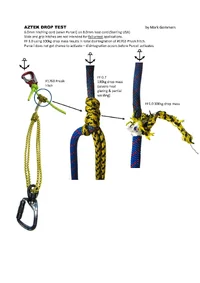
Purcell-drop-tests.webp
 
On a dual leg system, as the internal Purcel vs. the mono Prusic external of Purcel to green/blue lines
>>totally different things>>fave topic.
.
Is there plenty of elastic length in tested system to take initial hit?
>>visualizing steam pressure, any elasticity dampening allowing pressure relief to lower system loading, connected devices etc.
>>thus some slide in hitch at certain time could be beneficial, anything that allows steam pressure to sneak outside of kettle.
.

A mono leg system part totally has all load, slipping hitch is commanded to tighten more.
vs. non-mono, where knot slip is like rope tearing on one leg buddy(s) take load as stiffer lines.
>>friction hitch can be slid loaded on command, knots don't tighten as hard
>>cuz other leg(s) are stiffer as the weak or slipped leg goes to extend.
>>sometimes this is all that is needed in certain ranges to look normal.
.
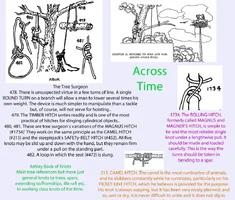
Many tree climbers use olds-cool DdRT Doubled Rope Technique over a limb and back to self for friction hitch as a retrievable setup as ABoK shows. Thus this gives different effects, and more fall/fault tolerant, especially with friction of support. But, the dual leg w/o slide will give less elsatic dampening response than if same weight on single line /SRT. But, then also gives 2/1over own bodyweight before friction on self lift and descent on htch clean and smooth between half loaded and stiffer leg mechanic. See similar in Bowline.

abok-across-time.png
.
More History>>found this again the other day, kinda heritage of tree work craziness, rico
finishing his first tree about 1.15, nice gunning footage about 3.00 etc.
 
Last edited:

New threads New posts

Kask Stihl NORTHEASTERN Arborists Wesspur TreeStuff.com Teufelberger Westminster X-Rigging Teufelberger
Back
Top Bottom