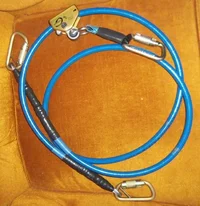
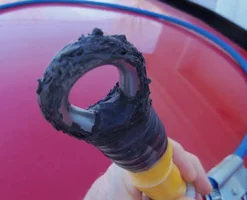
Steel core lanyard failure.

hearing that the failures are occurring on lanyards without the swivel snaps i suspect that also might have something to do with it? these lanyards are several strands of wire twisted together, and each of those strands are individual steel threads comprising those strands. all i can think is that perhaps without the swivels any twist that is put into the lanyard during regular use that it opens up these strands allowing water to penetrate more and reach the interior of each strand, essentially corroding each thread as opposed to just the outside of the strands if they remained woven tightly.

I look it like when ripping a phone book, the technique isn't to rip all 1000 pages at once, you hold it so basically each page starts ripping independently and it makes it much easier... with the twist imparted with the regular rope snaps as opposed to the swivels, this lets water and rust to degrade each strand individually opposed to as a 'wire' as a whole. Id like to see break tests between old used traditional snap lanyards and lanyards with swivels in place.
 
So a couple things are:

-Like above uncover the splice completely.
-I've heard they cover it to help protect the users hands from every day cuts and scrapes.

-The other thought is to make the swivel snap a must.
-Snaps without a swivel can sometimes be twisted and apply extra force on places it isn't supposed to be.

If I am contacting manufacturers it should be once with a list instead of one thing at a time.
 
hearing that the failures are occurring on lanyards without the swivel snaps i suspect that also might have something to do with it? these lanyards are several strands of wire twisted together, and each of those strands are individual steel threads comprising those strands. all i can think is that perhaps without the swivels any twist that is put into the lanyard during regular use that it opens up these strands allowing water to penetrate more and reach the interior of each strand, essentially corroding each thread as opposed to just the outside of the strands if they remained woven tightly.

I look it like when ripping a phone book, the technique isn't to rip all 1000 pages at once, you hold it so basically each page starts ripping independently and it makes it much easier... with the twist imparted with the regular rope snaps as opposed to the swivels, this lets water and rust to degrade each strand individually opposed to as a 'wire' as a whole. Id like to see break tests between old used traditional snap lanyards and lanyards with swivels in place.
I assume if it's life support the manufacturers would have those numbers. It can't hurt to ask and see what they say.
 
I assume if it's life support the manufacturers would have those numbers. It can't hurt to ask and see what they say.

well when brand new both types, swivel snaps and non swivel snap lanyards will meet or exceed the 54oolb breaking strength according to ansi. im saying after years in the field, where additional twist from the lack of a swivel might allow the strands to open up more letting water and grime attach each thread individually more than what might happen with a lanyard that relieves the twist through a swivel. This isn't fact by any standpoint, rather its just a thought that crossed my mind that seems to make a little sense, especially explaining how these failures seem to come from lanyards without swivel snaps.

-Steven
 
I make my own, and I keep about 6" to 12" at the ends reinforced to stiffen them up, so all of the flex occurs out in the main length of the things, not at the crimp ferrules. I use three ferrules and a lot of rubber hose and double-wall, adhesive lined shrink tube to do this. I also don't use rope for the sheath, I use ordinary 3/8" air hose. Sounds strange, but it works great. The stuff is a lot tougher than rope, grabs the tree well, and yes... ordinary rope grabs hold onto it just fine. I use 5/16" cable (stainless steel, lately), although the ones I've made with 1/4" cable are holding up fine. Those ones, I put 3/8" dbl-wall, adhesive lined shrink tube over the cable before putting it through the hose. Makes it fit the 3/8" hose better. I worked with a friend at a local utility company when I was prototyping them, and we did a lot of pull testing and drop testing with them.

The down side is, you can't inspect the cable without cutting off the shrink tube and pulling the hose back a bit. My original prototype is still in use, I've done this several times with it over the last 6 years. I just shrink tube it back up, because it's still not showing any problems. I've seen so many videos of people using ragged, rusty fliplines that I decided to try this approach to see if it worked better, and so far, it has for me. They're stiffer, and heavier. I tolerate the weight because I like the way it works, and I wasn't impressed with the construction of the two commercially made ones I've owned. Obviously, my attorney at the law firm of Dewey, Cheatum & Howe has advised me that I cannot recommend that people use homebrew PPE equipment because you might fall on your head.


I absolutely love the idea of making your own lanyard out of stainless steel wire. That would produce an end product superior to anything else on the market, in my opinion. I like the way you think about excess length after the crimp, and multiple crimps.

I would love to see photos of some of your end products, as well as any you might have taken during the assembly process. I fully understand that anything I produce as a result of your sharing of such information is fully at my own risk and responsibility.

Any links you might be able to provide for the crimp tool that you use, as well as any particular materials that you prefer to use (especially the crimps or swags or whatever you call them) would be greatly appreciated. I know this is asking for a lot, and I'll understand if you choose not to do all of this.

Thanks in advance for any help you can provide.

Tim
 
If the guys from treestuff, Sherrill, etc. Made the requests for lanyards with clear shrink wrap instead of the black rubber it may happen. I'd be willing to start a petition to send to the manufacturer as well to help push a change for safety.

Would anyone be willing to put there name on that?

I would.

Tim
 
I also happened to have a Maryland Arborist Association meeting today, I brought this up. Two very large (well known) companies said they also heard about this death and the entire company threw ALL of their steel core lanyards away.

That is very impressive. A testament to how serious those companies are about safety. They have their minds in the right place.

Tim
 
Where are you looking? Maxi 5/8 is all I use now and I have a hard time finding them without swivel snaps.

By the way 'work hardening' is the bigger culprit. That doesn't take time it takes cycles to failure. Bend a piece of wire back and forth in the same place and it will break. Aluminium 5 or 8 cycles, mild steel like a coat hanger 15 to 20 cycles, strands of cable?

Thanks for this. Makes one wonder. If not rope, or wire core, what else exists that could allow a huge number of cycles to failure with regard to being flexed like that?

It makes me think about high volume manufacturing operations, and what solutions they've found in similar circumstances.

Tim
 
I know this is asking for a lot...

No, actually, it's not. I'd be more than happy to. I'll spread the pics out over a few posts so as not to interrupt the flow of the thread. I'll put together another one in the coming days, and take some pics of the process, as there are some details that might be helpful. I'll start on this today. Here's a couple of pics of some of the ones I have laying around the house.

Flipline-Long.webp

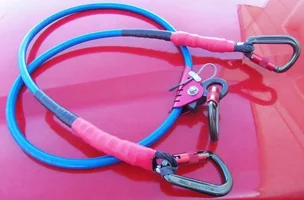
This one (above) is about 8.5' long, 1/4" SS cable with 3 ferrules at the business end and two ferrules at the "tail" end. Nylon link on adjuster can be cut to release injured climber in an emergency (I don't do this on all of them, I try a lot of different ideas). Ferrules are spaced well apart, sections of hose between them. Gorilla Glue (polyurethane, expands) dripped into the ferrules fills up any gaps, helps stabilize the ferrule/cable crimp, and keeps water out. Wrapped very tightly with several layers of PVC (electrical) tape. The cheap, 3 rolls for $1 stuff is fine for this. Remaining length of cable is covered with 3/8" adhesive-lined shrink tubing plus another layer of the regular single layer stuff, to fill the space between the cable and the hose and keep moisture off the cable. Followed by 3 or more layers of double-wall, adhesive-lined Polyolefin heat shrink tubing, in about 3 sizes, over the whole end where the swaged ferrules are. When done, these ends are very stiff, there is NO flex down by the thimble/eye regardless of the connector type. All flexing and twisting takes place in the main body of the cable, starting about two or three inches out from the last ferrule.

This eats up about 6 to 12 inches at the ends, where the cable is so stiff it doesn't really want to bend around a stem. This is only a problem if you try to adjust it so you're real close to the tree... which I don't do, anyway. It does limit how close to the tail end of the cable the adjuster can get, as it will jam up against all that shrink tubing, so you have to allow for this when deciding on the length you want. This particular flipline uses steel carabiners with stainless bar type corner traps, and the larger Climb Right rope grab. The adjuster must be able to handle 5/8" rope, because that's about the outside diameter of the hose. This adjuster works fine. Since I have used a lot of different adjusters, I'll mention any problems I've had with any that are shown in the pics. Also, this does NOT make a lightweight flipline. It makes a very, very tough one. Stiffer than the commercially made ones, even. Very easy to flip, I've found, but a tad awkward, because it's not supple, so you have to adjust to it. I climb up with two of these, and when the stems get down to about a foot in diameter, I switch to a short one of these and short rope lanyard, and just leave the two long ones hanging on the tree for the trip back down.
 
No, actually, it's not. I'd be more than happy to. I'll spread the pics out over a few posts so as not to interrupt the flow of the thread. I'll put together another one in the coming days, and take some pics of the process, as there are some details that might be helpful. I'll start on this today. Here's a couple of pics of some of the ones I have laying around the house.

View attachment 30992

This one (above) is about 8.5' long, 1/4" SS cable with 3 ferrules at the business end and two ferrules at the "tail" end. Nylon link on adjuster can be cut to release injured climber in an emergency (I don't do this on all of them, I try a lot of different ideas). Ferrules are spaced well apart, sections of hose between them. Gorilla Glue (polyurethane, expands) dripped into the ferrules fills up any gaps, helps stabilize the ferrule/cable crimp, and keeps water out. Wrapped very tightly with several layers of PVC (electrical) tape. The cheap, 3 rolls for $1 stuff is fine for this. Remaining length of cable is covered with 3/8" adhesive-lined shrink tubing plus another layer of the regular single layer stuff, to fill the space between the cable and the hose and keep moisture off the cable. Followed by 3 or more layers of double-wall, adhesive-lined Polyolefin heat shrink tubing, in about 3 sizes, over the whole end where the swaged ferrules are. When done, these ends are very stiff, there is NO flex down by the thimble/eye regardless of the connector type. All flexing and twisting takes place in the main body of the cable, starting about two or three inches out from the last ferrule.

This eats up about 6 to 12 inches at the ends, where the cable is so stiff it doesn't really want to bend around a stem. This is only a problem if you try to adjust it so you're real close to the tree... which I don't do, anyway. It does limit how close to the tail end of the cable the adjuster can get, as it will jam up against all that shrink tubing, so you have to allow for this when deciding on the length you want. This particular flipline uses steel carabiners with stainless bar type corner traps, and the larger Climb Right rope grab. The adjuster must be able to handle 5/8" rope, because that's about the outside diameter of the hose. This adjuster works fine. Since I have used a lot of different adjusters, I'll mention any problems I've had with any that are shown in the pics. Also, this does NOT make a lightweight flipline. It makes a very, very tough one. Stiffer than the commercially made ones, even. Very easy to flip, I've found, but a tad awkward, because it's not supple, so you have to adjust to it. I climb up with two of these, and when the stems get down to about a foot in diameter, I switch to a short one of these and short rope lanyard, and just leave the two long ones hanging on the tree for the trip back down.
Why no swivel?
 
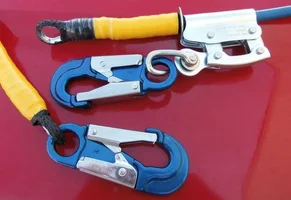
The short version, mentioned in previous post. I use both ends, because the full length is about right lots of the time, without the adjuster. Rope grab is the CMI Ropewalker one. Cable is 5/16" galvanized. Aluminum carabiners and short length make this one fairly light, in spite of bigger cable. It's 6.5' long. I really like this one a lot. Going to make up one very much like it using stainless steel cable, stainless thimbles and a stainless version of the CMI adjuster.

Short-Flipline.webp
 
Why no swivel?

Just haven't needed them. The eye/thimble doesn't flex on these, and the coil memory of the cable gives them a curved shape. I put them together so that this natural curve keeps the carbiners or snaphooks oriented correctly. This means, of course that they tend to only show wear on the inside of the curve... but the ones in the pics have actually been used, but you'll notice they aren't ragged. That hose is tough stuff. If you hold it in your hand, there's light scratches and scuffing on them, but it's hard to see. I also clean them up after a climb by spraying a little WD-40 on them and wiping them down good. The methanol in that stuff is a good solvent. The light machine oil in it soaks a little bit into the polyurethane hose and actually keeps it from drying out and shines it back up. Weird side effect or bonus, I guess.

This is an ongoing project of mine, but I've discovered a couple of nifty things, already. You'd think that any moisture that got into these would rust them up quick, but that just hasn't been the case, at all. In my next post on this thread I'll have a pic of an early prototype I made in 2011 that started out 14' long, but I've cut it apart a few times to inspect it and it is now only about 9' long. That one is lots older, but doesn't look any worse for the wear. It doesn't get used a LOT, but it does get used a bit throughout the summer. Earlier this winter I pulled it with 900 lbs. to see if the swaged ferrules would slip after a few years of being on there... they did not. I was not attempting a destructive test, as I don't like to destroy usable gear if the results are not going to be enlightening. I've already done enough of that in 2012 to know that these aren't going to break, but I've retested some to see if there was any difference between using 2 ferrules or 3, and quite honestly, there isn't enough difference to warrant the third one. But, it does move the stress point even further away from the end, so I still do it, sometimes.
 
Stainless wire rope may well have far different properties...

It does, indeed. With cable, the 316 SS isn't as strong (tensile) but that one isn't an issue for this application, in itself, because it's still far above what's needed. I'm still working on some definitive information on work hardening and flex properties. I can do some testing on my own, with that regard, so I'm negotiating with a friend to get my hands on an old hardware store paint shaker machine that he suddenly claims is a highly prized family heirloom, in some weak ass attempt to drive the price up. I'm pretty sure I can modify it to serve my needs, once I convince him that another idiot willing to actually pay him for it won't be coming along anytime soon. As long as the Smithsonian Institute doesn't make him an offer to aquire it as a museum piece, I think he'll come around.
 
Here's the prototype I mentioned. The "tail" end has been cut off several times so that I could inspect for any damage or signs of corrosion. The last time, I added the washers to stop the adjuster from jamming into shrink tubing if it slipped, although it hasn't actually ever slipped. I did some low-height testing with hanging off of the adjuster with the thing hooked to an anchor at the other end (single rope mode) and I expected that it would slip down to the end, but it didn't. The adjuster is a dual-cam rope grab used for fall arrest, and has to be threaded onto the lanyard during construction. This one is actually the best of the lot, as far as grab power. You just squeeze it to move it, so really easy to use. Cannot adjust it under load, though, you have to take most of your weight off of it first.

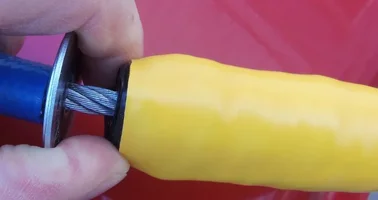
The washers also allow me to pull them back, against the hose and expose the cable where it enters the last swage ferrule. As you can see, the cable looks brand new and there is no fraying, but this is the tail end. The first time I cut it apart, I redid both ends (basically rebuilt the thing) and the working end of thing looked the same, as well. It appears that the basic idea works well, in that all the reinforcing keeps the flexing away from the terminal end. It also appears that the heavy use of hose and shrink tube is not, in fact, trapping moisture and causing the cable to corrode, which was a concern I had when I started out. Of course, I don't leave them laying around in truck beds or toolboxes, and I clean them at the end of the job. I have been spraying WD-40 down into the tubing, on this one, at the tail end where I can expose the cable. I then hang it up with that end at the top so it can run down the length of the cable. I'm not sure if this is helping, or not, but it isn't hurting anything, either.

Proto-Detail.webp

Proto.webp

Proto-Detail2.webp

Last photo shows Permatex black silicon adhesive/sealant used to seal up cable ends. Looks a mess, but works. On others, I have used heat shrink tubing around the part of the cable that goes around the thimble, before assembling it, and that looks a whole lot neater.
 
I think the difference is whether the construction method requires inspection. If the flex and corrosion at the terminal ends aren't there, there's nothing to see. You would still need to have an idea about what an appropriate schedule would be to replace the lanyard, and that is something that requires time and more testing than I've done. I have an idea for windowing one of these in a few places, that I hope to try sometime in the next week or two. To be honest, I'm not expecting to see a damn thing that I don't already know, but I think that it is always a good idea to keep testing/improving things constantly. Lack of that attitude might be part of what has led up to the current steelcore flipline problems. I'm convinced that the problem isn't the idea, it's the construction methods... and the "if it ain't broke don't fix it" attitude. I think it is broke, myself. With only minor changes, it appears that you can address the problems. I agree that the clear shrink tubing will help with the current method being used to make the things, but I think it's like checking the oil twice a day in your truck, because you don't want to have to fix the oil leak. It doesn't actually address the problem very well. For me, I'd rather play around with homebrewing them in the hopes of coming up with a better solution. Perhaps someone with more brain power than I have will come up with even better solutions.
 
After jeffgu theory I think the main problem is the movement before it is the corrosion. Especially if stainless is used. So it looks like jeffgu has fixed that. Even if his flex a tiny bit it is not nearly flexing enough to break with the repetitions to failure theory. If galvanized is used wouldn't the treatment be compromised by the over flexing? Then lead to corrosion? Sounds like DED[emoji3] the bending is the beetle and the rust is the fungus.


Sent from my iPhone using Tapatalk
 
...the bending is the beetle and the rust is the fungus...

I think that's it, exactly. With a single, steel, hydraulically swaged ferrule right at the eye, all of the flex is right there and it's a lot of flexing in a very short span. With the multiple, aluminum ferrules, spread out and the cable reinforced with extra hose, etc. for a few inches past the last ferrule, the flex is spread out over the next foot or so of the cable. The cable is doubled from the eye/thimble for several inches going through the ferrules, so that part is very stiff. The cable handles reasonable flexing very well... just not the severe flexing over a short span that occurs with the usual construction method.
 

New threads New posts

Back
Top Bottom