Knot Starting Over!?!

per *useless info*
Is there plenty of elastic length in tested system to take initial hit?
I am unclear if you are directing this question to me?
If yes, and you are referring to the AZTEK drop tests... i would comment that in my test it was configured to induce FF 1.0.
This resulted in total destruction of #1763 Prusik hitch on host Sterling 8.0mm cord.

Richard Delaney (Rope Test Lab) also tested the AZTEK at FF 2.0.
See his video here:
He also did tests at lower FF magnitudes - but you need to be a member to view them.
I found that any FF at 1.0 or above resulted in catastrophic burn through.
At FF magnitudes below 1.0, its a game of Russian roulette - for example, at FF 0.7, the #1763 Prusik suffered severe heat glazing and partial welding to host cord. Similar results would be expected with other slide and grip hitches... Traditional 'tandem prusik' belays in vertical rescue systems are also disappearing...due to unpredictable results in the field. Operators are moving toward products such as Petzl 'ASAP', Camp 'Goblin' (etc) and other EN compliant devices that work 'hands-free'.

Thus this gives different effects, and more fall/fault tolerant, especially with friction of support
You appear to be suggesting that a slide and grip hitch can be employed in a fall-arrest role.
This is something that you should not promote.
Slide and grip hitches are not intended for fall-arrest (ie arresting a free-fall).
Perhaps your understanding of the term 'fall-arrest' is different to mine?

Regardless of how you might attempt to frame the issue of fall-arrest, a lot of work has been done by height safety PPE manufacturers over the years to come up with effective product solutions.
Petzl have their 'ASAP', and other manufacturers also have various gadgets.
None use slide and grip hitches - as none would pass the EN12841 / ANSI Z359.15 requirements.
The rope access industry is well ahead in this regard - and none promote any type of slide and grip hitch as a means to arrest free-falls.

Since no tree climber can precisely guarantee the magnitude of any potential fall, it would be an unacceptable risk to rely on a slide and grip hitch to arrest a free-fall.
 
Last edited:
I couldn’t find any reference to what the 6mm cord is made of, perhaps a dyneema core, or it might be their Powercord, which has a technora core. Dyneema breaks easily from shock loading and from being knotted, haven’t seen where Technora does the same.
I see that the Purcell is used as a fall restraint, what is a scenario where a FF1 could occur, stepping off the edge with slack in it is the only thing I could think of maybe occurring.
 
Last edited:
Thanx for warning, this industry is moving that way.
Our anchors of wood, and it's size, positioning can give different dampening effects than field rock or lab metal tests. i know we been making it work for a century as ABoK pictures isn't good excuse, but truly is where we are at; with guys bull dogging it thru 8x5x52hrs/yr. Also, with mouths full of sawdust, running 600 hyper sharpened cutters/second tool around ropes keeping 900degree muffler away from ropes too. Living thru that is usually primary over fall arrest theory in the moment while watching out for logs etc. have cut. i guess we are Ashley's 'backward brothers' in this. We just don't climb above TiP(Tie in Point), and try to keep slack out; working from positioning more than fall arrest mostly; lending tighter line if get off balance. work with rigs enough to determine if falling what side to keep rope tightest, try to have lanyard as 2nd tie in etc.
.
Really tho, meant the mechanix of dual vs. mono in these systems, especially Adjustable Hitch/loop (i use Blake's/ProLaska in loop instead, and find Blake's also good for 1" nylon flat webbing). For adjusting height of hanger on adjustable bit out of reach, find smoothed fingers on a stick of garden rake as fair push or pull on hitch, not has to be loaded for hsot to resist, and this then is loop not mono scenario... Then as that same math traces into pulley systems were person is not the load but part of ballast against, then employing 2/1 effect as separate inputs into the pulley systems for higher ratio output than usually quoted. But here too, as the capstan math see trail of inefficiencies compounding against output, so more efficient delivery very helpful. These larger exposed mechanix, are the secrets of what happens inside microcosm of knots hidden away i think. Same forces, materials, curves of action, just shorter straight legs between parts to compress all to knotting, but same rules etc.
.
Have you seen on Zeppelin/Riggers the side by side box car vs. inline coupled box cars then each pulling on bitt(er) in 'horses mouth'? Zepp near miss open side of 1st arc, bitt shared across as external but shared iron bar bitt almost. But, in Riggers, bitt shared as 1 between, the cross coupler gives no relief to either as open side just compresses together w/o open side in these hardest tensioned parts, more imitating RT compression all around, rather than Turn of open side. Further aggravated by more Clove, non-opposing , continuous direction ends pinching together to 'traction' as 1 in the pinch all around w/o open side, if 1 slips, tightens other etc. Reverse 1side to Alpine Butterfly build now, have Bitter Ends more of Cow, opposing HH's, 1 end gets pulled towards into knot, other side tracks to it and loosens too. i think this (and couter torque) is why 2HH opposing rated s-lightly less secure, but much easier untie after hard loading. These are my main inter-locked Overhand Bends, not so much of internal curvier Ashley's; suspect many around here about same. Quickie in field many times for pulling loads across ground etc. is still Double-SheetBend slipped or same as Becket to pre-made DBY, to have same strategy of tying to eye or tail, carabiner for 2 eyes, tapered metal toggle(iron workers wrench or other tapered 'bull pin' with knobby grab on fat end) used some for slips. This is also were SOME creep, slip of hitch without shearing is good.
.
Back to beginning knot basics; thinking straightness of SPart should be next with Tensionless, Continuous/even if crossed turns vs. Backhand builds etc. To long teepee points of turn wrap 2/pull 1 or wrap 3/pull 2 seam on tree vs. turn(or RT for grip on host) with friction hitch as seam to SPart. i think if can get friction hitch on that right, is not jsut restraint slight bend to SPart, but 2nd leg of support like wrap 2, pull 1 only seam on SPart exposed in works, rather than seam buffered on mount/tree. Then concept of no RT on support to pass as much as possible force to RT base back to self to form eye. This position for the effect of more pulling along SPart than across doesn't need the 3 arcs of RT try to push for in many things tho i think. In loop/dual legs think only 2 arcs needed to break from pulling across SPart to pulling more along it. Like 2 twist Cat's Paw build or #272 Slingstone (right after notable #271 Killeg example of right angle pull to Killick rather than lenghtwise pull of usual focus) that also once set buffer against temp slack release of host. Restraining pulls more along SPart rather than across deforms it less, but lessens grip on host by lessening the across pull tho as a consideration to build.
.
Wow, already sounds like a bunch of drawing and trashing mistakes to polished end!
 
Last edited:
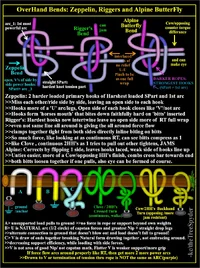
My take on similarities of Overhand Bends: Zeppelin/Rosendahl , Riggers and Alpine
>>and why Rigger's more prone to jam than other 2.
How related to basic forms , descriptions of force flows and mechanix i see this is based on
.

overhand-bends-zeppelin-riggers-alpine-butterFly_4.webp
 
Last edited:
I tried tying the Rigger’s from your picture and there might be an error in the crossings of the pink rope, it doesn’t appear to form a overhand knot. The tails should be on the same side of sections of the standing parts just before the hooks,also.
 
Last edited:
Thanx!
Moved mask, let me know if see any more; usually catch those!
This one lots of layers each, break brain!
What seems like could do in 10mins. can take 4 days of being upside down!..
 
Last edited:
Ashley's Book of Knots Lesson#479 said:
The TIMBER HITCH unties readily and is one of the most practical of hitches for slinging cylindrical objects.

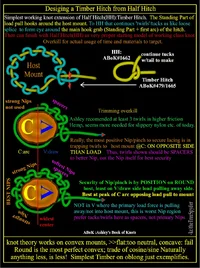
To me Timber is a very basic hitch of 'twirls' around self to form choker eye to hold the Standing Part as most loaded I-Beam to pull outside the knot in makeshift choker form.
In 'evolution' of knot hierarchy/family tree i think of it as an extension of Turn + HH. Giving more Nips, in more valuable positions than simple Half Hitch.
The 'magic of round' gives these things several ways.
.
desiging-timber-hitch-from-half-hitch.png
.
Some guides quote out the 3 tucks for Timber Hitch
>>some say may have to add more on large host/mount
This is WHY:Nip by position, more than count
>>3 is many times, lucky number more than science!
C is part of capstan math
V is not
O would be if C continues to circle on host mount (RT etc.)as part of capstan math
until ends drawn together in V as breaking from capstan math.
 
Last edited:
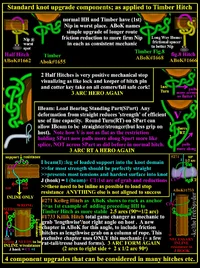
Knots as mechanical systems , whereby can add different components to a simple base like Timber Hitch
>>but could be added to aforementioned : Half Hitch, Turn, Round Turn, Crossed Turn(Clove base) , Backhand Turn (Cow base).
>>or even what i call (fierce) family of Crossed Backhands : Pile/Icicle and Sailor Gripping Hitches.
These mechanics shown below of greater friction reducers, better nip security, failsafe systems, greater strength and errant angle of pull lengthwise prevail thru many lacing forms.
Recognizable component breakdown can give easier to remember assemblies; sense of purpose as crafting the assembly etc.

standard-knot-upgrade-components-applied-to-timber-hitch.webp
.
Of course ABoK #1733 Killick leads into our friction hitches. Only this mechanic and a few tresse/rat tails /Chinese finger puzzle braids are seen for this type of 'lengthwise' usage.

rat tails type braids after Bitts as final stop on ship at Animated Knots
rattailstopperR13.jpg


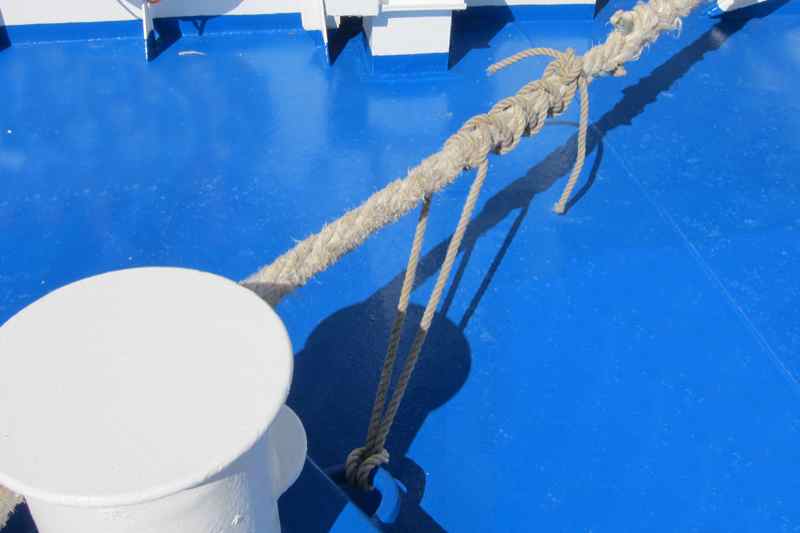
In old ships these massive bollards might have been Timberheads (or 'knightheads') of framework for ship .


Special notation in drawing to
J hook of most power, therefore hardest rope surfaces in system
>>power reductions after first arc assure this is most powerful, determining part of knot.
J hook contains:
C1 first arc, even if 1/2 arc +
I Beam: Standing Part directly to load pull feeding into knot
>>(for most strength, try not to bend most loaded I Beam )


.

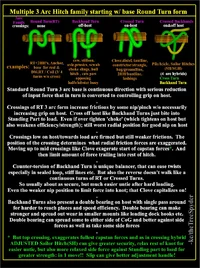
The 3 arcs to reduce input force to 1/10 (as thumb rule in capstan math for Round Turn)
>>and the gripped control of host proportionally gained at same time
seem worth watching for as a pattern...
 
What were the cord and rope made of, and did you only test these materials?
Pretty sure the Purcell is all nylon with very low ratings for tree work. Not sure of it even meets our 5400# life support per ansi z133.
The 8mm host rope I think is all nylon too but I could be mistaken but I don't think there's anything in the host rope besides polyester or nylon.
 
I’ve had some of the 8mm nylon accessory, which looked like the Purcell cord. It is stronger, 16 kN, than most other accessory cords of that diameter, but nothing I would call “high strength”.
 
I’ve had some of the 8mm nylon accessory, which looked like the Purcell cord. It is stronger, 16 kN, than most other accessory cords of that diameter, but nothing I would call “high strength”.
That Purcell agent smith spoke of in the pictures that comes with the aztek kit is sterlings 6mm nylon accessory cord
 
i really like self contained adjustment loops like Purcell for utility etc. FF can compromise many other mechanix that are still usable in proper power bands. Like in DdRT... Shredding from friction hitch grip can perhaps be tuned by less friction if some extension allowed. Would dissipate some force, and not run out of closed loop if could be controlled /metered like this.
.
Agent Smith obviously doesn't hail from simply retrieving wood; but rather bringing back a critically injured victim whole. There are more flags and worries; each if even near fail given more weight etc. A land where even success is questioned and picked apart more brutally. Also, totally assumes rock, steel sound anchors many times vs. resonant dampening/ impact absorption strength of wood in a structure made to give daily w/o failing. Still, these things are more alike than different, just varied levels of forgiveness in systems that in total have same potential force outputs from same inputs into same materials/constructions.
.


Besides a Half Hitch(es) to base turn forms and then HH extended to Timber Hitch; we can extend working class hitches from mostly the 3 arc Round Turn(RT) form so as to include crossing versions; then even hybrid joining of those anti-torsion Backhand Turn Crossing turns to induce more friction just as preceded Timber(descended from HH) by yet another HH as separate evolutionary mechanic(HH extends again later to Sheetbends and Bowlines).
.
Capstan math empowers 3arc form and gives nylon on aluminum 3 arcs(3 half turns) in total, uncrossed as 10x force trade from input to output, then gripping host to same in trade! Rough benchmark thumb rule to trace thru these forms nylon on nylon list higher and lower frictions sometimes, would think nylon on wood as more 'frictive', nylon on nylon might only get 5x change is more slick etc. But in general , just use thumbrule model know some less, some more crossings are more friction, but not grip etc. Real working machinery, with trace-able force in this model.
.
Where on radial force math of line pasted tighter to host by crossing happens is a very important variable(especially if is Zer0 like Backhand Turn class)!
>>Just as crossing of HH close to load /for weakest nip or farthest/for best nip from load (in simplest model single Turn) or some midpoint like its fig8 style HH,
>>position of Crossing Turn likewise matters enough that Sailor (Gripping)Hitch lends firmed shape contours to host that give/keep most superior top crossing if properly adjusted.
While more common Clove has Crossing Turn midway on host, where capstan math starts.
>>But top nip position is where that capstan math peaks for locking into host/least at side
Top nip is most valuable position for crossing to 'paste' the underlying line(s)/rope parts to host even firmer than already.
>>In SH this pastes down the Standing Part and Bitter End, securing knot very early for less said force on SPart/so stronger and nips Bitter End real hard after many tension reductions IF ADJUSTED TO HIGH CROSS POSITION and also favor make sure side force on loaded IBeam of support of SPart to load; isn't very harsh for most strength via isolated peak of J hook off of load/primary into knot. ABoK tho, does note small host mounts can use an RT bearing to share the wear of loading.


multiple-3-arc-hitch-family-starting -with-base-round-turn-form.png


side note: on small diameter host, think Bag and Groundline BETTER HITCH for positioning of final nip on Bitter End being farther around radius (in small stuff) than Constrictor(cross at start of capstan math), AND slipped Bag/Groundline can be used as spacer (like in Timber twirls) to even tighter nip positions . Constrictor best in BINDING where force flows outward/inward uniformly from all points inside(i always try to view force path as an electrical schematic ) and Crossing on Bitter End has re-enforcement. BUT, as hitch, force input from 1 leg into system, radial force positions simply again, not the same..
 
Last edited:
This is more towards what i'm trying to draw to in re-examination of all hitches etc. to focus on number of arcs and if/how crossed;
where understand a group of similarly based hitches and how their differences lend to different scenarios.
Seeing the base parts becomes a mnemonic whereby remembering sets of familiar moves to tie, rather than all individual nuances that must be traced to form the lacing. Trying to show things not generally shown together, but can be compared. And very logical genealogy of family builds and the properties of the mechanics passed on etc.
.
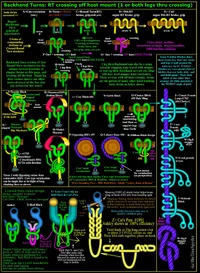
i try to show there are only 2 primary parts of knots: straight extensions and arcs(2x90degree turns as single unit reaching halfway around a circumference), really arcs cuz extension is just an extension of force carried.. So pic below traces (GREEN) thru uncrossed forms to find workhorse 3arc Round Turn and it's 2 crossed forms : Backhand and Crossed Turns, drilling down Backhand Turn path we find our subject matter of 1 or both legs thru OFF host crossing and then knot derivatives from there.
.
As a family the OFF host crossing grouping of Muenter and Cow etc. shows across forms inheritance of notably easier untie than uncrossed or crossed ON host forms due to counter-torque reverse of these not seen in continuous uncrossed and crossed forms(w/o reverse direction). Yet about as secure, and less tendency to walk to end of line/self tighten etc. due to anti-torque reverse thingy. Also ABoK notes several times only needs single pass around host for double bearing that can be a key balancing and angled pull mechanic.
.
backhand-turns-roundturn-crossing-off-host-1-or-both-legs-thru-crossing.webp
(smaller version)
.
Uncrossed Forms
A>line extension primary form
B>Turn consists of a simple re-direct arc (primary form) and A>line extension to each side(arc ends stop half-way around host and line segments take over)
C>Round Turn (RT)gets into real working class force and grip control of 3arcs and extension
D>Dbl.Round Turn is simply super form of RT
E>Coil is likewise Dbl.Round Turn super form
>>>Can call RT as 2 arcs, 3rd is re-direct turn back; but short math is 3arc is most usable form, and accentuates, firms the forces even more to what look for from RT anyways..
.
Following GREEN 3arc UNCROSSED workhorse RT to descendants and find 2 crossed forms that seem to reduce grip but increase frictions to the 3arc from RT.
F>Backhand Turns where crossing is OFF host and 1 or both legs thru as a group (focus of page)
G>Crossed Turns where a riding turn bears likewise across other rope parts but this pressure is ON host, 'pasting' turns tighter to host for more friction force contact ; like would make better electrical contact to be tighter (page in some stage of lack of progress)
>>>>Sailor/Sailor Gripping, Pile/Icicle are then seen as hybrid group each containing Backhand and Crossed Turn forms in 1 lacing.
.
Find F>3arc crossing OFF host form; itself have 2 subforms(focus of page)
H>Backhand Turn proper, pretty much applying Muenter/Italian (belay) Hitch to host mount
i> Cow based forms of both legs thru the OFF host crossing as stop over-ride of belay function of 1 leg thru OFF host crossing
.
Other 1 leg thru crossing forms :
J>Tumble Hitch: knudeNoggin improvement of Highwayman Hitch's betrayals. After holding strong this releases totally cleanly
K>Slipped Backhand in contrast to Tumble Hitch is quick release to controlled lowering
L> Backhand and 2 HH's offered by ABoK (shown as opposing halfs to keep page theme). So gives also 1 leg thru OFF host crossing form with sister both legs thru OFF host crossing
M>Muled Muenter is similar, release 2 HH's (opposing shown) to Muenter control. Usually in doubled bight of long rope as shown
.
Cow Hitch (i) is also very recognizable base form, 2nd leg thru crossing stops belay function
N>Girth is same only use both legs to hold load
O>Bale/Choker Sling/Hitch is same with loop that allows legs to carry load evenly to both legs to maximize and rotate wear, also cleaner on/off motions
P>Opposing Halfs very secure, lots easier untie than continuous halfs in more of Clove finish
Q>Lobster Buoy is 'innie' form of above much more secure, MUCH easier untie than similar Clove innie finish of Bunt Line (Bunt Line is much better slip than Lobster slipped tho)
R>Stillson is a mix of old friends brought together for very secure form, as such shows theme of whole page of recognizing base forms to assemble, not each itemized move to trouble over..
.
ALL above show the proper right angle of pull across host mount; for pulling 'lengthwise' along /not across host is WORST angle of possible pull.
Friction Hitches can thus pull right angle but also can help on the 'lengthwise' pulls.
Another game changer of friction hitches is that most knots hold, some belay, but this class holds/slides/holds on command unlike any other knot species!
S>Prussic : a basic friction hitch as simply 3arc rt to each side of choker instead of single Turn as leading OFF host crossing friction hitch.
T>ABoK shows a 1 leg pull form of same
U>6 Coil Prussic >>Can add more turns for more grip but also pushes the side pull to higher leverage
V>Schwab tames some by adjusting amount of turns, but side pull is from lowest turn so less side leverage distortion
>>>Of above friction hitches, would expect only T>single leg pull to be same diameter as host support line grabbed. Other forms shown of dual pulls on hitch favor hitch 50-75% of host diameter to make up for the divided force to 2 legs of hitch grabbing the full force tightness of host
>>Forming separate Friction Hitch page starting with these and parallel Clove type friction hitches etc. as base to that world
.
W>note all friction hitch openings (single leg pull) and 'tracks' (host line) should be terminated so don't 1> run off line or cord, also 2> so stop is early enough so can't run into ground etc. Fig.8 stoppers shown as reminder!
.
Strength notes finish with focus on age old shipping dock methods for most strength from simple sling.
X>Bull Hitch(stronger than choke) control side pulls more along loaded side more, doesn't cut across loaded line of force like simple choke
Y>alternative ways to make Bull Hitch and Cat's Paw from simple choke.
Z>Cat's Paw takes this even further and ABoK boasts 100% strength of loop. Also says if one side failed, the other side might hold until got to ground and tension came off. This was in more frictive(knudeNoggin) line AND hook pinches together to stop unravel of 'loose splice'. Small ring would expect similar then, but flat log seems could unravel 1 side etc. if failed as top not pinched together.
.
i think ABoK was trying to preserve things for us from really a past time even in his day before they slipped into eternity un-noticed. In 1940 writing about the generation before of 1900 or earlier. When the newest 12yr.old boy joining ship might be only one that could read much; and likewise simple knot tying inaccuracies could phenomenally change the day.
.
i think knotting came before controlling fire, speech, lever or wheel and is root to many mechanix; and the first time could combine properties outside self to something larger with more attributes. i think these are the things to bring forward and not lose as Ashley lent. Just as have tried to show Yoga as tracing the root stages of animate existence to not lose the powers of the lessons of each stage as we go forward. The forgotten principles simply don't change, so can haunt if forsaken! Every generation sees this worry in some way or other; things easier on offspring as a blessing, but some curse of raw lessons lost that are closer to pivotal functions and truths and the advancements buffer us from. As like health food, these lost lessons can be as dis-guarded fiber in over-processed world..
 

New threads New posts

Kask Stihl NORTHEASTERN Arborists Wesspur TreeStuff.com Teufelberger Westminster X-Rigging Teufelberger
Back
Top Bottom